




2021 scienceXart winners announced

Congratulations to the five fantastic winners of the Academy’s ‘scienceXart: food for thought’ competition!
This year’s scienceXart competition was hosted by the National Committee for Nutrition, celebrating the creativity of nutrition science. It received hundreds of entries from primary students nationwide, who described the science using a creative plate of food.
The judges were particularly excited by the number of entries from students who explored nutrition science together in their classrooms.
Foundation/Kindergarten/Prep
Summer, whose plate featured an array of healthy fruits and vegetables. “Every day at school we eat healthy because fruit and vegetables make us grow. I eat bananas and healthy fruit because it is yummy.”
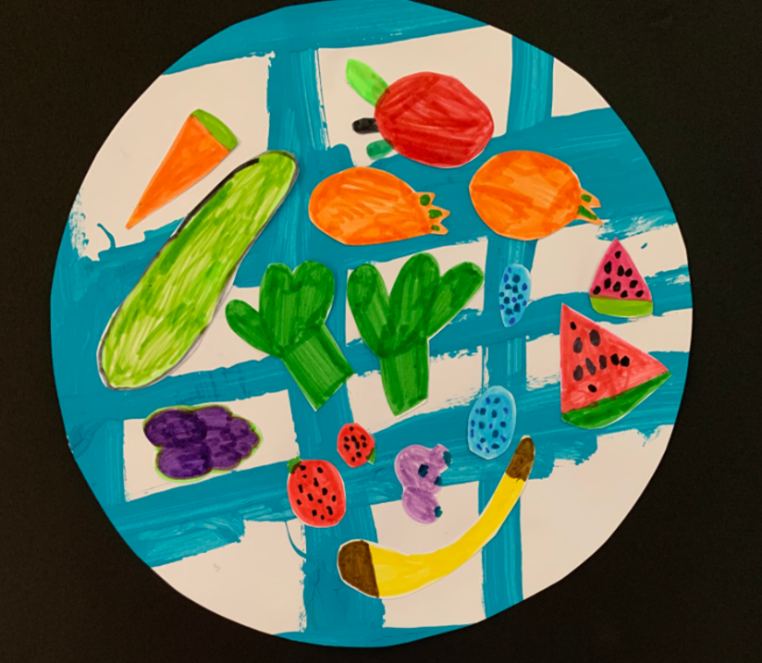
Summer’s winning entry in the Foundation/Kindergarten/Prep category
Year 1/2
Ellie, with a creation designed for her mum, which was commended for featuring all food groups and water. “ … Vegetables and fruits are mum’s favourite foods, they have fibre to keep digestive system healthy. Also they provide vitamins A, C and K as well as folic acid to support body. Milk gives calcium to support bones. The most important food for our daily life is water, it is a key to make our body works normally.”
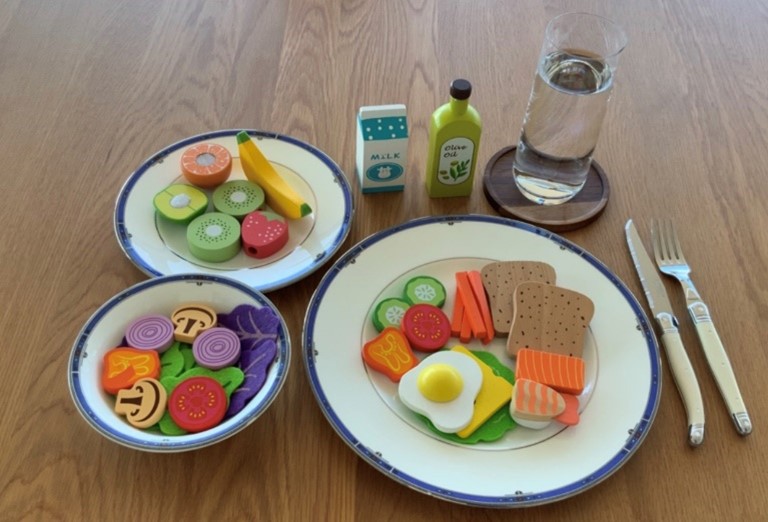
Ellie’s winning entry in the Year 1/2 Category
Year 3/4
Arabella, who created a fun way to eat all the colours of the rainbow. “I created a fun, healthy plate using mainly organic and whole foods and based on the strategy of eating all the colours of the rainbow. My aim was to get a maximum variety of nutrients and minerals into a balanced meal in a memorable and fun way. I hope it inspires you to eat a rainbow and eat more healthily. Remember, you are what you eat!”

Arabella’s winning entry in the Year 3/4 category
Year 5/6
Awarded jointly to William and Oceana, for their vitamin-filled illustrations. Says William: “… [Apples] have 6 different vitamins and minerals including vitamin c vitamin b6 vitamin k manganese copper and potassium. The extent that I eat them may be a bit unhealthy but it's worth it to get the sweet sweet taste of an apple every day…”
Says Oceana: “I decided to make a nice, fitting lunch having a medium rare cooked steak with a few slices of tomatoes which can also help your cells from being damaged. There is also cooked asparagus having vitamin C, K and A! For the sides, we have cooked spinach and cooked corn. Corn having vitamin C, and spinach having vitamin E.”
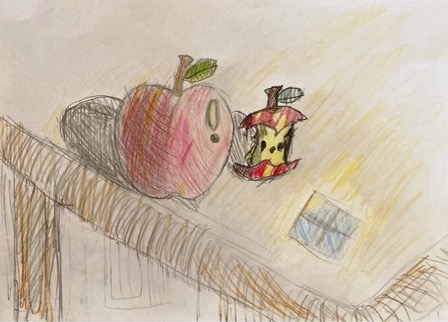
William’s winning entry in the Year 5/6 category
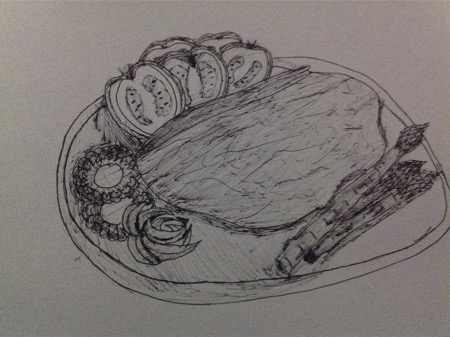
Oceana’s winning entry in the Year 5/6 category.
Celebration of the International Year of Fruits and Vegetables
This competition offered an opportunity for primary school students to explore the science of what they eat alongside their creativity, and was held to celebrate the International Year of Fruits and Vegetables. Entries were judged by a panel of experts in education, nutrition science and art.
The panel included:
- Professor Helen Truby, Chair of the Australian Academy of Science’s National Committee for Nutrition
- Victoria Alexander, author, photographer and designer
- Kate Di Prima, dietitian and paediatric and family nutritionist
- Nicola Dziadkiewicz and Jennifer Lawrence, Primary Connections
Thank you to Dietitians Australia for sponsoring this year’s competition and the National Committee for Nutrition for hosting scienceXart, as well as the students, teachers, parents and schools who took on this year’s scienceXart challenge.
Three winning ideas heading to Berlin for Falling Walls Lab 2021
Watch the full livestream of Falling Walls Lab Australia 2021 above.
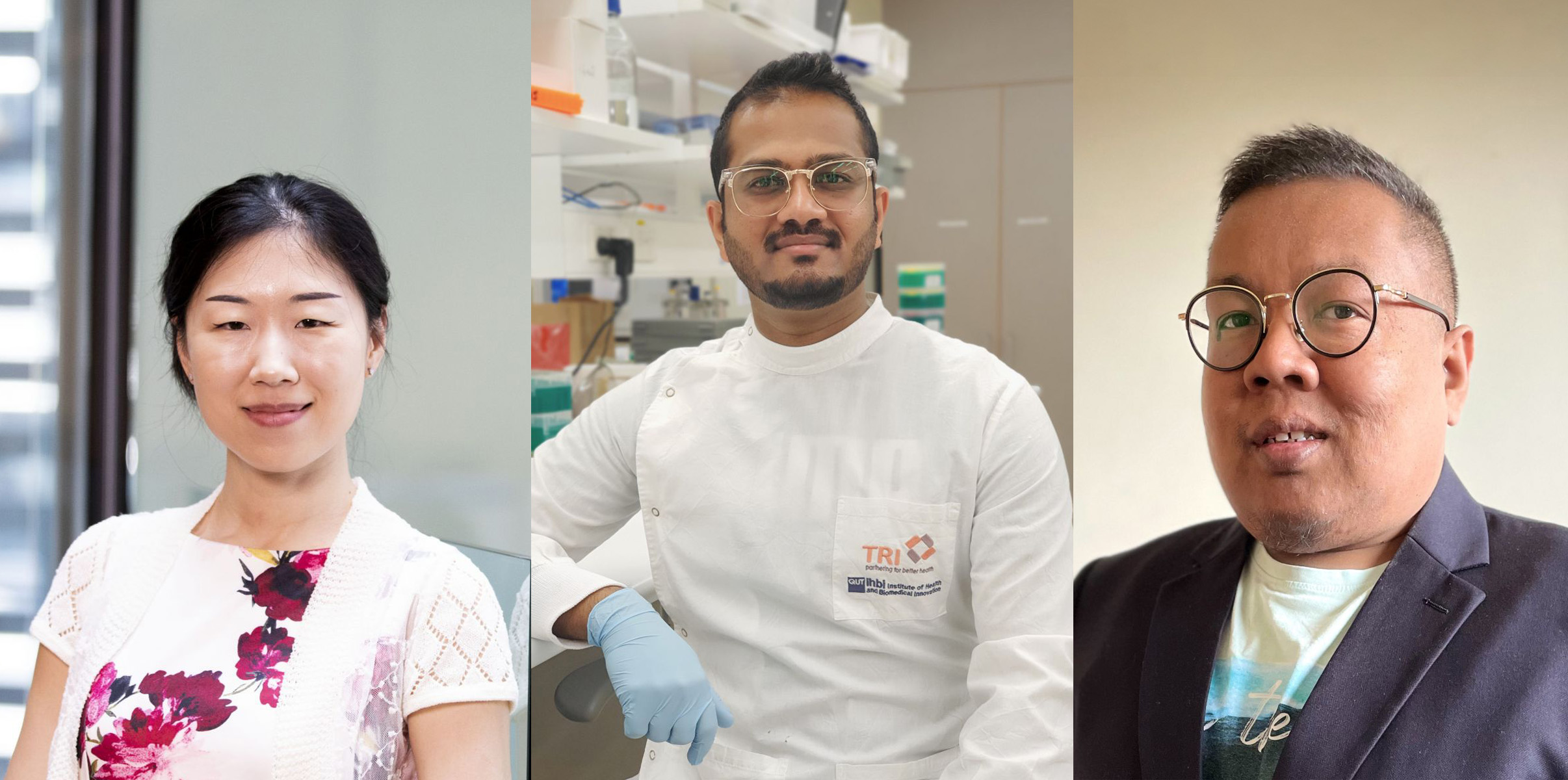
First place winner, Dr Jiao Jiao Li. Second place and joint people's choice winner, Chamikara Liyanage. Third place and joint people's choice winner, Dr Lockman Norazmi. All Photos: supplied
Dr Jiao Jiao Li is the winner of the sixth Falling Walls Lab Australia event, hosted online today by the Australian Academy of Science in partnership with the Embassy of the Federal Republic of Germany in Canberra and EURAXESS Australia and New Zealand.
The second place winner was Chamikara Liyanage, while Dr Lokman Norazmi took third place.
The People's Choice winner, selected via a survey of audience members, was tied between Chamikara Liyanage and Dr Lokman Norazmi.
The nine contestants presenting at the Australian finale event were selected by the Falling Walls Lab New South Wales, organised by DAAD, the German Academic Exchange Service and EURAXESS; the Falling Walls Lab Queensland, organised by the University of Queensland; and the Falling Walls Lab Victoria, organised by veski with support from Deakin University.
In another Falling Walls category, ‘Science Breakthroughs of the Year’, Academy Fellow Professor Thomas Maschmeyer from the University of Sydney, Professor Warwick Bowen from the University of Queensland and Professor Geoffrey Spinks from the University of Wollongong have been selected by Falling Walls 2021 in Berlin as global finalists in the category Engineering and Technology. They will be presenting their breakthroughs at the event in Berlin in November.
The question of every Falling Walls Lab is: Which walls will fall next?
Three-minute pitch
Each participant had three minutes to make their pitch in front of a jury of eminent academics and leaders from business chaired by Australia's Chief Scientist, Dr Cathy Foley.
Dr Jiao Jiao Li of the University of Technology Sydney is developing a new and off-the-shelf, disease specific, stem cell based therapy for osteoarthritis, a next-generation treatment solution that can also be adaptable for other diseases.
Chamikara Liyanage of the Queensland University of Technology introduced a microprotein gene therapy to overcome prostate cancer treatment resistance and a diagnostic immunoassay that early predicts treatment resistance.
Dr Lokman Norazmi of the University of Tasmania established an army of chromosome fish to fight in the war against alien mosquitofish invasion in Australia, thus protecting our unique and diverse aquatic ecosystem.
The people's choice award tied between Dr Lockman Norazmi and Chamikara Liyanage.
Winners to compete internationally
The top three winners will each receive a prize of AUD1,000 and support from the Academy on their online participation at the Berlin Falling Walls Conference. The winners’ videos will be shared with the influential global audience of Falling Walls Berlin and on the Academy’s social media platforms to over 2.4 million followers.
Academy partner EURAXESS will also provide high-quality online science communication training to the three winners led by European experts, including opportunity to have one-on-one consultation with the experts.
The three Australian winners will represent Australia in the hybrid Falling Walls Conference 2021 alongside the other 97 global winners, and the top 10 global finalists will compete in the Falling Walls Pitches on 7 November for their title in the Emerging Talents category.
Jury members
The event organising partners are grateful for the involvement of the jury members for Falling Walls Lab Australia:
- Dr Cathy Foley AO FAA—Australia’s Chief Scientist
- Dr Dan Grant—MD and CEO, MTPConnect
- Ms Kate Hart—Partner ANZ, A.T. Kearney Australia
- Ms Rosie Hicks—Chief Executive Officer, Australian Research Data Commons
- Professor Michael Schuetz—Director, Jamieson Trauma Institute
- Professor John Shine AC PresAA FRS—President, Australian Academy of Science
- Dr Jack Steele—Director Science Impact and Policy, CSIRO
Read the event program booklet (PDF).
About Falling Walls Lab
Each year, the Falling Walls Foundation supports scientific organisations around the world to host a Falling Walls Lab. This international forum promotes interdisciplinary connections between aspiring academics, innovators, entrepreneurs, investors and professionals known for their excellent work.
Falling Walls Lab is a challenging and inspiring format for emerging bright minds, giving them a unique chance to become the next big success story in innovation. Each year, nearly 100 international Labs are held with more than 1000 presenters, 100 of whom make it to the final in Berlin. In 2019, Australian researcher Rhys Pirie took out first place at the Falling Walls Lab Finale in Berlin and was named 2019 Young Innovator of the Year. Read more about his success and a follow-up interview six months after winning the competition.
The Falling Walls Foundation is a non-profit organisation in Berlin dedicated to the support of science and the humanities. It was established in 2009, 20 years after the fall of the Berlin Wall. At its heart is the question ‘Which are the next walls to fall?’ as a result of scientific, technological, economic and sociological breakthroughs.
Celebrating stories of science for National Science Week
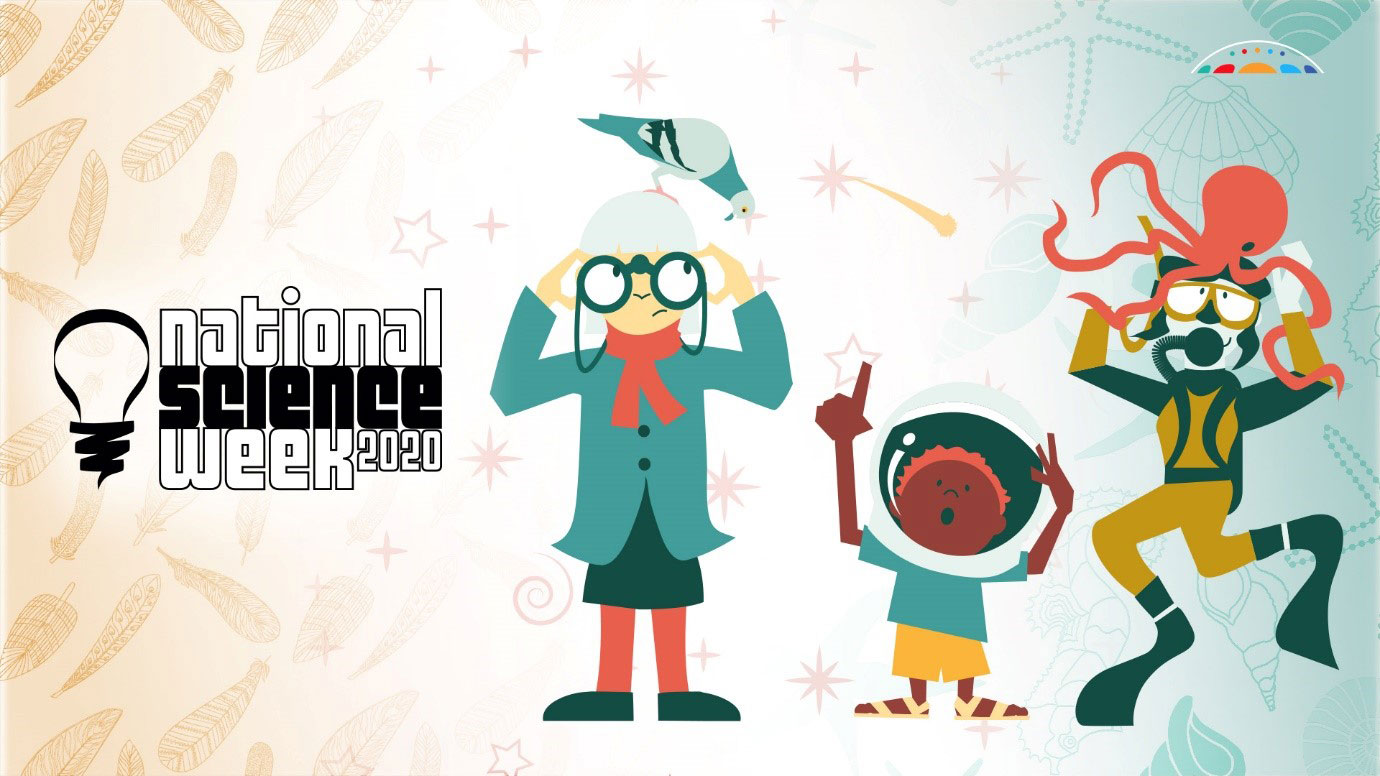
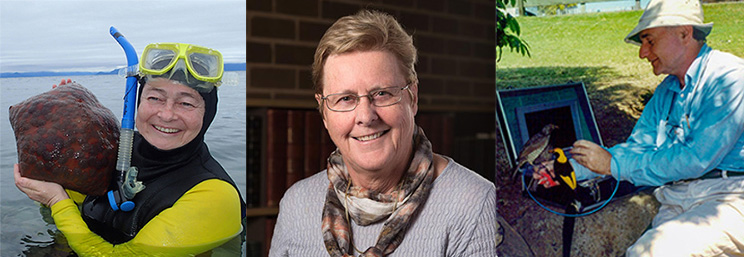
Academy Fellows featuring in National Science Week include (from left) Professor Maria Byrne, Professor Rachel Webster and Professor John Endler.
Who do you see when you look at this image above?
These Science Activity Characters show people engaging with a range of science-related activities. Last year, the Academy worked with the National Science Week team to share real stories of Australian science to bring these characters to life. For National Science Week this year there are three new stories to explore. What better time is there to celebrate the work of our Fellows?
Lifelong passion
There’s never a dull moment when you work as a marine biologist. You might come face-to-face with an octopus, a seal, a dolphin—or maybe a predatory sea star that can destroy our coral reefs. Professor Maria Byrne followed a lifelong passion for exploring the underwater world and applies her in-depth knowledge of sea stars to find better ways to manage crown-of-thorns starfish.
“I wanted to know what made animals tick, why animals are where they are in the world, and how did they get there?” said Professor Byrne.
What questions do you ask whenever you gaze up at the stars in the night sky? There aren’t too many questions more fundamental to our existence than ‘how did the Universe begin?’. Professor Rachel Webster explores how astrophysicists can get precious glimpses of our early Universe by peering around galaxies, inside black holes and back through time itself.
Professor Webster was inspired to delve a lot deeper into the Universe after “accidentally” attending a lecture on cosmology at the University of Sydney one summer, saying “it blew my 17-year-old brain out of the water.”
How do birds see the world—and how do we know? Understanding what a bird’s eye view really looks like helps us understand why different animals perceive the world in different ways. Professor John Endler specialises in understanding the visual systems of birds, and how some of them can even create visual illusions.
Professor Endler said his path to studying animal vision was initially triggered by “pure curiosity. I was curious about the why, rather than just the usual who, what, where and how. What are the animals trying to do, and why?”
You can also explore the ethics of artificial intelligence, how bees help us design better drones, and how virtual reality helps environmental conservation.
How will you science this National Science Week?
Share your own stories on social media with the #ScienceWeek, #SolveItWithSTEM and/or #STEMsavinglives hashtags and tell us how you use STEM to solve problems or who in STEM inspires you. Make sure to tag National Science Week (@Aus_ScienceWeek) and the Academy (@Science_Academy) so we can hear from you!
Find out more about the Academy's activities in National Science Week.
What if we cannot find a vaccine? German and Australian scientists discuss COVID-19
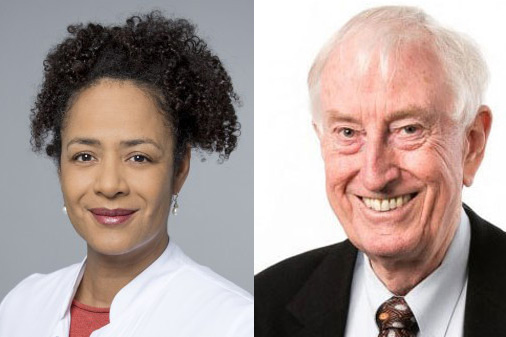
Professor Doctor Marylyn Addo and Laureate Professor Peter Doherty AC FAA FRS. Photos: supplied
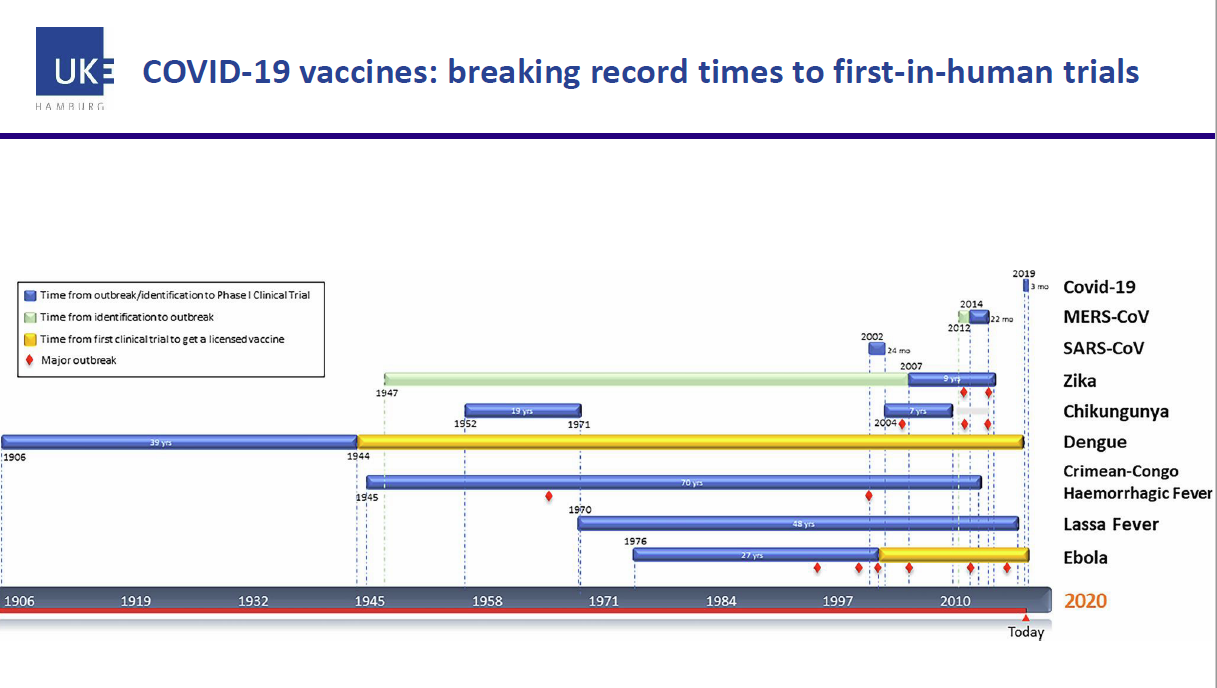
Despite an unprecedented global research effort and record-breaking times to first in-human trials there are no guarantees that a vaccine will be available soon for COVID-19, according to one of Germany’s pre-eminent virologists, Professor Doctor Marylyn Addo.
Professor Addo made the comments during a recent webinar titled ‘Under the Microscope’ held by the Australian Embassy Berlin, the German Embassy Canberra, the Australia-Germany Research Network (AGRN) and the Australian Academy of Science.
The webinar was held on the six-month anniversary of receipt of the first reports of a cluster of cases of pneumonia of unknown cause in China by the World Health Organization. Now the world has just crossed over a minimum of 10 million infections and 500,000 deaths.
“I am optimistic, but nobody can say when we’ll definitely have a vaccine and there are many open questions,” said Professor Addo, who is head of infectious disease at the University Medical Center Hamburg-Eppendorf, Germany.
Professor Addo has developed and tested vaccines for Ebola and MERS and is currently developing a viral vector-based COVID-19 vaccine.
“While we are talking about the vaccine it’s critical that we develop other therapeutics. The repurposed drug remdesivir, developed to treat Ebola, is one of the frontrunner options for treating COVID-19, while the search for a vaccine continues,” said Professor Addo.
“It’s got the advantage of already having lots of data from clinical use. It’s not going to be our saving drug but it’s an important first step.”
Professor Addo was joined by patron of the Doherty Institute, Nobel Laureate Professor Peter Doherty AC FAA FRS. The institute has been at the forefront of Australia’s response to the COVID-19 pandemic.
On the importance of international collaboration Professor Doherty said there is a massive global commitment to finding solutions to the pandemic.
“I think in general the world is working together very well on this. There is great consciousness that this is a global problem and recognition that this has to be solved globally,” Professor Doherty said.
“This is the only truly novel respiratory virus pandemic in modern history. This is quite a benchmark and I think we should be very much warned that these things are around and out there and there is a lot more of them.”
Professor Addo said the global pandemic has shown how connected we are.
“A unilateral approach is not going to tackle this. There might be a new normal and we must talk about that. We have to be cautious about whether we’ll go back to the way things were,” Professor Addo said.
The webinar was opened by Her Excellency Ms Lynette Wood, Australian Ambassador to Germany, and Emeritus Professor Hans Bachor, Secretary for Education and Public Awareness at the Australian Academy of Science.
Eureka Prizes celebrate innovators and leaders in Australian science
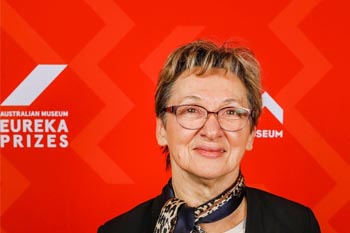
Professor Branka Vucetic has won the CSIRO Eureka Prize for Leadership in Innovation and Science
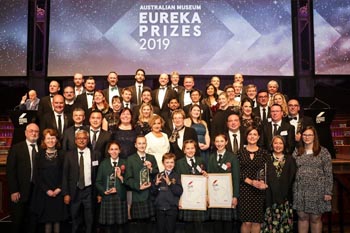
Seventeen Eureka Prizes were awarded this year
Academy Fellow Professor Branka Vucetic of the University of Sydney has been awarded the prestigious CSIRO Eureka Prize for Leadership in Innovation and Science for her major contributions to the science of coding theory and wireless communications that underpin much of the wifi technologies we use today. Professor Vucetic was elected to the Academy in 2017.
Also acknowledged at the awards was the Academy’s 2019 Gottschalk Medal winner, Associate Professor Laura Mackay of the University of Melbourne. She was awarded the Macquarie University Eureka Prize for Outstanding Early Career Researcher, and is regarded as a leader in the field of immunological ‘memory’. The Academy awarded Associate Professor Mackay the 2019 Gottschalk Medal in recognition of her contribution to the discovery of tissue-resident memory T cells.
Four Academy Fellows were shortlisted for the prizes: Professor Terry Hughes, Professor Stephen McMahon, Professor Branka Vucetic and Professor Michelle Coote.
The Australian Museum Eureka Prizes shine a light on Australia’s world-leading science and scientists, acknowledging leaders and innovators in STEM from primary school students to science journalists, to research teams at our top scientific institutions in 17 separate awards.
The finalists and winners for the awards demonstrated the diversity of the STEM sector and the top-level science that is coming out of Australia. The Academy applauds the introduction of the Australian Government Department of Industry Eureka Prize for STEM Inclusion this year. The inaugural winner of this award was the National Indigenous Science Education Program (Macquarie University, Charles Sturt University and the Yaegl Country Aboriginal Elders).
Newly-formed International Science Council to provide a unified voice
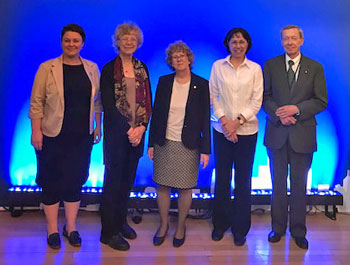
The Academy delegation at the General Assembly (from left): Tayanah O’Donnell, Director Future Earth Australia; Professor Cheryl Praeger, former Foreign Secretary; Professor Elaine Sadler, Foreign Secretary; and Nancy Pritchard, Director International Programs. They are with Professor David Black, Academy Fellow and former Secretary-General of the International Council for Science.
The newly-formed International Science Council has met for the first time at its founding General Assembly in Paris.
A new board was elected at the meeting, with South African mathematician Daya Reddy announced as President and New Zealander Peter Gluckman as President-elect.
The International Science Council is a merger of the former International Council for Science and International Social Science Council. The Council is set to champion both the natural and social sciences, providing a unified voice to respond to the scientific and societal challenges of the future.
The Academy represented Australian science at the historic meeting, with a delegation consisting of the current and former Foreign Secretaries and the directors of International Programs and Future Earth Australia.
The Academy has represented Australia on the International Council for Science since 1954, and is looking forward to continuing as an active and valued member of the newly merged organisation.
Academy Fellows receive international recognition
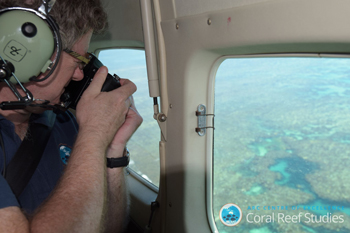
Professor Terry Hughes. Image courtesy of ARC Centre of Excellence for Coral Reef Studies
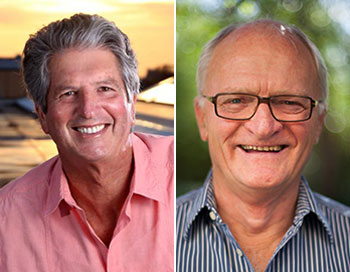
Professor Martin Green (left) and Dr Brian Walker
The Australian Academy of Science congratulates Academy Fellows Martin Green, Terry Hughes and Brian Walker on recent international recognition of their research.
James Cook University Distinguished Professor Terry Hughes received the Prince Albert II of Monaco Foundation’s 2018 Climate Change Award.
The award recognises Professor Hughes’s contribution to advancing understanding of the influence of rapid climate change on the world’s coral reefs.
The Foundation’s awards ceremony, now in its 11th year, honours key international figures and organisations who have made an exceptional commitment to safeguarding the planet. Previous recipients include Dr Jane Goodall, Professor David Suzuki and Sir David Attenborough.
Solar expert UNSW Scientia Professor Martin Green has become the first Australian to win a prestigious Global Energy Prize for his research, development and educational activities in the field of photovoltaics.
The annual Global Energy Prize honours outstanding achievements in research and technology that are addressing the world’s pressing energy challenges. Professor Green shares the prize and $820,000 prize money this year with Russian scientist Sergey Alekseenko, an expert in thermal power engineering.
Dr Brian Walker, from CSIRO and the Australian National University, has received the 2018 Blue Planet Prize, an international environmental award sponsored by Japan’s Asahi Glass Foundation.
He is only the second Australian in the award’s history to claim the prize, which recognises outstanding achievements in scientific research and its application in solving global environmental problems.
The award recognises Dr Walker’s achievements as a pioneer of ‘resilience science’ in social–ecological systems.
Academy Fellows win Australian of the Year awards
The Australian Academy of Science congratulates its Fellows Professor Michelle Simmons and Professor Graham Farquhar AO, who have been named the 2018 Australian of the Year and Senior Australian of the Year respectively.
Professor Michelle Simmons
Professor Simmons, who becomes the first female Fellow from the Physical Sciences to be named Australian of the Year, is the Director of the UNSW-based Centre of Excellence for Quantum Computation and Communication Technology and is a Fellow of ATSE, the Academy's partner in the Science in Australia Gender Equity (SAGE) program. Her Australian of the Year citation reads:
‘One of the world’s top scientists, Professor Michelle Yvonne Simmons has pioneered research that could lead to a quantum leap in computing and reshape the way we live and how we experience the world—her work is helping develop leading technology on a global scale, right here in Australia.
Since arriving in Australia from Britain in 1999, Michelle has transformed the University of NSW quantum physics department into a world leader in advanced computer systems.
In 2012, Michelle and her team created the world’s first transistor made from a single atom, along with the world’s thinnest wire. The breakthrough means Australia is now at the forefront of what Michelle calls the “space race of the computing era”.
Michelle’s aim is to build a quantum computer able to solve problems in minutes which would otherwise take thousands of years. Such a discovery has the potential to revolutionise drug design, weather forecasting, self-driving vehicles, artificial intelligence and much more.’
Academy President Professor Andrew Holmes said Professor Simmons’ leadership in the field of quantum computing, and as a role model for young women scientists, are a shining beacon for Australian science.
“Michelle is someone who has always been willing to try the experiment that others never dared to do and this had paid off many times. What a thrill it is for Michelle's colleagues to be able to share in her wonderful achievements,” Professor Holmes said.
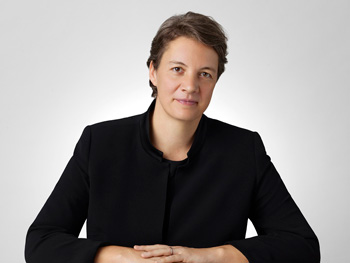
Professor Michelle Simmons, 2018 Australian of the Year. Photo: L’Oréal Group
Professor Graham Farquhar
Biophysicist Professor Graham Farquhar is based at the Australian National University at the ARC Centre of Excellence for Translational Photosynthesis. His Senior Australian of the Year citation reads:
‘One of Australia's most eminent scientists, Professor Graham Farquhar is helping reshape our understanding of photosynthesis—the very basis of life on Earth. His work focuses on food security and how the world will feed growing populations into the future.
After growing up with a Tasmanian farming family background, Graham has used his love of science to deliver practical benefits to the agricultural sector. His study of mathematics and physics formed the bedrock of a career creating mathematical models of how plants work.
His research addresses agriculture and climate change and aims to solve some of the greatest challenges of our generation. Graham has received a string of accolades during his distinguished career for his research examining how water efficient crops can protect food security in a changing climate. Importantly, he has worked to improve world food security by developing strains of wheat that can grow with less water.
In 2017 Graham became the first Australian to win a Kyoto Prize—the most prestigious international award for fields not traditionally honoured with a Nobel Prize.
From his long-term base at the Australian National University in Canberra, and now aged 70, Graham is tackling some of the most profound challenges facing humanity and the environment.’
Academy Secretary for Science Policy, Professor David Day, said Professor Farquhar is one of Australia’s most eminent scientists and amongst the very best plant biologists in the world.
“Professor Farquhar’s seminal work on photosynthesis and the way plants use water forms the foundation for improving crop plant production in a world that is facing an ever-increasing demand for food in a changing climate,” Professor Day said.
“He has received many accolades for his crucial research and is a most worthy senior Australian of the year.”
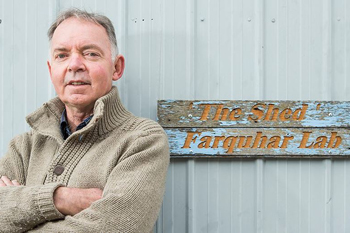
Professor Graham Farquhar AO, 2018 Senior Australian of the Year.
Two young scientists receive environmental science award
PhD students Ms Melissa Houghton from the University of Queensland and Mrs Charlie Phelps from Edith Cowan University are the 2018 recipients of the Australian Academy of Science Max Day Environmental Science Fellowship Award.
The award provides up to $20,000 for early-career researchers working on the conservation of Australia’s flora and fauna, the ecologically sustainable use of resources and the protection of the environment and ecosystem services.
It is named in honour of Academy Fellow, the late Dr Maxwell Frank Cooper Day AO, who spent a lifetime championing entomology, conservation and forestry, as well as helping other scientists. He died in July this year aged 101.
Macquarie Island invertebrates
Ms Houghton will use the award to conduct the first study of insects, spiders and other organisms without a backbone (invertebrates) on Macquarie Island since the eradication of rabbits, rats and mice in 2014. The World Heritage Listed subantarctic island is located in the Southern Ocean, approximately half way between Australia and Antarctica.
As a dog handler Ms Houghton took part in the successful eradication mission on the island. Now she is studying the island’s 300 native and 50 non-native invertebrate species and their interactions to determine how Macquarie Island’s complex ecosystem is recovering and changing following the conservation effort.
Ms Houghton will return to the island in January for her third and final invertebrate survey. She is supported by the National Environmental Science Programme, Threatened Species Recovery Hub.
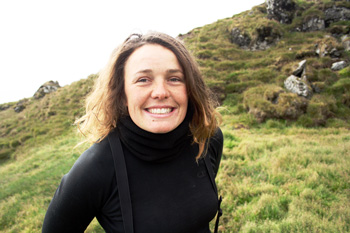
Melissa Houghton will study insects, spiders and other invertebrates on Macquarie Island.
Kelp in temperate Australian reefs
Mrs Charlie Phelps will study the effects of bacteria, increasing temperature and kelp-eating organisms (herbivory) on the ecologically-important kelp, Ecklonia radiata, sometimes referred to as the ‘biological engineers of temperate Australian reefs’.
The kelp provides habitat and shelter for many marine animals and juvenile fish, enhances biodiversity, assists in nutrient cycling and supports the fishing and tourism industries.
Bleaching of the kelp, where the surface tissue turns white, can have a drastic effect on its health and can lead to death. Increasing water temperatures and bacteria have been identified as possible causes. Mrs Phelps’ study will be the first to inoculate the kelp with microbial pathogens and use interactive stressors (temperature and herbivory) to help determine the extent of bleaching from a type of bacteria known as R10.
Ms Houghton and Mrs Phelps will receive their awards at the Academy’s annual signature science event Science at the Shine Dome on 23 May 2018.
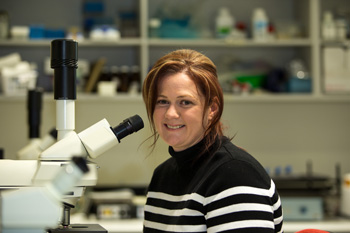
Charlie Phelps will study the effects on kelp of bacteria, increasing temperature and kelp-eating organisms.
Highly commended
Two researchers were also highly commended for the Max Day Environmental Science Fellowship Award:
- Dr Tatiana Soares Da Costa from La Trobe University for her project ‘Development of New Herbicide Cocktails for Effective Weed Management’.
- Dr Emma Camp from the University of Technology Sydney for her project ‘Set-Up For Survival – The Holobiont Signature Facilitating Australia’s Coral Communities In The Face Of Climate Change’.
EMCRs rethink food and nutrition
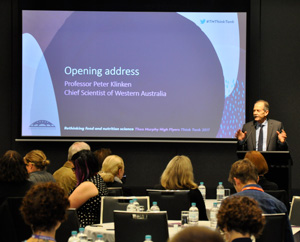
Chief Scientist of Western Australia, Professor Peter Klinken, opening the 2017 Theo Murphy High Flyers Think Tank.
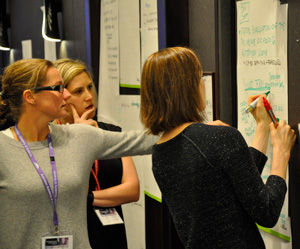
The Think Tank is a highly focused event that seeks answers to big issues.
Early- and mid-career researchers (EMCRs) gathered in Perth in July to explore the future of nutrition science. Sixty researchers with diverse research backgrounds from Australia and New Zealand critically evaluated nutrition science and identified goals, tools and control points to advance the discipline into the future.
The meeting was dynamic, with regular interactions between the four working groups resulting in revising and redeveloping the program and the path ahead.
Following the event the researchers are continuing to work together to produce a series of discussion papers. These will contribute to long-term strategic planning for nutrition science in Australia being led by the Academy's National Committee for Nutrition.
Rethinking food and nutrition science was the 16th Theo Murphy High Flyers Think Tank event.
There was a very positive vibe throughout the meeting, with ... participants keen to make a positive impact on nutrition in Australia.Think Tank participant