




Alexander George Ogston 1911-1996

Written by O. Smithies.
- Science
- Early days
- World War II
- Postwar work at Oxford
- The Australian years, 1960-70
- Trinity College, 1970-78
- Retirement years, 1978-96
- A well-balanced life
- Family
- About this memoir
For science is more than the search for truth, more than a challenging game, more than a profession. It is a life that a diversity of people lead together, in the closest proximity, a school for social living. We are members one of another.
A. G. Ogston, 1970 lecture to the Australian Biochemical Society
In 1984, at the age of 73, Alexander ('Sandy') Ogston, with the gentle encouragement of Professor R. B. ('David') Fisher as an interviewer, recorded a video tape of his life and science (now in the Biochemistry Society Archives). A few years later, in 1988, he completed a more comprehensive written account in his 'Reminiscences, 1911-1988' (now in the Royal Society Archives in London). These eloquent records and a published lecture given in 1970 to the Australian Biochemical Society (119a) have provided much of the material for the present biographical memoir and are quoted or paraphrased extensively. Unannotated 'quotes' are from Sandy's own accounts or his papers.
Science
Ogston published his first three scientific papers in 1935 (1–3); in them he used a physical chemical method (potentiometric titration) to investigate the nature of several biologically relevant substances (amino acids, vitamin B1 and xanthines). Almost fifty years later, in 1982, he published his last paper (127), of which he was the sole author; it also applied physical chemical principles (kinetic and equilibrium parameters) to a biologically relevant problem (enzymatically catalyzed reversible reactions). Essentially all of Ogston's work between these publications had this same theme – the application of physical chemistry to biology. He claimed not to be irrevocably committed to any particular biological problem or to any particular physico-chemical method, and described the span of his work in typically self-deprecating terms as 'rather a kind of grasshopper existence' putting his 'oar into this or that thing'. In reality he was a deeply committed physical chemist who found many puzzling problems in biology irresistible, and who constantly kept himself informed in a variety of fields. Not surprisingly, therefore, any selection of Ogston's most significant publications spans a wide range of problems. Most of them also illustrate Sandy's intellectual signature – an ability to arrive at simple solutions to complex problems. And, despite his assertions to the contrary, there is one long-term problem to which he returned many times – the complex physical chemistry and biology of hyaluronic acid.
Perhaps the foremost example of Sandy's intellectual ability is a brief one column letter to Nature (37), published in 1948 at a time when biochemists were deeply involved in deciphering the intermediary chemical steps in carbohydrate and amino acid metabolism. The Krebs citric acid cycle, originally proposed by Krebs & Johnson (1937), was being subjected to detailed tests by many investigators including Wood et al. (1941). These investigators studied the fate of the isotopic carbon following the biosynthesis of oxaloacetate from pyruvate and isotopically labelled CO2. Hans Krebs had postulated in his cycle that oxaloacetate condenses with a second pyruvate molecule to yield citric acid and eventually a-keto-glutaric acid. Because citric acid is a symmetric molecule, the expectation was that the CO2-derived isotope in a-ketoglutaric acid would be found equally distributed between its two carboxyl groups: one next to a methylene group and the other next to a carbonyl group. Wood et al. found all the isotope in the latter; they therefore excluded the symmetrical molecule citric acid as an intermediate. A comparable situation arose when Shemin (1946) found that serine isotopically labelled in both its amino and carboxyl groups yielded glycine with the two isotopes still in the same proportion as in the input serine; he concluded that amino-malonic acid (a symmetrical molecule) was thereby excluded as an intermediate.
Ogston, in his videotaped interview, describes how he initially accepted these conclusions, but suddenly realized the fallacy of the premise on which they were based: that two identical groups of a symmetrical molecule cannot be distinguished. 'On the contrary, it is possible that an asymmetric enzyme which attacks a symmetrical compound can distinguish between its identical groups'. (37) He demonstrated this with a simple diagram accompanied by a brief explanation showing how two seemingly identical elements in a substrate will behave differently when acted on by an enzyme if combination between the symmetrical substrate and the enzyme occurs at three points with the catalytic activity being at only one of the points.
The Ogston concept of 'three-point attachment', conceived in two seconds and written the next day, was widely and rapidly accepted. Indeed, shortly after publication of the idea, Krebs wrote excitedly to Sandy and subsequently spent much of his 1949 Harvey Lecture (Krebs 1949) on the topic. Krebs' lecture included the statement that the 'ideas which Ogston has initiated thus offer a satisfactory explanation for the mechanism of formation of optically active substances in biological material'. Sandy was always somewhat embarrassed by the importance others placed on an idea that had been conceived in such a brief time!
A problem that occupied Ogston's attention for a much longer time but eventually yielded to his theoretical treatment was prompted by an observation by McFarlane (1935). Sandy described the situation succinctly in his 1970 lecture to the Australian Biochemical Society (119a) as 'an apparent conversion in the ultracentrifuge of the globulin fraction [at that time only two fractions had been described in plasma proteins] into the albumin fraction to an extent that increased as the total concentration increased'. Ogston was intrigued by this problem to the extent that in the late 1930s he performed experiments on the osmotic pressures of mixtures of proteins, their ultraviolet absorption spectra, potentiometric titration curves and salting out. No explanation was forth-coming. However, the problem continued to interest Sandy sufficiently that after World War II he and his doctoral student J. P. ('Johnny') Johnston carefully surveyed the behaviours of mixtures of proteins in the ultracentrifuge. In his reminiscences, Sandy modestly records:
The following June found us with an accumulation of results but still with no satisfactory explanation. I went on holiday leaving 'Johnny' to write a thesis. Within a week he wrote to me what in qualitative terms was clearly the correct explanation. I had only to put what became known as the 'Johnston-Ogston effect' into mathematical form.
The resulting paper by Johnston and Ogston (27) is an elegant restatement of the problem and of earlier attempts at solving it. Their words (slightly paraphrased) are:
The idea is a very simple one. If molecules of the slower protein move faster in the absence of the faster protein, behind the faster boundary, than in its presence ahead of it, then...the concentration of slower protein above the faster boundary must be greater than below it. So the size of the slower boundary is actually increased, while that of the faster is apparently decreased – when observed refractometrically – by an exactly equivalent amount. It looks as if faster protein is being converted to slower. Since the effect on velocity increases with total concentration, it looks as if conversion increases with concentration.
This is comparable to the way that traffic speeds are affected by traffic density. Automobiles can travel faster when traffic density is low than when it is high and the effect becomes greater as the traffic density (its 'concentration') increases. Johnston and Ogston validated their theoretical treatment by demonstrating that the coloured protein carboxyhaemoglobin mixed with g-globulin (a larger molecule) was more concentrated above than below the sedimentation boundary of the faster-sedimenting protein.
Sandy could transform questions from his students into significant contributions to knowledge. I recall my admiration when an essay describing an obviously impossible metabolic scheme (to generate by cyclical oxidation and reduction an energy-rich phosphate bond in phosphoenoloxaloacetate from an energy-poor phosphoester bond in phosphomalate) was transformed by Ogston into a respectable article in Physiological Review (35). This review extended the thermodynamic and kinetic understanding of metabolic sources of energy by developing the idea that gradients of chemical potential can generate energy. Ogston showed that suitable carriers could allow energy to be derived from the coupled transfer of hydrogen from a low partial pressure of oxygen at an initial site of substrate oxidation to a higher partial pressure close to that of molecular oxygen. However, he also stressed that constraints imposed by the kinetics of the system should not be overlooked.
The relationship between thermo-dynamic and kinetic factors remained a life-long interest to Ogston: his last theoretical paper (127), one page in length, was titled 'A New Relationship Between Kinetic and Equilibrium Parameters of Reversible Reactions'. Less brief was his collaborative treatise with C. C. Michel (125) in which a non-equilibrium thermo-dynamic treatment led to 'General Descriptions of Passive Transport of Neutral Solute and Solvent Through Membranes'. Its twenty pages, the result of three years of work at a time when Ogston was also the President of Trinity College, Oxford, are packed with difficult and somewhat impenetrable equations.
Ogston had a scientific love affair with hyaluronic acid, which first began in 1938 with studies of the oestrus-dependent swelling of the sexual skin of Rhesus monkeys (with his brother-in-law John Philpot and Solly [later Lord] Zuckerman), and continued with work on the contents of synovial fluid, initially with his student and friend Jean E. Stanier. Later work was with J.P. Johnston, B.I. Aldrich, C.C. Curtain, J.H. Fessler, B.S. Blumberg, C.F. Phelps, T.F. Sherman, M. Davies, B.N. Preston, T.C. Laurent, L.W. Nichol and P. Silpananta. In summarizing this work, Ogston wrote in his Reminiscences that a 'variety of physico-chemical methods established...[the] particle weight [of hyaluronic acid] and its random chain-polymeric structure' and demonstrated 'its capacity to prevent surfaces from coming into contact under compression'. This last property is vital to the physiology of joints, and might not have been considered by a less biologically inclined physical chemist. 'Each molecule ...occupies an enormous volume of solution. Consequently, at concentrations of physiological interest, neighbouring molecules must overlap or interpenetrate extensively, forming a continuous mobile network of intertangled molecular chain'. However, when mixtures of hyaluronic acid and serum albumin were studied, it became clear 'that the albumin behaves as if it occupied only a fraction of the total volume of solution, i.e. that the hyaluronic acid excludes the albumin from a part of the solution' (119a). Subsequent attempts to determine the exclusion volume turned out to give too low a value, but they stimulated Ogston in 1957 to do 'what proved to be a rather fruitful calculation' (77).
The resulting and elegantly simple equation states that the fraction of volume (f) available to spheres of radius R in a solution containing a length L of fibres of radius r ml-1 is exp[-¼(r+R)2L]. Tests of the equation by Ogston and Phelps (88) over the next two years established its validity. The relevance of this work to the theory of gel partition chromatography by Sephadex beads is obvious, and to the behaviour of solutions such as synovial fluid that contain mixtures of proteins and hyaluronic acid. The effect can be quite spectacular, as illustrated by Sandy's experiments with B.S. Blumberg (74) in which a high concentration of protein (but not of glucose) caused hyaluronic acid to 'sediment' upwards in the ultracentrifuge.
The exclusion of proteins from that part of the solution space occupied by hyaluronic acid
increases the osmotic pressure of a mixed solution above the value expected from the contributions of its components. Osmotic measurements made with Laurent in Uppsala [(94)] and with Preston and Davies at the ANU [(96)] on mixtures of hyaluronic acid and albumin gave values for excess osmotic pressures in good agreement with the exclusion theory and with the results of dialysis experiments.
(Here Ogston is still investigating the osmotic pressures of mixtures of high-molecular-mass solutes – a physical chemical problem that he had suggested to the writer for a thesis problem twenty years earlier!) Anomalously high osmotic pressures generated by this type of phenomenon help explain how polysaccharides trapped in a collagen network allow cartilage to support heavy loads.
By no means were all of Ogston's contributions theoretical. He greatly enjoyed experimental simplicity. A combination of this enjoyment with theoretical considerations led to a series of papers in which he described how to measure osmotic pressures by observing changes in the diameters of single Sephadex beads (117). Sensitivities were later improved (122), in the same way that bimetallic strips are used in thermostats, by measuring the curving of a bilayer strip of osmotically sensitive polyacrylamide on an insensitive backing (Kleenex).
More complex but no less valuable forays into the design of scientific apparatus included improvements in the optical systems for following the behaviour of boundaries during diffusion (29, 40) or ultracentrifugation (38) and for measuring refractive indices (48). And the need to measure the viscosities of dilute solutions of hyaluronic acid led to improvements in the Couette viscometer (58).
In all, Ogston published over 125 papers. The scientific time span of these is revealing. They began at a time when so little was known of protein structure that serious consideration was given to the possibility that under some circumstances 'globulin' can dissociate into elements that reassociated to generate albumin. They ended at a time when determining the three-dimensional structures of proteins at the atomic level and the nucleotide sequences of their genes was rapidly becoming routine.
Early days
Alexander George Ogston, the first of six children, was born on 30 January 1911, in Bombay, India, where his father, Walter Henry Ogston, of firmly Aberdonian ancestry, was a businessman for twenty years. His mother, nee Josephine Elizabeth Carter, fourteen years younger than her husband, trained at the Froebel Educational Institute as a teacher, won silver and gold medals at University College, London, studying biological sciences, but married before completing her degree. Although neither of Sandy's parents was an academic, his paternal family had a strong academic bent. In the early seventeenth century William Ogston was Professor of Moral Philosophy at Aberdeen. Sandy's great-grandfather, Francis Ogston, was Professor of Medical Jurisprudence, also at Aberdeen. His grandfather, (Sir) Alexander, became Surgeon in Ordinary to Queen Victoria but did not wish his sons to become doctors. Sandy's oldest sister, Flora Jane (married to John St.L. Philpot), trained in biochemistry at Cambridge and became a professional biochemist; his brother Walter Mactavish, an engineer, obtained first class honours at Oxford; his third sister, Josephine Alice Coreen, married to M. Weatherall, was Reader in Pharmacology at the London Hospital.
When Ogston was three, his family returned to the UK and lived in and around London. From ages eight to thirteen years he attended Kingston Hill Preparatory School, where his headmaster thought his classics good enough to get him into Eton, although his mother had thought that, as a potential scientist, he might go to Oundle. He was, in the end, offered scholarships at both, at Oundle for his Latin and at Eton for his scientific promise. This was recognized by the Eton head science master on the basis of Sandy's answer to a question on tides and trade winds in the general paper, a topic that had been covered by the only formal scientific subject (physical geography) taught at Kingston Hill! At Eton, Sandy began as a classics scholar but 'drifted into chemistry'. Although initially considering Cambridge, he was urged by his chemistry teacher, himself an Oxford graduate, to try for Balliol College, Oxford. Partly as a result of mathematical prowess (one of the three best at Eton), illustrated by his scoring an a- on an optional additional mathematics paper on which no question was familiar, Sandy was awarded a Brackenbury Scholarship (Balliol's highest). An unfearful use of mathematics remained another Ogston characteristic throughout his scientific life.
At Balliol, Ogston's first (eight-week) term, 1929, under the tutorial guidance of Harold (later Sir Harold) Hartley, proved to be a formidable introduction to the principles of physical chemistry. It was entirely spent studying methods for determining the atomic masses of elements, with all reading confined to original papers, some more than fifteen years old. After Hartley left for industry shortly thereafter, Ogston was tutored by David Murray-Rust, a temporary lecturer at Balliol, with electrochemistry, quantum chemistry and stereochemistry as particularly enjoyed subjects. Despite being 'only a moderately diligent student' for much of his undergraduate period, Ogston worked hard towards the end and in 1933 achieved first-class honours in chemistry. His appetite for research had been whetted by a term in his second year during which he performed 'unconvincing' experiments in electrochemistry in the Balliol/Trinity laboratory originally set up by Harold Hartley in the cellars of staircase XVI at Balliol.
As a means towards a career in academic science, in 1933 Sandy applied for and was granted a limited-period Junior Demonstratorship in Balliol. He was now a don and a member of the college Senior Common Room – at least for two years! One of his duties was to help supervise the work of undergraduates in the Balliol/Trinity laboratory, and he was also responsible for the first-year University lectures on electrochemistry. His enjoyment of electrochemistry and questions asked by his sister Flora, who was reading biochemistry in Cambridge, were the causes of Ogston's transition into biochemistry, and of his first scientific paper in 1935, in conjunction with a Balliol undergraduate J. F. Brown (1), aimed at determining whether amino acids in aqueous solutions were doubly charged zwitterions.
This work in turn led to Ogston being invited to move his site of work from the Balliol/Trinity laboratory to the Department of Biochemistry with the task of investigating the electrochemical behaviour of vitamin B1 (2), the structure of which Professor R. A. (later Sir Rudolph) Peters was trying to determine.
By now Ogston was married and hoping for more permanent work at Oxford. None being forthcoming, in 1935 he accepted a Freedom Research Fellowship to work on proteins with Ensor R. Holliday at the London Hospital. Their joint attempts to understand how antibodies differed from normal serum globulins using spectrographic (Ensor) and titration (Sandy) methods were twenty years in advance of the necessary knowledge and technology to yield any relevant data. But it was during this period that Ogston first became interested in apparent anomalies in the ultracentrifugal behaviour and osmotic pressures of mixtures of proteins that became a recurring theme in his research.
To pursue what he now recognized as his preferred field of research, the physical chemistry of biological systems, Ogston decided that, to become independent, he would need some systematic knowledge of physiology and biochemistry, and was planning to take a year off work to do this at Oxford. He was also trying to arrange for an Oxford DPhil, on the basis of previous and continuing research to be performed under the pro-forma supervision of R. P. Bell (by then Hartley's successor at Balliol). The opportunity to accomplish all these aims presented itself in 1937 when Balliol offered him a Fellowship and agreed that he could spend the first year reading honours physiology while at the same time performing the tutorial teaching of first-year and second-year medical students. 'David' Fisher and Humphrey Leach were his tutors. He chose to sit the final examination, a voluntary choice because he was overstanding for honours, but was unable to obtain any measure of his success because his examiners were barred from revealing this and in any case on encountering an Ogston script had said, 'Oh, we needn't read that'.
After completing honours schoolwork, Ogston was able to take up fully his duties as a Tutorial Fellow in Balliol and was appointed Departmental Demonstrator at the Department of Biochemistry in 1939. These two appointments carried with them heavy teaching responsibilities. During the three eight-week terms, he was responsible for as many as forty students and had primary responsibility for selecting biology students for admission to Balliol on the basis of their scholarship and entrance examinations. My first remembrance of Sandy (in 1943) was when he asked me, while attending the annual scholarship examinations, whether I would take an intelligence test, the results of which would not be used in making decisions on the scholarships. This test, administered by Sandy, and a mathematics paper similar to his own at the same stage, are all that I remember of the proceedings. Like Sandy, I later heard the results of my mathematics paper, but I never did hear how (un)intelligent I was. For Sandy, terms were busy, but he made a resolution that he kept for all his scientific life: never, except for teaching or college business, to work after dinner or between Saturday lunch and Monday morning. The generous Oxford University vacations were the time for research.
For twenty-two years from 1938 to 1960 (with a few breaks during the Second World War) Ogston carried the full load of tutorial teaching of medical students and later of biochemists. The challenge of covering the whole of the field, not just his own specialty, was always there; and watching and helping students mature never became dull. Teaching and learning from his cleverer students was exciting, but 'it was the less able that [he] felt best able to help'. His pupils became to him, almost like his own children. '[He] was delighted by their successes, hopeful for their hopes, distressed by their failures, anxious about their anxieties'.
World War II
Somewhat exhausted from the intense first year of Balliol teaching and his own studies, Sandy cast around in 1939 for a new line of research. John Philpot and David Fisher, knowing of his interest in osmotic pressure, thought he might enjoy working on the exudate that could be obtained from the swollen sexual skin of female Rhesus monkeys during oestrus. In typical fashion, he guessed the nature of the expressed 'mucin' and devised ways of fractionating it. This was his introduction to hyaluronic acid.
When war broke out, Sandy, although reserved from military service as a teacher of medical students and a scientific researcher, joined R. A. Peters' external research team of the Ministry of Supply. The team's aim was to find a non-toxic reagent able to compete with tissue substances in converting mustard gas into a non-toxic derivative. John Philpot and Lloyd Stocken devised and made reagents; Sandy investigated the ratio of the reaction of activated mustard gas with the test substances relative to water; and Ensor Holliday tested their biological effectiveness. Although the best were 10,000 times more reactive than water, none proved biologically effective.
After the chemical warfare work ended in 1943, Ogston worked for the Inter-Service Research Bureau (ISRB) for about two years. The only recorded work that he did in this context included the direct testing, by himself during a solo expedition up the side of Ben Macdui, of the utility of compact rations devised by ISRB. He was also assigned the job of designing medical packs to accompany French doctors parachuting to aid the Maquis. On protesting his unsuitability for this assignment, since he was not a medical doctor, he was told that if he would not do the job someone even less suitable would have to.
In 1944, at age thirty-three, he chose to return to Oxford, believing that the war would end before anything more that he could do would have any effect. To my good fortune, this meant that he could resume his teaching, including lectures on the application of physical chemistry to biological problems. I was enthralled, and decided to take a second degree in chemistry and to work for my doctorate under Sandy's guidance.
Postwar work at Oxford
For sixteen years from 1944 to 1960, the Ogston family (himself, Elizabeth, three young daughters and later a son) lived in a modest college house at 5 Mansfield Road in Oxford. During this period, Sandy developed his professional life. In college, he had his tutorial duties. At the department, he devised and conducted experimental and lecture courses. In the early 1940s, he also first suggested the desirability of having the Honours School of Biochemistry and helped to develop it. Before establishment of the school in 1948, biochemistry was included as an unnamed part of the Honours School of Physiology. For his research laboratory he chose a pattern to which he adhered for many years. The theme of the laboratory was physical biochemistry. He aimed at having at any one time several (never more than three) pre-doctoral research students and a more senior post-doctoral collaborator. He had 'inherited' from John Philpot the Svedberg ultracentrifuge – one of fewer than half a dozen in the world at that time. Its optical system extended through two rooms and it was installed on a deep concrete pier. With it went the obligation of making ultracentrifuge measurements for other investigators. This obligation was made less onerous, and even enjoyable, by Sandy's being able to enlist the services, as a graduate assistant, of Rupert Cecil. Rupert, a distinguished ex-bomber pilot, understood the intricacies of this monstrous machine, and worked harmoniously in maintaining and operating the instrument while still developing his own research.
The decade 1945-1955 was Ogston's most enterprising and productive period. It was during this time that the long-sought solution to the ultracentrifugal anomaly was reached, as the Johnston-Ogston effect (1946), and the Ogston three-point attachment paper was written (1948). He was elected to Fellowship of the Royal Society and appointed as a Reader in Oxford in 1955.
A window into Ogston's view of science and scientists is opened by his description of his attendance at a 1950 Gordon Conference in New Hampshire, USA, on the Physical Chemistry of Proteins. These annual conferences with rarely more than 100 attendees cover a wide range of special topics and are held in isolated small rural colleges (the American equivalent of English public schools) with quite austere accommodations. Sandy greatly enjoyed this particular conference with its sessions held in the mornings, between tea and dinner, and after dinner. The informal afternoons allowed him to teach other participants how to play croquet 'properly' (more likely ruthlessly).
In the same year he was asked, as a result of his having written the review of oxidative phosphorylation, to substitute for R.A. Peters at the annual Solvay Conference in Brussels. It was 'as different an affair from the informality of the Gordon Conference as could be imagined'. The sessions were held in a large room, and the papers were delivered with great formality. Sandy must have conveyed to his students his sense of the difference between these ways of approaching science. Certainly I continue to enjoy the informal atmosphere and rigorous science of the compact Gordon Conferences (still held) infinitely more than the formalities and inaccessible science of the gargantuan International Congresses that now pervade the biological-medical field.
In 1955 Ogston attended a conference in Australia, the First International Wool Conference. He clearly enjoyed this visit to Australia and spent a week in Canberra at the Australian National University (ANU). He was asked by Professor Hugh Ennor, acting dean of the John Curtin School at ANU, whether he might be interested in joining the university, and responded that he 'would certainly consider such a proposal'.
By now Ogston was being sought by other universities. He visited Birmingham and received an offer of the Chair in Biochemistry, another from Imperial College and a third from Edinburgh. Understanding well, but having little relish for the financial and administrative tasks of large teaching departments, he refused all three. However, the offers made him question whether he wished to continue at Oxford for the remainder of his working life (perhaps twenty more years), and whether he would remain effective for so long. As a result, when in 1958 he received a firm invitation to establish a small new department of physical biochemistry in the John Curtin School at ANU (in contrast to taking over a large old one), he accepted the job for at least five years. He was fortunate to be able to appoint Hugh A. MacKenzie as his second-in-command, who would start to set up the department before the move to Australia.
The Australian years, 1960-70
For the whole of their stay in Australia, the Ogstons lived in a house, 27 Lawson Crescent, Canberra, that belonged to ANU, and was only a few minutes' walk from the John Curtin School (one of the four research schools comprising the university). Ogston organized his new department in four groups. Each group had a permanent head and was able to carry out independent work in the field of macromolecules. Under the group heads were research fellows, research scholars, graduate assistants, and technical assistants.
The group heads, in addition to Ogston, were McKenzie (milk proteins), A. B. Roy (sulphatase enzymes) and J. R. Dunstone (cartilage components). In his own research, Sandy followed up previous lines of thought and, in the absence of teaching medical students, tended to revert more to pure physical chemistry. Hyaluronic acid once again held his attention, and with B. N. Preston as a Research Fellow and M. Davies as a Research Scholar he carried out a concerted attack on its physicochemical properties. With J. R. Dunstone and students Elizabeth Edmond and Susan Farquhar he returned to his fruitful investigation of the interpenetration or the lack thereof of various polymers in solution, in this case the exclusion of randomly coiled high-molecular-mass linear dextran from slightly cross-linked polymers (Sephadex beads). With the use of P. J. Flory's treatment of the swelling of gels, the internal osmotic coefficients of the Sephadexes were shown to be similar to those of high-molecular-mass dextran. One outcome of this type of thought was the single Sephadex-bead osmometer, which Sandy devised (117), and its 'bi-metallic strip' improvement (122). In his reminiscences, Sandy laments that 'of the forty-six papers based on work during this period, only ten were under my name alone, and only one of those was experimental'. Few chairpersons of even small departments can look back at ten years of work in the 1960 to 1970 time period and find any, let alone ten, papers on which they were the sole authors!
Ogston's initial promise of staying at ANU for five years was fulfilled by the time that in 1966 he was offered the (Whitley) Chair of Biochemistry at Oxford in succession to Sir Hans Krebs. For reasons similar to his earlier refusal of chairs of large departments, he declined the invitation. But again the invitation made him think, this time of returning to teaching as a lecturer at one of the new universities in England. Quite unexpectedly, however, he was shortly thereafter asked if he would allow himself to be considered for election as President of Trinity College (over the wall from Balliol and a long-time rival). With no hesitation, he accepted. Knowing something of the life of the head of a college at Oxford, he felt that he could do the job and would enjoy it. So began in earnest the phase of Sandy's life devoted to helping others carry out their vocations, presaged already by his chairmanship at ANU, and by his service from 1952 as a member and subsequently from 1955 to 1959 as chairman of the editorial board of the Biochemical Journal.
Trinity College, 1970-78
Something around half the time of the president of an Oxford college is likely to be spent on college business, with the allocation of the remaining time depending on the tastes of the individual, including university business or scholarly or worldly or even leisure activities. Sandy, with enormous help from his wife Elizabeth, chose to make the college the centre of his interest, as had been hoped by the Governing Board of Trinity. Research was to be secondary, to be performed in the Department of Biochemistry as time allowed. Because Trinity in the early 1970s was a relatively small college (about two hundred undergraduate and fifty graduate students) Sandy could resume the direct contact with students at their transition into adulthood that had been such an important part of his earlier Oxford days but had been lacking at ANU. Past custom at Trinity College was for the tutors (Fellows and Lecturers) to meet with the President during the last week of term and report on their students' progress, or lack thereof. Sandy continued this custom but changed the time of seeing the graduate students to the beginning of term, when written reports from their supervisors on their previous term's performance would be available and the pressure of time was less. However, an average of four minutes for each meeting was not sufficient to satisfy Sandy's overriding wish to know and help his young men (the Oxford colleges at that time were still gender-segregated). He and Elizabeth therefore decided to have an evening encounter with every student at least once a year by inviting a batch of ten to twelve to the President's lodging on one day of each week during term. Unfortunately, dinners in the lodgings for so many were too difficult for the college kitchens. Typically, Elizabeth solved the problem by inviting the young men to dessert, accompanied by rather unusual dessert wines (Madeira or Barsac), served with elegant fruit knives on a beautiful service of college plates. An hour of talk around the dining table followed by coffee in the drawing room must have left memorable impressions on those who chose to attend. All who could not attend, except those who neither came nor responded, were re-invited again during the same year. Married graduates and their wives were invited to small dinner parties instead.
The daily business of the college occupied Sandy's weekdays in the study of the President's lodgings from 9.15 to 11.00 a.m., or later as needed. His 'spare time' between 11.00 a.m. and around 6.00 p.m. was spent mainly at the Department of Biochemistry. (He still had one last doctorate pupil, J. D. Wells, who had moved to Oxford from Canberra to complete his thesis research.) Most evenings were spent socially, entertaining or being entertained. No wonder that Sandy described this period as being 'a strenuous life for both of us'.
A college decision made during this period, although quite uncrucial, reveals the sense of continuity that characterizes the old universities. The stucco and stonework on the east end of the chapel, and on some outer walls of the Garden Quad, needed refacing, either by stone or by concrete blocks and stucco. The latter would save £30,000 but would have a life expectancy of one hundred years rather than the four hundred years of stone. Sandy's remark, that the difference spread over three hundred years was cheap at the price, convinced the governing body. 'How good it was to belong to an institution that could look forward with confidence to the next four hundred years'.
Sandy retired from the presidency in 1978, without regrets, following a change in the College Statutes making retirement mandatory at 67. A Victorian mansion in Rawlinson Road, remodelled as a college residence towards the end of Sandy's tenure, was fittingly named Ogston House. He was pleased.
Retirement years, 1978–96
Sandy's service to others did not cease with his retirement from Oxford. After a year of travelling to Canada, the USA, Australia, Israel and Greece, which still included the giving of seminars and some collaborative theoretical work, the Ogstons chose York as a retirement city, and bought a house on Dewsbury Terrace. It proved to be a happy choice. Collaborations in science continued until Ogston was 75. Nor did Sandy's efforts to help others cease with his departure from Oxford. He had accepted an invitation in 1976 to serve first as Vice-Chairman and in 1981 as Chairman of the Council of Selly Oak Colleges, Birmingham, and he continued this task until 1986, well into his retirement. It was an important part of his life at that time, although unfortunately the duties of chairman did not encourage the close connections with the lives of students and staff members that he so much enjoyed.
A well-balanced life
Ogston's contributions to academic matters, through original science and through his service on behalf of succeeding generations of scholars, show a breadth that few distinguished scientists can match. Surely this was no accident, for his decision to live a balanced life was made consciously and early. Three leisure activities weave in and out of Sandy's long life: boating, hiking and music. The first began seriously when at the age of 13 during one of the family's annual Deeside holidays he learned to sail a lug-sailed twelve-foot dingy. Holidays in Norfolk when he was 16 and 17 taught him how to progress upwind in narrow waters. At 19, as a young Oxford undergraduate he bought a Norfolk punt, 'Jenny Spinner', which he sailed later on the Thames with his young wife. Racing or organizing races was an occasional enterprise. His first experience in the organizational category was at Eton when as 'ninth man' he had the task of marshalling the annual boat races of the school, hitherto always disorganized and behind schedule. By obtaining from earlier records the slowest time for each type of race and by having late-comers disqualified, he succeeded in transforming the event to order and punctuality: a transformation that continued when he left for Oxford. He rowed briefly as an undergraduate and was stroke of the second college eight. Canoeing was another Ogston signature. During his early days in Oxford, Sandy had purchased for £10 a used but beautiful wooden canoe from Timm's Boathouse. The boathouse had ceased renting it because it was too tippy and their customers always returned wet from excursions. When he was President of Trinity, he and Elizabeth on several occasions watched the Oxford Eights college boat races from this narrow, perfectly varnished but now fifty-year-old canoe after having followed the Eights down the Thames to the start, paddling 'a bit show-off-ish[ly]' in unison from the kneeling position.
Hiking also began in childhood in Scotland and continued to be actively pursued as long as limbs allowed. Active is indeed the word. In Canberra the Australian bush can be dense scrub vegetation with fallen trees beneath a virgin eucalyptus forest. On one occasion Sandy and Elizabeth took 7 hours to travel 4 miles! Navigation by pocket altimeter to keep on a contour and by prismatic compass to maintain a sense of direction was at times the only means of knowing one's whereabouts. The Ogstons, with their constant attention to students, involved others in these activities. Graduate students and fellows from University House frequently joined them in hiking, picnicking and swimming expeditions.
Making music began to play a part in Sandy's life when he returned to Oxford after the war. Encouragement by and participation with his doctoral student Jean Stanier, when both were learning to play the recorder in 1946, helped to overcome his diffidence regarding his musical ability, at least sufficiently to enjoy playing if not performing. A term's sabbatical leave in 1951 was spent learning to play a keyboard instrument, and he bought a small Goble harpsichord, which on going to Australia he gave to his daughter Liddy. On his return from Australia he built his own from a kit, being at a loss without one. He never thought his playing good enough for others to hear, but he played regularly for himself.
Religious matters were of great importance to both Sandy and Elizabeth Ogston. During the war, Elizabeth had begun to attend the University Church (St. Mary's) in Oxford, and sometimes took the older girls to Sunday School. Sandy began to accompany her to Evensong conducted by the Vicar, Roy Lee. Roy's undogmatic teaching and a gentle encouragement from Elizabeth led to their both being confirmed in 1954. Sandy treasured the rich and varied religious diet provided by St. Mary's 'in beautiful buildings, soaked in history'. The Ogstons missed this at ANU, and so varied their continued Anglican connection with attendance at the Meeting House of the Quakers, whose approach to religion they both found very acceptable.
Leadership, not usually sought, was often thrust on Ogston. On being asked to attend the ecclesiastical council meeting (the Diocesan Synod) as a lay member, he agreed on condition that his first action would be to support a motion that women should be eligible for membership in the Synod. The motion carried without any dissent following Sandy's enraged remarks after titters were evoked by the proposer: 'At the beginning of this Synod we heard an inspired address about not regarding the people of Papua New Guinea as second class citizens...Are we to regard half of our [own] people as second class citizens?'.
The Ogstons attended all of the annual conferences of the Australian Student Christian Movement (ASCM) held while they were at ANU. Sandy tried, with only partial success, to have the 1968 ASCM meeting (which he was co-opted into organizing in Canberra) to be joint with the annual meeting of the Catholic Students Union. His constant wish to do something for undergraduate students, otherwise missing during his tenure at ANU, was fulfilled somewhat by participation in and organizing these meetings.
Family
I have left until last a mention of Sandy's family – in the literal and figurative senses – because of its absolutely essential role in all of his life. He was courting Elizabeth (nÈe Wickstead) during his early days in Oxford and married her in 1934. They had been married over sixty years when he died. They had three daughters and a son. As 'Barry' Blumberg, Nobel Laureate in Physiology and Medicine (1976), Sandy's most illustrious student, said during his 1996 memorial ovation, 'Sandy and Elizabeth were loving and extraordinarily compatible. In our later years I hardly ever remember seeing one without the other'.
I was fortunate, in part because of the vagaries of accommodation in wartime Balliol, to be invited to share with Richard Tucker a bedsitting room in the Ogston family home at 5 Mansfield Road. To be a member of Sandy's scientific family is a privilege that many have shared. But to be a member – even if to some degree adopted – of his home family was more than a privilege: it was a joy. The home that Sandy and Liza (I almost never heard him address his wife other than as Liza) gave to their children and to us two wartime adoptees was full of life and humour. We were made welcome despite episodes of sinks stained with potassium permanganate and desperate attempts to bleach the results with other chemicals.
When Sandy died, I wrote to Liza and mentioned what I felt constituted the successful formula for her relationship with him, 'a great deal of affection but at the same time a complete understanding of the weaknesses as well as the strengths of one's spouse, and the courage and sense of security to indicate which is relevant at any particular time'. Her later reply included a quiet statement of the love and affection that Sandy and Liza shared. She wrote that she was 'glad that I have stayed alive longer than he did'. Then, in writing of the early post-war days in Oxford and of having had 'a letter from Jean [Stanier] this morning' she continued: 'Now that was the best part of Sandy's life. That gang of you all in the lab, and the undergraduates in Balliol. It was good wasn't it? He was lucky, wasn't he?...with the people he knew? And all of us were lucky to know him'.
E. M. Southern (Whitley Professor of Biochemistry, Oxford), at about the same time, wrote to me: 'I think that many a young scientist reading [about Sandy] will feel that that is the kind of scientist they would like to be. It is becoming more and more difficult to be like Sandy. We must strive to keep it possible'.
About this memoir
This memoir was originally published in Historical Records of Australian Science, vol.12, no.4, 1999. A shorter version of this memoir is also published in Biographical Memoirs of Fellows of the Royal Society of London, 1999. The memoir was written by O Smithies, School of Medicine, University of North Carolina, Chapel Hill, USA.
Numbers in brackets refer to the bibliography.
Acknowledgement
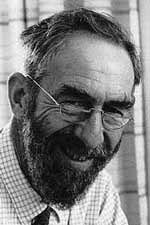
The frontispiece photograph was taken in 1970 by R. Westen and is reproduced courtesy of the John Curtin School of Medical Research, Australian National University.
References
- Krebs, H.A. 1949 The Tricarboxylic Acid Cycle. In The Harvey Lectures 1948-1949, series 44, pp. 165-199. Springfield, Illinois: Charles C. Thomas.
- Krebs, H.A., & Johnson, W.A. 1937 The role of citric acid in intermediate metabolism in animal tissues. Enzymologia 4, 148-156.
- McFarlane, A.S. 1935 Biochem. J. 29, 407.
- Shemin, D. 1946 The Biological Conversion of l-Serine to Glycine. J. Biol. Chem. 162, 297-307.
- Wood, H.G., Werkman, C.H., Hemingway, A., & Nier, A.O. 1941 Mechanism of fixation of carbon dioxide in the krebs cycle. J. Biol. Chem. 139, 483-484.
Bibliography
- 1935 (With J.F. Brown) The potent-iometric titration of non-aqueous solutions applied to amino acids. Trans. Faraday Soc. 31. 574-585.
- (With R.C.G. Moggridge) The potentiometric titration of solutions of vitamin B1. Biochem. J. 29. 866-870.
- Constitution of the purine nucleosides. Part III Potentiometric determination of the dissociation constants of methylated xanthines. J. Chem. Soc. 1376-1379.
- 1936 (With B. A. Potus) Potentiometric titrations of vitamin B1 and of thiochrome. Biochem. J. 30. 736.
- Micro-potentiometric filtrations of normal horse serum globulins. Biochem. J. 30. 1845.
- Some dissociation constants. J. Chem. Soc. 1713.
- Temperature coefficients of electrical conductivity of electrolytes in methyl and ethyl alcohols. Trans. Faraday Soc. 32. 1679.
- Ionisation of amines in alcohol: a possible slow reaction. J. Chem. Soc. 1023.
- 1937 Some observations on mixtures of serum albumin and globulin. Biochem. J. 31. 1952.
- 1938 (With E. R. Holiday) Ultraviolet absorption and potentiometric titration curves of human serum proteins and some others. Biochem. J. 32. 1166.
- (With C. Wilson) Treatment of peripheral vascular disease by intermittent venous occlusion: a new, simple and inexpensive method. The Lancet. 606.
- Enzymatic removal of bound carbohydrate from normal horse serum pseudoglobulin. Nature. 141. 1056.
- 1939 (With J.St.L. Philpot and S. Zucherman) Observations related to the swelling of sexual skin in Rhesus monkeys. J. Endocrinol. 1. 231.
- 1942 Addendum: Examination in the ultracentrifuge (of Tobacco Necrosis virus). Brit. J. Path. 23. 328.
- 1943 Addendum: Examination of Bushy Stunt Virus in the ultracentrifuge. Biochem. J. 37. 78.
- Addendum: Examination in the ultra-centrifuge (of antigen of Salmonella typhivenrium). Biochem. J. 37. 612.
- On the theory of the periodic structure of proteins. Trans. Faraday Soc. 39. 151.
- 1945 (With J.P. Johnston and H.C. Longuet-Higgins) On the distribution of the molecular weights of proteins. Trans. Faraday Soc. 41. 588.
- (With H. Gutfreund) Physical properties of bovine serum after heating with formaldehyde. Biochem. J. 39. 186.
- (With J.P. Johnston) Ultracentrifugal examination of fractions of Tobacco Mosaic virus. Brit. J. exp. Path. 20. 313.
- On the numerical consequences of certain hypotheses of protein structure. Trans. Faraday Soc. 41. 670.
- Ultracentrifugal examination of a virus causing tobacco necrosis. Brit. J. exp. Path. 26. 286.
- 1946 Spreading of boundaries in electrophoresis. Nature. 157. 195.
- (With H. Gutfreund) The sedimentation constant of insulin. Biochem. J. 40. 432.
- Addendum. Examination in the ultra-centrifuge (of a milk protein). J. Dairy Res. 14. 328.
- (With G.S. Adair and J.P. Johnston) Osmotic pressures and sedimentation velocity of Gastrophilus methaemoglobin. Biochem. J. 40. 867.
- (With J.P. Johnston) A boundary anomaly found in the ultracentrifugal sedimentation of mixtures. Trans. Faraday Soc. 42. 789-799.
- 1947 The definition and meaning of pH. Physiol. Rev. 27. 228.
- 1948 (With C.A. Coulson, J.T. Cox and J.St.L. Philpot) A rapid method for determining diffusion constants in solution. Proc. Roy. Soc. A. 192. 382-402.
- (With E.R. Holiday, J.St.L. Philpot and L.A. Stocken) Replacement reactions of b-b'-dichlorodiethyl sulphide and of some analogues in aqueous solution: isolation of b-chloro-b'-hydroxydiethyl sulphide. Trans. Faraday Soc. 44. 45.
- Chemical reactions of mustard gas in aqueous solution. Biochem. Soc. Symp. No. 2. 2.
- (With R. Cecil) Addendum: Sedimentation and diffusion of glucose oxidase (Notation). Biochem. J. 42. 229.
- (With K. Bailey and H. Gutfreund) Molecular weight of tropomyosin from rabbit muscle. Biochem. J. 43. 279.
- (With D.J. Bell, H. Gutfreund and R. Cecil) Physicochemical observations on some glycogens. Biochem. J. 42. 405.
- (With O. Smithies) Some thermo-dynamic and kinetic aspects of metabolic phosphorylation. Physiol. Rev. 28. 283-303.
- (With R. Cecil) Sedimentation of thymus nucleic acid in the ultracentrifuge. J. Chem. Soc. 1382.
- Interpretation of experiments on metabolic processes, using isotopic tracer elements. Nature. 162. 963.
- (With R. Cecil) Accuracy of the Svedberg oil-turbine ultracentrifuge. Biochem. J. 43, 592-598.
- 1949 (With R. Cecil) Sedimentation constant, diffusion constant and molecular weight of lactoglobulin. Biochem. J. 44. 33.
- The Gouy diffusiometer; further calibration. Proc. Roy. Soc. A. 196. 272-285.
- (With R. Cecil and J.P. Johnston) Influence of solvent movement on sedimentation. Nature. 163. 919.
- (With H. Gutfreund) A method for determining the sedimentation constant of material of low molecular weight: studies on oxidation products of insulin. Biochem. J. 44. 163.
- The sedimentation and diffusion of poly-saccharrides from Penecillium luteus; interpretation of the results obtained from polydisperse material in the Gouy diffusiometer. Biochem. J. 45. 189.
- 1950 (With R.E. Davies) On the mechanisms of secretion of ions by gastric mucosa and by other tissues. Biochem. J. 46. 324.
- (With J.E. Stanier) On the state of hyal-uronic acid in synovial fluid. Biochem. J. 46. 364.
- (With J.E. Stanier, B.A. Tomes and D.J. Strawbridge) Elastic properties of ox synovial fluid. Nature. 165. 571.
- Sedimentation and diffusion of desoxy-ribose nucleic acid. Trans. Faraday Soc. 46.
- (With R. Cecil) A simple double-prism refractometer. J. Sci. Instruments. 28. 253-254.
- 1951 (With J.P. Johnston and J.E. Stanier) A modification of the Elson and Morgan method for the estimation of gluco-samine. Analyst. 76. 88.
- (With J.E. Stanier) The dimensions of the particle of the hyaluronic acid complex in synovial fluid. Biochem. J. 49. 585.
- (With J.E. Stanier) A micro-method for the estimation of uronic acids. Biochem. J. 49. 591.
- (With J.H. Fessler) Studies of the sedimentation, diffusion and viscosity of some sarcosine polymers in aqueous solution. Trans. Faraday Soc. 47. 667.
- Specificity of the enzyme aconitase. Nature. 167. 693.
- 1952 (With J.E. Stanier) Further observations on the preparation and composition of the hyaluronic acid complex of ox synovial fluid. Biochem. J. 52. 149.
- Addendum: sedimentation and diffusion of Licheniformius A, B and C. Biochem. J. 51. 558.
- (With R. Cecil) Addendum: Sedimentation and diffusion of fumarase. Biochem. J. 51. 494.
- (With E.F. Woods) Molecular configuration of dextrans in aqueous solution. Nature. 171. 221.
- 1953 (With J.E. Stanier) A Couette viscosimeter. Biochem. J. 53. 4-7.
- (With J.E. Stanier) Composition and properties of hyaluronic acid complex of ox synovial fluid. Faraday Soc. Disc. No. 13.
- (With J.E. Stanier) The physiological function of hyaluronic acid in synovial fluid: viscous, elastic and lubricant properties. J. Physiol. 119. 244.
- (With J.E. Stanier) Some effects of hyaluronidase on the hyaluronic acid of ox synovial fluid, and their bearing on the investigation of pathological fluids. J. Physiol. 119. 253.
- Dimensions on solute particles from dynamic properties of their solutions. Trans. Faraday Soc. 49. 1481.
- 1954 (With E.F. Woods) The sedimentation of some fractious of degraded dextran. Trans. Faraday Soc. 50. 635.
- (With R.L. Baldwin) The diffusion and sedimentation coefficients of a liquid two-component in terms of macroscopic properties of the system. Trans. Faraday Soc. 50. 749.
- Methods of describing unidimensional diffusion in binary liquid systems. Trans. Faraday Soc. 50. 1303.
- Sedimentation and solvation in multi-component systems. Trans. Faraday Soc. 50. 1363.
- (With J.H. Fessler and J.E. Stanier) Some properties of human and other synovial fluids. Biochem. J. 58. 656-660.
- 1955 (With J.M. Tilley) Studies on the heterogeneity of crystallized b-lactoglobulin. Biochem. J. 59(4). 644-653.
- Removal of acetylcholine from a limited volume by diffusion. J. Physiol. 128(1). 222-223.
- Chemistry of proteins, peptides, and amino acids. Annual Rev. Biochem. 24. 181-206.
- (With E.O. Field) Boundary spreading in the migration of a solute in rapid dissociation equilibrium; theory and its application to the case of human haemoglobin. Biochem. J. 60(4).
- Examination in the ultracentrifuge. Biochem. J. 61(4). 696-697.
- 1956 (With J.R. Hall) Sedimentation and diffusion of samples of penicillinase. 62(3). 401-403.
- (With B.S. Blumberg) The selective solvation of the hyaluronic acid complex of ox synovial fluid. Biochem. J. 63(4). 715-717.
- 1957 (With B.S. Blumberg) The effects of pro-teolytic enzymes on the hyaluronic acid complex of synovial fluid. Biochem. J. 66(2). 342-346.
- (With M.P. Tombs) The heterogeneity of bovine b-lactoglobulin. Biochem. J. 66(3). 399-403.
- 1958 The spaces in a uniform random suspension of fibres. Trans. Faraday Soc. 54. 1754-1757.
- (With T.F. Sherman) Electrophoretic removal of protein from hyaluronic acid. Nature. 181. 482-483.
- (With B.S. Blumberg) Further evidence on the protein complexes of some hyaluronic acids. Biochem. J. 68(1).
- Conditions for differential reaction of identical chemical groups. Nature. 181(4621).
- (With B.S. Blumberg, D.A. Lowther and H.J. Rogers) Physicochemical properties of hyaluronic acid formed by Streptococcus haemolyticus. Biochem. J. 70(1). 1-4.
- Sedimentation in the ultracentrifuge. Biochem. J. 70(4). 598-599.
- 1959 (With T.F. Sherman) Degradation of the hyaluronic acid complex of synovial fluid by proteolytic enzymes and by ethylenediaminetetra-acetic acid. Biochem. J. 72(2). 301-305.
- 1960 Biochemical investigation of a case of glycogen-storage disease (von Gierke's disease). Addendum-examination in the ultracentrifuge. Biochem. J. 74. 229-230.
- Some tests of the effect of stirring on the rate of dialysis: the indeculator. Arch. Biochem. 89. 181-183.
- (With C.F. Phelps) Exclusion of inulin from solutions of hyaluronic acid. Nature. 187. 1024.
- 1961 (With T.F. Sherman) Effects of hyalu-ronic acid upon duffision of solutes and flow of solvent. J. Physiol. 156. 67-74.
- (With C.F. Phelps) The partitions of solutes between buffer solutions and solutions containing hyaluronic acid. Biochem. J. 78. 827-833.
- (With J.F. Morrison and W.J. O'Sullivan) Kinetic studies of the activation of creatine-phosphoryl-transferase by magnesium. Biochim. Biophys. Acta. 52. 82-96.
- 1962 Molecular weights of enzymes. Nature. 196. 171-172.
- Some thermodynamic relationships in ternary systems, with special reference to the properties of systems containing hyaluronic acid and protein. Arch. Biochem. Suppl. 1. 39-51.
- 1963 On uncertainties inherent in the determination of the efficiency of collison between virus particles and cells. Biochim. Biophys. Acta. 66. 279-281.
- (With M. Davies and L.W. Nichol) Frictional effects in the migration of mixtures of hyaluronic acid and serum albumin. Biochim. Biophys. Acta 75. 436-438.
- (With T.C. Laurent) The interaction between polysaccharides and other macromolecules. Biochem. J. 89. 249-253.
- 1964 On the estimations of glucosamine in hyaluronic acid. Anal. Biochem. 8. 337-343.
- 1965 (With B.N. Preston and M. Davies) The composition and physicochemical properties of hyaluronic acids prepared from ox synovial fluid and from a case of mesothelioma. Biochem. J. 96. 449-474.
- (With B.N. Preston) Use of light-scattering to measure the selective interaction of a macromolecular solute with the components of a binary solvent. Nature. 207. 80-81.
- (With M.A. Denborough) Failure of phenol to remove residual protein from hyaluronic acid. Nature. 207. 1389.
- 1966 (With B.N. Preston) The exclusion of protein by hyaluronic acid. Measurement by light scattering. J. Biol. Chem. 241. 17-19.
- Discussion: protein-polysaccharide interaction. Federation Proc. 25. 1039.
- When is pressure osmotic? Federation Proc. 25. 1112-1114.
- Measurement of osmotic properties of hyaluronic acid by equilibrium sedimentation. Federation Proc. 25. 1118-1119.
- Measurement by light scattering of the exclusion of protein by hyaluronic acid. Federation Proc. 25. 1122-1123.
- On water binding. Federation Proc. 25. 986-989.
- Macromolecular hydration in solution. Federation Proc. 25. 993.
- On the physical chemistry of porous systems [Review]. British Med. Bulletin. 22. 105-108.
- 1967 (With L.W. Nichol and B.N. Preston) The equilibrium sedimentation of hyaluronic acid and of two synthetic polymers. Biochem. J. 102. 407-416.
- (With P. Silpananta and J.R. Dunstone) Fractionation of a hyaluronic acid preparation in a density gradient. The isolation and identification of a chondroitin sulphate. Biochem. J. 104. 404-409.
- (With L.W. Nichol and D.J. Winzor) Evaluation of gel filtration data on systems interacting chemically and physically. Archives of Biochem. & Biophys. 121. 517-521.
- 1968 (With R. Cecil) Addendum: Sedimentation of human catalase. Biochem. J. 43. 209.
- (With P. Silpananta and J.R. Dunstone) Fractionation of ahyaluronic acid preparation in a density gradient. Some properties of the hyaluronic acid. Biochem. J. 109. 43-50.
- (With E. Edmond) An approach to the study of phase separation in ternary aqueous systems. Biochem. J. 109. 569-576.
- (With E. Edmond, S. Farquhar and J.R. Dunstone) The osmotic behaviour of Sephadex and its effects on chromatography. Biochem. J. 108. 755-763.
- 1969 (With L.W. Nichol and G.D. Smith) The effects of isomerization and polymerization on the binding of ligands to acceptor molecules: implications in metabolic control. Biochim. Biophys. Acta. 184.
- 1–10.
- (With P. Silpananta and J.R. Dunstone) Protein associated with hyaluronic acid in ox synovial fluid. Australian J. Biol. Sci. 22. 1031-1037.
- 1970 (With E. Edmond) Phase separation in an aqueous quaternary system. Biochem. J. 117. 85-89.
- (With J.D. Wells) Osmometry with single sephadex beads. Biochem. J. 119. 67-73.
- (With P. Silpananta) the thermo-dynamics of interaction between Sephadex and penetrating solutes. Biochem. J. 116. 171-175.
- (With G.E. Hibberd and D.J. Winzor) An experimental and theoretical investigation of boundary spreading in gel chromatography. J. Chromatography. 48. 393-399.
- An open-ended tale. Search 1 (2), 60-63.
- 1972 (With J.D. Wells) The osmotic properties of sulphoethyl-sephadex. A model for cartilage. Biochem. J. 128. 685-690.
- (With B.N. Preston and J.D. Wells) Micro methods of osmometry based on the equilibrium swelling of gels. Biochem. J. 130. 16P-17P.
- 1973 (With B.N. Preston) A sensitive and accurate gel osmometer. Biochem. J. 131. 843-850.
- 1975 (With P.A. Baghurst, L.W. Nichol and D.J. Winzor) Quantitative interpretation of concentration-dependent migration in gel chromatography of reversibly polymerizing solutes. Biochem. J. 147. 575-583.
- 1978 (With C.C. Michel) General descriptions of passive transport of neutral solute and solvent through membranes [Review]. Prog. Biophys. & Molec. Biol. 34. 197-217.
- 1979 (With B.N. Preston) The molecular compression of dextran. Biochem. J. 183. 1-9.
- 1981 (With L.W. Nichol and P.R. Wills) Effect of inert polymers on protein self-association. FEBS Letters. 126. 18-20.
- 1982 A new relationship between kinetic and equilibrium parameters of reversible enzyme reactions. Biochim. et Biophys. Acta. 707. 289-290.

Alexander Boden 1913-1993
Written by I.G. Ross
- Early years
- The student
- The manufacturing chemist
- The end of DDT
- Hardman at Seven Hills
- Science press
- The author
- The farmer
- Bioclone Australia Pty Ltd
- Planner and manager
- Business philosophy: The Newcastle address
- The public persona
- Family man
- Travelling and the cultivation of friendships
- The philanthropist
- The Boden chair of human nutrition
- The Boden Conferences
- Recognition
- Envoi
- About this memoir
Alex Boden was a manufacturing chemist who succeeded in that most difficult of industries; through his texts, he was an exceptionally successful educational author; and he was a publisher who relished editing, a man of some privacy and reticence who made deep and continuing friendships across the world, a singularly devoted husband, parent and grandparent, and a philanthropist in an age when philanthropy had almost dropped out of sight. His life was one of remarkable richness, variety, originality and generosity. It is unlikely that there has been another Australian of his kind.
His election to the Australian Academy of Science was on the nomination of Professor John Swan, who has recalled:
Alex Boden was a man of remarkable talents, pconcealed by a modest, even humble, exterior. I never saw him angry. He was greatly admired as a man who had achieved much in life but whose ambition was to contribute to family, social and community welfare, to give rather than take, to be supportive of others, and above all to foster the advancement of science.
One can wonder of how many, not professionally engaged in scientific research, it could be said that the voluntary side of their life was 'Above all, to foster the advancement of science'. Or that, as was the case, that they enjoyed no social contacts more than the company of scientists.
In writing this memoir I have depended on much help from Alex's family and former business associates, but I have also relied at times on my own recollections. We first met in 1942 in a manner so typical of Alex's style that it should strike a suitable note for appreciation of the longer narrative.
I was in Dymock's bookshop in Sydney looking at an enticing shelf of chemistry texts. There was a young, suited man beside me, and he asked me - I was in school uniform - what books I used at school. Idrew down two favourite English texts. He said: 'What about this one?' and he picked out Boden's Handbook of Chemistry. 'Oh', I said, 'it's our set text but it's no good'. 'Oh, I'm sorry,' he said. 'I wrote it'. The next day I sent him a letter detailing my reasons for that embarrassing verdict. They were actually only nitpicking ones. In response Alex bravely offered me my first job, at £2 a week, to work through the vacation at the Hardman Research Laboratory on revisions of the Handbook for the next edition. I accepted.
Early years
Alexander Boden was born on 28 May 1913, shortly after William and Helena Boden arrived in Australia from Northern Ireland. They established a drapery business in the main shopping centre of the Sydney suburb of Chatswood. He was the only son; there were two sisters.
His father, William Boden, was born in Ballinasloe on the border of counties Galway and Roscommon, but went in his youth to join his uncle in the latter's evidently prosperous drapery story in Magherafelt, Co. Derry. A surviving photograph of the staff of the store is impressive: some fifty men and women in starched collars and prim blouses stand in well-ordered ranks. The move to Australia in 1913 followed the emigration of two brothers and a sister. His mother, formerly Helena Isabella Hutchinson, a schoolteacher, came from Knockboy, near Broughshane, Co. Antrim, of a family of schoolteachers and clerics.
Alex Boden's education was at Willoughby Public School and North Sydney Boys High School. His father's premises were owned by the pharmacists Washington H. Soul, Pattinson and Co. and one day, while the young Alex was still at school, his father asked his landlord what was the best career for a boy. 'Buyin' and sellin'' was DrPattinson's counsel. In a greatly expanded sense it could be said that Alex Boden followed this advice.
The student
In 1929 Alex passed the Leaving Certificate with honours in Mathematics and Chemistry. An exhibition took him to the University of Sydney, where he enrolled in science to which he, like many before and after him, had been drawn by school chemical experiments:
I can trace my interest in chemistry to my first chemical experiment in school, changing the colour of litmus paper. I took some paper home and spent an exciting afternoon changing it from pink to blue with vinegar and washing soda. This was something I could do without instruction or interference from others. [1]
The last sentence is revealing: self-reliance was to be the hallmark of his life.
He made ample time for extracurricular activity, and set a possible record in ecumenism through his simultaneous membership of the Student Christian Movement (he had been a Sunday school teacher at Willoughby Presbyterian church), of Professor John Anderson's notoriously subversive Freethought Society, and the Sydney University Regiment (Corporal 1931). He became a highly-qualified Boy Scout leader. He spoke at the Sydney University Union's parliamentary-style Union Night debates, and engaged in hockey and wrestling.
Notable survivals of that time are notebooks in which Alex recorded in carefully marshalled tables the books he had read and his opinions of them. Thus in his first university year he records reading, wholly or in part, about a hundred books. Representative entries from that year include Better Ballroom Dancing by Scott (75% read) with a note 'Correction of mistakes etc.'; Goodbye to All That by Robert Graves (all read) 'Good realistic. No censoring of language'; Handbook of Photography by Sinclair (most read) 'Pretty good but a bit old-fashioned'; Religion and Science, by Draper (all read) 'V. readable'; English Regal Copper Coins, by Bamah (most read); 'Coins 16721860. No pics. may be good for reference'; La Vie des Abeilles by Maeterlinck (2/3 read) 'V.g. Hard French. Interesting and novel'; Communist Manifesto by Marx and Engels (all read) 'Quite fair. Rather old but still interesting'. This remarkable reading programme continued, with unabated assiduity and eclecticism, right through to the end of his fourth year - 400 titles, all similarly noted.
He graduated with honours in the bleak year of 1933. While this account must shortly take up his business career, it will be convenient here to carry on with one of his subsequent extra-professional interests - the theatre. He joined The Playmakers and in 1934 made his debut in Crime Made Legal. Advance publicity noted that 'Alex Boden is a newcomer to the Society and is making his first appearance in the important part of Inspector Burke. His fine speaking voice and confident bearing are sure to find favour.' It must be assumed that they did, for he made at least a dozen subsequent appearances, mostly with Sydney's oldest repertory company, The Sydney Players. His notices were generally flattering, as in A Midsummer Night's Dream: 'As Theseus, Alex Boden was easily the most competent of last night's performers. He alone gave real dignity to his lines.'
After 1936, however, the store of programmes and press clippings stops. Life had acquired other dimensions. He wrote in his notebook:
Aged twenty four and watching now the last grains of 1937 run through our fingers. A book [his Handbook of Chemistry] was born in January. Perhaps it will be worthy of rebirth. Almost a beginning on another. Finances are dull but they have been smoothed sufficiently to give a little takeoff for 1938. Sentiments not entirely controlled and showing no practical advance.
1937 was the year of a blundering young chemist in ignorant virtuous lazy search for better things (what better things?). The need is for better blending of gravitas and j[oie] de v[ivre]. The morning is ripening rapidly.
The manufacturing chemist
Boden's business career took two paths that need to be traced separately. One, his career in science and chemical manufacture, follows naturally at this point. Later, there will be an account of his parallel career as publisher and author.
His first job (1934) was a nine-month temporary appointment as an assistant biochemist at Royal North Shore Hospital. This was the only time he worked for a salary. While searching for a next job at the depths of the depression, his eyes were clearly on the commercial world. On 28 June 1935 there was registered the Pastoral Products Company for 'the manufacture and sale of chemical products etc.', proprietors Alexander Boden (then just 22) and Douglas J. Bush. Of this venture nothing has been found but a letterhead with a mid-city address describing the company as 'manufacturers and distributors of accessories for the man on the land'.
He did however make another more durable move the same year through an advertisement for a position with a Hardman Research Laboratory, at 1035 Bourke Road, Waterloo. The owner, name unknown, was 'an oldish bachelor' who wanted to build a business for a protégé, Kethel Hardman. Dr Len Atkins, a life-long friend, remembers Hardman as a youngish man, not a technologist, who had set up a business based on contract analytical work supplemented by the recycling of 35 mm movie film, recovering nitrocellulose and silver. The business lacked a chemical director. Alex wrote: 'I knew so little that I thought I knew everything and fitted in immediately'. The Waterloo premises included a modest laboratory. Alex expanded the recycling business to the reprocessing of X-ray plates, the recovery of silver from spent fixing fluids from photographic processors, and of lead from toothpaste tubes.
The arrangement with Hardman was presumably, since it was not salaried, of a commission or profit-sharing kind. In any event, it was unharmonious and short-lived and Hardman left. There was then a fire in the celluloid film plant which the owner had insured well. He told Alex that once he had the insurance money, Alex could have the business. Thus Alex, by then a Registered Analyst, acquired the Hardman business and chose to retain the name. He moved to a laboratory situated above a furrier's overlooking Hyde Park. The analytical services were transferred to premises in Crown Street, Surry Hills, under the name of Sydney Testing Laboratories Pty Ltd. Alex began to buy, repackage and sell chemicals. His products included 'Lotus Bloom' face powder, price 6d, advertised, with a portrait, by Woolworths in the Sydney Sun, 25 May 1939:
Chemist triumphs. For months and months Mr A. Boden B.Sc., skilled analyst, has been testing and comparing expensive world famous powders ... Read these amazing facts: 27 Actual tests were necessary before Lotus Bloom was perfected ...
Shortly after graduation Alex had been in friendly association with another chemist, who had found employment with a shoe factory and was formulating shoe finishes: dyes, waxes, latexes, adhesives. Having thus learnt about these arcane matters, Alex in 1939 suggested to a hockey team-mate, Max Carson, that they go into business to supply such products to the trade. The operation was conducted, as Shirley Finishes Pty Ltd, from a garage in Crown Street, later in Chippendale. In due course the adhesives side of the business, initially based on formulations of natural rubber but later moving to synthetics, became the dominant one. In the mid-1950s, Carson acquired Alex's interests.
In parallel (1940) with another partner, Ray Russell, Alex embarked on actual chemical manufacture in Enmore, an inner suburb. A new company, Alex Minter & Co., was formed: the name was invented. A meat chemist, George Levack, suggested the first product: glyceryl monostearate, an emulsifier used, for example, in hair creams, and made by heating hydrogenated stearine with glycerol. Other trademarked products were copper oleate as a waterproofing agent, and products for hardening paints and metal welding fluxes. Alex Minter & Co. later moved to a seven-acre site in Northmead, manufacturing products for water treatment, preservation of textiles and various agricultural applications: aluminium sulphate and aluminium hydroxide gel, copper 'naphthanate' (hexahydrobenzoate), and metal stearates. Alex Minter was sold in 1961 to Chemical Materials Ltd.
Meanwhile in 1948 Alex founded Hardman Chemicals Pty Ltd and in 1953 he moved this operation to the site of a former army warehouse in Marrickville, on a residuum of which Boden Books (owner of Science Press) and a later company, Bioclone Australia, now operate. He embarked on a new venture based on reacting chlorine gas with ethanol and with benzene, a development that came about indirectly through one of his clients, a carpet manufacturing company. The technical director, Dr Egon Grauaug, was interested in making certain wetting agents used in wool scouring and hence in carpet manufacture. They were based on epichlorhydrin which can be made from glycerol and hydrogen chloride, and hydrogen chloride is readily made as a byproduct of organic chlorination reactions.
A product requiring chlorination chemistry is DDT (p,p'-dichloro-diphenyl-trichloroethane), the demand for which was just developing. The original intent was thus to use the manufacture of DDT as a source of hydrogen chloride for the manufacture of epichlorhydrin. In fact that objective was abandoned quite early in favour of the manufacture of DDT in quantity much greater than the demand for a speciality wetting agent would justify. Alex carried out the initial experiments at home, where a pilot chlorination plant was built, supervised during the day by his wife. Primary products of the chlorination of alcohol and benzene are trichloracetaldehyde ('chloral', an hypnotic) and chlorobenzene (plus higher chlorinated benzenes: markets were established for p-dichlorobenzene as an insecticide and as a counter-odorant, and for o-dichlorobenzene as a solvent and cleanser). Condensed together in the presence of cold fuming sulphuric acid, chloral and chlorobenzene produce DDT which separates as a waxy solid.
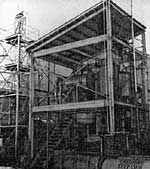
The accompanying rather dingy picture of the plant is reproduced from Boden's An Introduction to Physics and Chemistry (1959). The chlorination of ethanol was a continuous process. Alex recalled (in speaking notes for a lecture, post-1978) that in the early days he spent nights checking the process, sleeping near the coal-fired boiler to keep warm:
We could not afford to buy good chemical engineering equipment, so we made a lot of it ourselves. Teflon was relatively new then, and we pressed it and made it into gaskets and valves and pumps which worked well. No other plastic construction material was available to resist a mixture of hot solvent, chlorine, and hydrogen chloride.
Elsewhere he wrote:
The condensation of chloral and chlorobenzene is a right messy operation. Handling highly flammable poisonous solvents, corrosive hydrochloric acid and 103% sulphuric acid can hardly be taken as a chemical picnic. We had a keen team of fitters who built new plant as the old fell to pieces. [1]
The copious byproduct hydrogen chloride had to be disposed of. The economic viability of the enterprise was secured through a contract to supply the battery company Eveready, in nearby Rosebery, with drums of zinc chloride solution, made from Hardman's hydrochloric acid and scrap zinc obtained from galvanizing plants. In a reminiscence in 1986, he said:
We made DDT in those days, and when I say we, that meant everybody. We made zinc chloride and packed it into drums, and everybody had to help roll the drums up on to the truck which took them to Rosebery.
The manufacture of zinc chloride extended, using imported ammonium chloride, to zinc ammonium chloride for sale principally to the galvanized pipe division of Stewart and Lloyd, in Newcastle. There followed in the 1960s the establishment of a merchandising department selling eventually sodium fluoride, textile dyes and reflective sheeting. Cash flow was further bolstered by manufacturing, under license, a product for phosphatising steel prior to painting.
The company entered the 1960s with justifiable confidence, but Alex later said
I was fortunate to be involved in the chemical industry in the 1950s when shortages of chemicals meant that one could make a chemical with some hope of selling it. Now competition from overseas supplies and the high cost of labour make a new chemical enterprise expensive and hazardous. [2]
In fact, the 1960s were not easy. The company was short of capital and suffered from liquidity problems. There was a fire in the chlorobenzene plant. Against all Alex's instincts he was at times forced to retrench staff and at other times to ask staff to accept pay cuts.
His turnaround came in the late 1960s through George Levack who had moved to the central coast of New South Wales and had met Owen Chapman, an engineer involved in rutile mining there. Alex joined Chapman in a mining venture, Wyong Rutile Pty Ltd (later Wyong Minerals). For three years, as Coastal Chemicals Pty Ltd based at Wyong, he also manufactured rutile mining equipment in fibreglass. Wyong Minerals was later transformed into a sizeable holding in the then substantial Victorian Antimony Mining (VAM) group. The later timely sale of his interest in VAM was critical to his tenacious preservation of Hardman over the period that it was relocating to Seven Hills and recasting its product lines.
With the capital gained from the VAM transaction Alex further developed the Marrickville site and also built a portfolio of investments in public companies and commercial property developments. He had for many years been a ready and generous donor to causes scientific and individual. The income from these investments led him to think later about the possibility of larger philanthropies, and eventually made them possible.
The end of DDT
When Alex began manufacture in the 1950s, DDT was seen as a magical pesticide. It had saved possibly more lives than any previous man-made product. A change came with the raising of environmental alarms, for which DDT became the scapegoat and icon. Also, concern spread to human health. Alex, who had advanced ideas in regard to health checks for his staff, recalled:
During the years that our company made DDT I had, at various times, fears for my staff who, like myself, were reasonably saturated with the sticky stuff. I visited DDT plants in other parts of the world, and gradually became satisfied that DDT is harmless to man, and that DDT workers were as healthy as the general population. In the DDT plant in Los Angeles, the largest in the world, the workers were found to be average in all health respects except cancer cases which were, surprisingly, nil.
This led to a study of DDT as a cancer inhibitor. DDT was fed, along with a known carcinogen, to female rats. The results indicated that DDT-treated rats had a significantly lower incidence of mammary cancer, and a lower number of tumour sites than the control group. The work was not pursued because of the impossibility of experiments on humans, but it might have shown that the residues of DDT, for which DDT was banned on general aesthetic grounds, and because of its persistence in the environment, could have been beneficial after all. [2]
Also making DDT were ICIANZ and Union Carbide. Each eventually found its manufacture to be uneconomic. Hardman Chemicals continued making DDT through the 1960s, but environmental concerns led to its declining use and the problems of by-product waste disposal increased. Black liquid residues consisting mostly of sulphuric acid mixed with sulphonated chlorobenzenes were no longer welcome at the old brickpit tip at nearby St Peters. Alex could now buy hydrochloric acid more cheaply than he could make it. He told me too that whatever the case for continued approved uses, as a publisher of school texts that treated social issues in science, he could hardly continue to make such a controversial product. The resourceful integrated programme of manufactures based on chlorination chemistry, that had begun in the 1950s, closed in the early 1970s.
Hardman at Seven Hills
By then, most of the functions of Hardman had been moved to a 20-acre site at Seven Hills, in western Sydney. The land, a dairy farm, had been acquired in 1961. Production shifted from organics to inorganics, particularly aluminium chloride and chlorhydrate, zinc chloride and zinc ammonium chloride, which became the heart of the Hardman operation. With knowledge that his largest customer was planning to phase out its demand for zinc chloride, Alex sought an alternative product. For some years (commencing in Marrickville) he was able to secure a valuable raw material in the form of stockpiled baghouse fume from the copper smelter (Electrolytic Refining and Smelting, later Southern Copper) at Port Kembla. The fume was a complex mixture of 33% zinc, 25% lead and in amounts from 2% down to 0.5% copper, cadmium, arsenic, tin, bismuth and antimony, with other elements in still smaller quantities. Their recovery presented novel problems in extractive metallurgy. Eventually, zinc alone was recovered (as sulphate) at Hardman and the balance, in the form of lead sulphate with admixtures, was shipped profitably to an English smelter. By 1970 the company had built up a large export business, mainly of zinc sulphate (monohydrate and heptahydrate) to the USA. This achievement was recognised via a government E for Export Award.
Markets move: the demand for zinc chloride products fell, and further diversification was needed. To enlarge the company's customer base (up to that point, only about fifteen companies), manufacture commenced, under license, of a range of novel water-soluble epoxy resins for surface coatings and modification of concrete. Some non-chemical manufacturing was attempted, but faltered at the task of retail marketing.
In 1987 the company's name changed to Hardman Australia, primarily to identify more clearly its Australian origin and ownership, but also to distance itself from exclusive dependence on chemicals. The policy Alex set for it (recalled in later Board minutes) was simply that Hardman should be a conservative, ethical company to be operated with the aim of increasing its net worth. At the time of his death Hardman Australia had fifty staff and an annual turnover of the order of $15 million. Products manufactured included aluminium hydroxychloride and aluminium and magnesium hydroxide gel and polyaluminium chloride for adhesives, antiperspirants, liquid stomach antacids, and water treatment; zinc sulphate as a micronutrient for cereals and other crops and, specially formulated, as a treatment for footrot; zinc chloride and zinc ammonium chloride; magnesium chloride for textile processing and adhesives; magnesium hydroxide gel for pharmaceuticals; water-soluble epoxies; and certain moulded road-safety products such as reflective road markers and flexible reflective roadside posts. These manufactures were complemented by an extensive range of indented product lines, while a 49% owned company, Hardman Chemical Industries Pte [SIC] Ltd in Singapore, produced inorganic chemicals for the South-East Asian market.
Science press
There was a certain inevitability about Alex Boden becoming a publisher. As an undergraduate he had produced mimeographed lecture notes that were sold through the Sydney University Union. He is remembered as watching nearby to see how they were selling. He became production editor of the student newspaper Honi Soit and he sold advertising for the Science Association's Science Journal - no mean task in the depths of the depression. His reward was to meet Dr Ernest Harden, the Hungarian proprietor of the Shakespeare Head Press, whose advertisement appeared in the 1933 Journal.
A chance meeting after Alex's graduation led Harden to invite him to prepare a textbook for secondary school chemistry, suited to the New South Wales curriculum. From his own methodical high school notes, reworked to reflect his later studies and his developing interest in the economic significance of chemistry, he delivered in 1936 the manuscript of A Handbook of Chemistry. Notwithstanding that both professors of chemistry rang Harden to say that Alex didn't know enough chemistry to write a textbook, Harden went ahead and the book appeared in 1937 under the Shakespeare Head imprint. There was a revised edition in 1941, and then the publisher was taken over by Consolidated Press.
The Handbook of Chemistry was thus committed to the Consolidated (Shakespeare Head) Press, to that press's considerable profit. Harden described the book in his catalogue as one of the major successes of Australian publishing. Alex later compiled a more elementary Introduction to Modern Chemistry, which he thought should be sold at a low price. Harden said he could not sell it at the price proposed but encouraged Alex to publish it himself. He established Science Press in 1943, and its first productions in 1946 were the Introduction and a booklet of physics problems.
The notion, that the books produced by Science Press should be made available to students as cheaply as possible, was to be a hallmark of his press's operations. The result was, however, that the Press was in most years a drain on the group's finances, even though Alex never took out a salary for his role in it or charged rent. In short, the Press would not have survived without the backing of chemical manufacture.
Around this time Keith Bullen FAA FRS arrived in Sydney to the chair of applied mathematics. Alex agreed to publish his Introduction to the Theory of Dynamics (1948), subsequently enlarged to cover statics. The resulting Introduction to the Theory of Mechanics (1949), pitched at undergraduates or senior secondary pupils in the British system, received respectful reviews. Publication in Australia of a mathematical text to Bullen's excruciatingly meticulous standards presented problems. Having resourcefully resolved them, the effort brought its rewards: Bullen's Dynamics ran through eight editions over the next 22 years.
While the Press was active with reprints, further titles were added only slowly: another of Alex's own elementary books in 1959, then two mathematical texts by commissioned authors, and in 1962 his Senior Chemistry. Exclusive preoccupation with science ended in 1962/3, when the Press branched into high school texts in French and in literature. A six-part series on French was destined to be a conspicuous success, passing the landmark of a million volumes sold around 1990.
In the 1970s, Science Press's publication programme expanded, with an increasingly wide range of titles. Of the 140 titles published by Science Press up to the time of Alex's death, many would not have been of his direct concern. But surprisingly many would have been, to some degree. Alex loved editing and, to adopt the word he used for his role in Chemical Science (1976), producing books. The early textbooks on French were worked over intensively by him, providing exemplars of the way he thought Science Press should publish for Australian schools. To the end of his life he would use spare time on aeroplanes, in the early morning, or where else occurring, perfecting text: his own or his authors'.
An example will illustrate the ubiquity and detailed nature of his involvement. In 1975 the Press issued a kit text by T.Hackett et al. Communicate! An Introduction to the Language and Culture of Germany, Japan, France and Indonesia. With another edition on the way, he wrote in 1979 to Mrs Michiko Furosho, the opera singer daughter of a business associate in Tokyo, in the following terms:
Dear Michiko: I have a book on languages for Australian students. To go with each language we have a tape. On one side is text material, on the other we want to give songs of the country. These songs should be ones that the students can sing themselves and so learn to use the language ... I remember the beautiful songs that you sent to the ABC through me and your sweet voice would be ideal for the songs needed. What songs do you sing to Mikihito [her son]? I would like to ask if you could organise such a tape for me. Some variations would be welcome such as a male voice or a group of voices. Some of the children's choirs that I heard on Japanese TV were wonderful ...
A listing of the complete output of Science Press, up to the time of its founder's death, has been lodged with the Australian Academy of Science. This list of some 170 titles, seemingly so diverse, nevertheless reflects a consistent philosophy. One can discern in it the pedagogue manqué, the desire to deal with issues as well as with curricula and, even when the detailed decisions were not his, the hand upon the tiller. Music, art, communication, societies feature, far cries from chemistry; and new media such as audio and video cassettes appear.
The author
The chemistry texts used in Australian schools in the 1930s were invariably of British provenance and style. Alex Boden's first book, the Handbook of Chemistry, set a new pattern from the outset. Its frontispiece was a map of Australia with mineral occurrences marked. Its text was plain and clear with numerous Australian references and industrial and social allusions were prominent.
He was keen on the production of petrol from coal. The caption to Fig. 16 is pure, proselytising Boden (aged 23):
View of part of the works at Billingham, where petrol from coal is stored. Eventually coal may replace petroleum as a source of volatile fuel. New sources of energy will be one of the major problems of industry in the future.
Successive editions went through numerous changes. The second, in 1941, was 50% longer, and the seventh (1948) was further expanded. By then the book had been considerably transformed, especially in its much more numerous illustrations. The book remained in print, essentially unaltered, till the tenth edition (1957).
In 1945, to meet the requirements of the chemistry part of a combined Chemistry and Physics course in New South Wales, Alex compiled and, as had become his practice during successive revisions of the Handbook, trialled with the assistance of numerous school teachers, a shorter Introduction to Modern Chemistry (1946). The text was concise with generous illustrations and descriptions of applications of chemistry in industry and agriculture - and in a tentative way in biology.
Following the publication, collaboratively, of two small books of problems in elementary chemistry and physics, Alex next produced, in 1959, An Introduction to Physics and Chemistry. His diligence in locating appropriate and interesting illustrations is exemplified by a picture of tungsten atoms obtained by the then very new technique of field ion microscopy, the photograph having been obtained directly from the inventor of the method, Erwin Müller.
By 1960, the durable Handbook was out of date, and Alex set about preparing an entirely new Senior Chemistry (1962). In what became his characteristic mode, he was not just an author of the book but also its organizer, using his now numerous contacts in industry, CSIRO, and universities in Australia and abroad as sources of particular pieces of text and of illustrations. The book was copiously illustrated, often with pictures of recent research, especially in CSIRO: his objective was to have at least one half-tone or line block per page. Long before the rise of the feminist movement, he made a particular effort to include pictures of women and references to them. I was closely involved in this book and so witnessed his constant reworking of successive drafts, seeking clarity, conciseness and an effective page layout. I learnt a good deal from seeing my own contributions edited in this way. Frequently, revisions were made so that a page could end with a completed paragraph: a hard objective but one achieved with half of the recto pages of the book. Exquisite pains were taken with diagrams. Again the book was trialled extensively, in ten schools.
There followed an ambitious new venture: two multi-authored texts in general science, once again conceived, produced, copiously illustrated and ruthlessly edited by Boden. Introduction to Science (1964) is a notable achievement. Written for high school students in their first three years, it tackled the problem of teaching over the whole of science. It was successful and sold over 300,000 copies.
I see the production of this book, before its time in terms of international offerings, as a tour de force. This was to be a book for beginning science students: years seven-to-nine. The plan that Alex adopted for his Introduction to Science defined twelve chapters and within each about four defined sections, of which the fourth (given that the first chapters were to deal with the physical end of the sciences) deftly and progressively brought in treatments of biology, ecology, and issues of social consequence. The last of the twelve chapters, on Man and Food, presaged the concerns that were to lead him later to endow the Boden Chair of Human Nutrition.
The book, in six editions, had a successful market for the better part of twenty years. A self-contained sequel, with even more authors and more acknowledgements, was published in 1966 as Advancing with Science. Notable in this book is the explicit treatment of the biology of human reproduction.
Towards the end of the 1970s, Alex's Senior Chemistry became dated, socially as much as scientifically. At a colloquium on senior school chemistry in 1976 he said:
Chemistry is losing popularity among students because many of them consider it to be too hard; I suggest that the word 'irrelevant' be substituted for 'too hard'. Young people in general show a great aptitude for knowledge which they consider to be interesting or useful. Certainly the pressures of affluence affect the time available, and must be taken into account when we determine the rate at which knowledge can be fed to the students. They do not have as much time as they previously had to come to mental equilibrium with the great flow of new knowledge.
Having seen the need for an updated chemistry text, this time he enlisted help. The authorship of Chemical Science (1981) is attributed to Hunter, Simpson and Stranks, with a separate laboratory manual compiled by Carswell, the whole 'produced' by Boden. Eventual sales attained 100,000.
For some years, in the 1960s, when many publishers were commissioning their printing overseas, Alex considered he had a responsibility to support Australian printing houses. By the 1970s, however, the economics of offshore publishing were inexorable, and Chemical Science was printed, in multicolour, in Singapore.
With the production of Chemical Science one might have expected Alex to hang up his boots as a sole author of chemistry texts. Nevertheless, just five years later (he was then 73), there appeared his 512-page Chemtext (1986), just short of fifty years after his first book, the Handbook. Chemtext was a wholly new book as modern in its style as its snappy title, with an enthusiastic foreword by Barry O. Jones FAA, then Minister for Science. The next year, collaboratively, Alex published an accompanying Teachers' Manual.
For anyone who has taught chemistry - indeed science - over many decades, and perhaps was weaned on Boden's original Handbook, the shift that is shown in Chemtext is astonishing in its dimension, yet wonderful in its youthful spirit. Barry Jones launched the book and declared that Chemtext ought to be required reading for every member of the Federal Cabinet.
John Emsley, New Scientist's chemistry correspondent, in reviewing new offerings in the chemistry textbook market, also enthused:
Although people assume that the US is the only market capable of supporting full-colour general texts, Chemtext, by Alexander Boden from Australia, shows it can be done elsewhere. And done better. Here is a book imbued with the joy of chemistry. Items of human interest dot its pages, and Boden takes every opportunity to show the relevance of the subject to the everyday world ... Such is my admiration for this book that I can even forgive such words as 'weedicide' and the use of mL. [3]
For some decades the Australian Academy of Science lived, to a degree, on the proceeds of textbooks aimed at the same markets as those for which Alex Boden wrote and produced. Apart from the Academy's flagship biology text The Web of Life, Alex's books were as successful and influential as any.
The farmer
While searching for land on which to relocate Hardman, Alex was shown and later bought a dairy property near Windsor, from which in due course he delivered daily 150 gallons of Friesian milk to the Sydney market. The farm became his principal hobby and weekend retreat. It was also, from 1980, the site of an endeavour in the hydroponic production of vegetables, then more advanced in New Zealand than in Australia. With his son-in-law Hugh Thomas, he developed a 60m long pilot facility with automated analysis and supply of nutrients. Imported chemicals from New Zealand were replaced by Hardman, but there were continuing difficulties in maintaining chelated iron in solution. There were always difficulties in producing tomatoes and lettuce at premium price peaks. A flood terminated the venture. Dairying continues.
Bioclone Australia Pty Ltd
Alex had long deplored the loss to Australia when, as continues to occur, Australian innovations are exploited in other countries. An opportunity to take a personal hand in redressing the outflow came in 1979 through his chairmanship of the New South Wales State Committee of CSIRO. Here he became aware of the emergent outcomes of a collaboration that had been set up between CSIRO's Unit of Molecular and Cellular Biology (Dr Geoff Grigg) and the Garvan Institute of Medical Research (Dr Les Lazarus).
The objective of the collaboration was to develop a series of improved immunoassay systems for assaying human hormones, based on then new monoclonal antibodies. CSIRO and Garvan Institute scientists had isolated families of monoclonal antibodies specific to each of a series of pituitary hormones and began to integrate them into usable assay kits. At this point it was perceived that the development of practical kits for clinical use would be assisted by a commercial collaboration. In the market place these kits would be in competition with products dependent on an inferior technology using polyclonal antibodies. Grigg proposed to a business member of the CSIRO State Committee that a commercial venture be established to develop and market the new technology; the member, in turn, proposed that he and Alex form a partnership. The proposal fell on receptive ears, and Alex agreed.
This speculative enterprise engendered no enthusiasm at all among Alex's senior staff at Hardman, but after listening to the objections, he characteristically made his own decision. He explained that he had seen too much good research lost to the country, and that he considered that biological manufacturing had a promising future.
The decision he made was to set up a company, Bioclone, and provide its start-up finance. 'It happened that I had some shares which had been so much wallpaper for many years but had at last come good'. Management was through his senior Hardman staff. Dr John Smeaton, an expatriate who was running his own diagnostics supply company in the USA, was employed to run the new company and Bioclone was set up in Marrickville in mid 1981. Almost immediately Alex's intended business partner withdrew from the enterprise along with promised funds. Nonetheless, with resourceful improvization Bioclone eventually reached the market place, initially with a pregnancy test. When Smeaton left in 1985, turnover was approaching $1 million per annum, the on-site staff numbered six, and many more, funded by Bioclone, worked at the Garvan Institute and CSIRO.
Nevertheless, from the outset Bioclone seems to have experienced all the varieties of the culture shocks that are to be expected when academic and government scientists and commercial manufacturers meet under the same institutional roof. CSIRO and Garvan staff were critical of the resources Bioclone was prepared to provide or raise, while Hardman managers felt that the research staff saw Bioclone funds in the light of research grants: open ended, without fixed goals or milestones. There were different opinions about commercial strategies. In 1982 Alex made unsuccessful overtures for further capital but later, when urged to float the company - the funds, he was assured, would be easy to raise - he declined to do so. By then he had resolved to build the company through sales, as he had successfully done with Hardman. Another commercially sound objective, apparently favoured by some and certainly prevalent in the biotechnology world, would have been to get the company up to speed - or the prospect of it - and sell it quickly at a profit. This did not happen either: it would have negated Alex's basic reason for committing himself to Bioclone, and his instincts always were to invest for the long haul.
The venture did not enjoy a comfortable life. At its peak of sales performance Bioclone achieved annual sales approaching $3 million. For most of its time it was not profitable and Hardman Chemicals felt that it was haemorrhaging to support it. In the late 1980s, when cash requirements sought from Hardman magnified, there were fears that Hardman might be brought down. At that time Alex would gladly have floated Bioclone and sought to do so, but after the stockmarket crash of 1987 underwriters were unwilling. Crucial assistance was however negotiated through private equity investments, and the company's position improved to the point that it was holding its own and exporting some 25 diagnostic kits, mainly in the endocrine range. It was not, however, able to fund further development from its revenue. Following Alex's death, Bioclone was sold to Hitachi Australia and continues to operate at Marrickville. Thus, to some degree, Alex's primary motive in starting Bioclone was realised, even if not as spectacularly as might have been hoped for in the heady early days of biotechnology.
Ten years after Alex started Bioclone (1980), the Hawke Government initiated its Cooperative Research Centres (CRC) Program. The objectives of this programme are similar to those which Alex had for Bioclone. The social engineering which he sought to effect, in bringing public-sector research workers into effective collaboration with a market-driven private sector, for the benefit of everyone, has proved instructively testing in the six years of the CRC programme. In the execution of any cooperative contract there will be issues of governance, performance, intellectual property rights and strategy, foreign to managers accustomed to directing their own affairs. The university and other public-sector technology marketing companies that have sprung up since the mid-1980s all have hard-won experience of the problems. Alex was a decade ahead of the field.
Planner and manager
Alex Boden's forte was in vision and planning. Of necessity he coped with the mundane routine of general management but he did not enjoy it. Still less did he enjoy the personally distressing tasks that befall all managers at times. It is believed, for example, that he never personally sacked an employee.
Once Hardman Chemicals was on its feet, however, he was able to attract to the company a succession of capable managers. With his trusted managers in place, his style was to encourage, to give trust, to commend improvements and seldom to comment on what had gone wrong. He was also tenacious in holding to commitments he had made. Such tenacity, not always worn easily by his senior staff, was nevertheless characteristic of the way he stuck to and followed up all his decisions. Especially was this true of his philanthropy.
Behind Alex's success in building his company lay relentless enquiry, in the literature (he accumulated what was surely, in Australia, the only privately owned complete set of Chemical Abstracts - eventually given to Bond University), of consultants in the USA in relation to products, processes and markets, and of his exceptionally wide network of commercial, public sector and academic contacts.
His success was founded too on acute observation, of the world, of opportunities, and of the most trivial of passing events. Who else would have recorded in his daily diary that when he was driven from London to Slough at 7.30 am by Celltech's Chief Executive it was in a red Ford Granada? In his notes of business discussions he seems to have been as interested in his discussion partners as in the business matters. In 1967, some 30 tons of French DDT were brought in by a Perth company producing herbicides. Alex recorded a discussion with its principal. After noting that the latter had three children plus an adopted aboriginal boy, that his wife was keen on cooking and learning Russian, and that he had a large boat and 'doesn't worry about business', and yet more domestic details, he went on with:
At university [he] wrote anti-religious contributions to journals. He quoted Voltaire's 'the world will be happy when the last king is choked by the entrails of the last priest'. He talked of knowledge at various levels and [claimed that] with basic enough knowledge of tree and insect behaviour, infestations and even weather cycles can be predicted. I failed to see the connection and asked him to write it down for me.
I also said that business did worry me and instanced stray imports of DDT spoiling an overall arrangement with Australian manufacturers not to import. He said he had not acted with any intent ...
Alex was uninhibited and exceptionally diligent in pursuit of answers. It was entirely natural for him, when planning a visit to Cuba, to write first of all to Fidel Castro for permission to visit a factory (the request was granted). From time to time he would commission research (for example, in CSIRO on the purification of rutile and ilmenite) of a kind beyond the capacity of the company's laboratory. For Bioclone, he established a collaboration in Moscow.
Behind these enquiries lay relentless methodical note-making, a practice demonstrably entrenched in his undergraduate days. In thick carbon-copy volumes, entries were made every three weeks or so, summarizing technical data, market estimates and costs of potential products. Thus in 1955 a suite of successive entries were headed: Weed killers, DDT users, Potassium thiocyanate, Chloride factory, Copper cyanide, Ferrous oxalate, Phosphoric acid, Ammonium chloride, Zinc cyanide, Molybdenum salts. And later: Growing citrus.
Business philosophy: The Newcastle address
On 20 October 1987, Alex (then 74), was invited by the Newcastle Branch of the Royal Australian Chemical Institute to address it, before a dinner. He began: 'If you wish to doze off before dinner, please feel free'.
The unpublished text [1] that he prepared for this occasion traverses in serio-whimsical style his business life. 'My subject' he said, 'is the chemist as a businessman', and then he went on to say:
There is plenty of interest but little amusement in chemistry. Chemists generally are a serious bunch. They are taught to think before speaking and that is a serious handicap in a fast-moving world, especially if you are married.
Chemists are fenced off from the common herd by thoughts of accuracy and limits of error. A science student discussing his activities told his girl friend 'Today we measured thousandths of centimetres'. Gee', she said, 'How many thousandths are there in a centimetre?'. 'Bloody millions' he told her.
Then after discussing the conditions of employment of chemists, hinting at industrial relations, talking about risk taking and market appraisal comes, from the heart:
Some businesses begin as partnerships as prosperity starts to emerge, trouble sets in. Human beings have a great sense of self-esteem. It is rare that one partner credits the other for their prosperity. Sometimes, one becomes less satisfied with only half the cake, and the partnership can be in danger. The seeds of disagreement can be very small. The magnificent partnership of Gilbert and Sullivan broke up over the colour of a new carpet for a theatre. A successful partnership, like a good marriage, can be very satisfying, but it needs wary planning.
On the choice of a business:
What to make in a new business? Something that people want? Nowadays, people are [so] saturated with offers of many goods and services that they do not seem to want anything. Rather the question must be 'What can you sell?' A chemist is likely to think of starting up a business by making chemicals. This is an unlikely way to go
The majority of successful businesses do not involve chemicals. All involve service of some kind which people want to buy.
A business rarely starts with a new invention. That is too chancy. Find something to sell, and start selling it. Then look around for ideas to improve profit by your effort so that you can pay the rent and the wages. Use your friends to help you and your enemies to goad you on. You can spend a lifetime working out a better mouse container. Or you can buy traps from someone who already makes them, and then go out and sell them. A business is there to make money, not to make mouse traps, or chemicals, or magic pills.
As a general rule I suggest that a business is better based on consumable items than on items for which you need a stream of customers beating a path to your door. If you can find a customer for an item which can be sold to the same customers time after time it can be better than having to find a new buyer for each sale.
Further material of an autobiographical nature from this notable address has been incorporated elsewhere in this memoir.
The public persona
Alex was a private man. He did however belong to Sydney's best endowed club, the Australian, and, when not entertaining on his own territory, enjoyed using the club to consolidate friendships. He was a lifelong Freemason.
From the late 1960s onwards he accepted various honorary appointments, among them Vice-President (1968) of the Australian Chemical Industries Council (on which body he was the most substantial sole proprietor), Chairman of CSIRO's New South Wales State (advisory) Committee (1979), and by election a member of the Senate of the University of Sydney (197982). I think it could be said, however, that committees were not his milieu (unless he were in the chair).
Family man
On 20 November 1943, Elizabeth Constance McVicar was married to Alexander Boden at St Stephen's Presbyterian
Church in central Sydney. Beth McVicar was a science graduate who had met Alex some years before when, while an undergraduate, she sought vacation employment. They honeymooned at the Naval Lodge, Jervis Bay. The surviving receipt, a reminder of the times, says: please bring tea, butter and sugar coupons.
There were five children, all Sydney University graduates: Alexandra (medicine), Diana (a PhD in biochemistry), Elissa (agriculture and law), William (science) and Helena (science and psychology). All are married, between them they have eighteen children and grandchildren, every one treasured by Alex whose attention to them all was extraordinary, given the demands of his business life. The headmistress of his daughters' school used to say that he was the only father she could count on to turn up for the school's sports and open days.
The public side of Alex's life was business and its attendant risk-taking; his family was his haven and delight, and Beth was his complement. A colleague has commented that he lived very comfortably among females: four out of five children and nearby a vigorous artistic mother-in-law. Alex, for all his network of professional contacts, was inherently a reserved man. Beth, the most generous of hostesses, was his perfect foil. Between them, they projected, and delivered, a special kind of expansive hospitality.
There was a choice of venues for their hospitality, and all were much used by children, grandchildren and guests: their principal house in Roseville, a rangy holiday house at Palm Beach, another house at Blackheath in the Blue Mountains, and the farm.
Travelling and the cultivation of friendships
In a letter written in 1987 Alex supplied a short curriculum vitae concluding with:'Hobbies: Trying to avoid being drowned in paper. Travelling. Collecting personal relationships.' The last two of these 'hobbies' interlocked. While his travels were often for business purposes, the end result was as much the cultivation of friendships, new and renewed, as the achievement of any commercial objectives.
His first foray beyond Australia was in 1951, by air, when intercontinental air travel was novel, airport departures were as enthusiastic and social as the streamered farewells accorded to departing passengers on ocean liners, and the BCPA DC6 aircraft offered sleeping accommodation. Beth accompanied him. They went to the USA and attended the Diamond Jubilee Banquet of the American Chemical Society where he first met Linus Pauling, who many years later was to suggest the title for the endowed Boden Chair of Human Nutrition. Back in Australia, Alex sought out visitors to the country whom he might be able to entertain and assist. In 1956 he received the following letter from Missouri:
Your kind invitation was highly appreciated. I wish I could accept, but conditions have arisen, unfortunately, which will prevent my visiting Australia as planned. I regret it very much. Harry Truman.
Dr Geoff Grigg has recalled his style:
Alex liked making the opportunity to meet old scientific friends and to hear what they were doing with their science or their families. He was a kind man and always generous with his time and with his hospitality. On learning that an old friend was flying off somewhere or returning from overseas and arriving at the crack of dawn he would be down to farewell him or her or to pick them up and drive them home. Perhaps it was not such a sacrifice for Alex to get up early to go to the airport as it would be for most, since he made a practice of starting work very early, at 4.30 am anyway.
In 1976 agreements were concluded with the Mafatlal Group in Bombay to promote their dyestuffs and textile chemicals. Before long personal contacts including attendance at four magnificent Mafatlal family weddings in Bombay - became far more important to Alex than mere business.
In the mid-1960s Sergei Kapitza, son of the Nobel Laureate Peter Kapitza, spent some months in the Physics Department at the University of Sydney. He was admirably sociable and it was inevitable that the Bodens would draw him and his wife into their hospitality. The Kapitzas became family friends. Again, in 1979 Alex met Professor Yuri Obchinnikov who represented the USSR Academy of Science at the Australian Academy's 25th anniversary celebration. Professional contacts ensued. These connections became close, evidenced by five visits to Moscow, photographs of three generations of Kapitzas, and in travel diaries admiring descriptions of Obchinnikov's offices and his ways of dealing with the Soviet bureaucracy.
Some years later Obchinnikov, his wife and two colleagues came at Alex's invitation to attend a Boden conference on 'Membranes: Fundamentals and Applications'. It was then learned that Obchinnikov had a terminal illness; upon his death Alex was invited to contribute a memoir to a commemorative volume Portrait of a Scientist (Through his Friends' Eyes) in which it has presumably been published in Russian.
He had other close friends in Japan, China, Singapore, Europe, America and China. The last included two doctors, married, whom he twice funded for experience in Australian hospitals.
The better to sustain these friendships, Alex in his later years was grappling with Russian and Mandarin.
The philanthropist
It may be that, for those few with great accumulated wealth and a philanthropic inclination, they do not know how to begin. Hence charitable foundations. For Alex, charity began while he was still anxiously watching his bottom line. The University of Sydney was his principal beneficiary over many decades, starting in 1946 (he was then 33 and hardly grandly pecunious), when he met a request for funds to restore the third year chemistry laboratory (the cost was £1230/6/8, which closely approximated the salary of a professor at the time). But beyond the formal record lie many gifts unrecorded. They include help to his many immigrant employees, especially towards the education of their children, and (gleaned from letters poked into filing cabinets) frequent assistance towards travel abroad by scientists. However, no donation from Alex ended with the gift: the donor would take a long-term interest in the outcome and the recipient might well benefit further. The impersonal character of the conventional welfare charities thus held no attraction for him.
His gifts to the University of Sydney escalated when approached by Professor Hans Freeman FAA, in his pre-professorial days. Freeman has recalled his first conversation with Alex at a departmental cocktail party.
I had recently returned from CalTech to take up a Lectureship. My ambition was to explore the function of metals in biological systems by studying the crystal structures of metal complexes with simple biological ligands. At the time this was avant-garde stuff and the prospects for getting support for the research in Sydney were not promising. The world, even after sherry, looked gloomy. Someone introduced me to Alex and to this day I do not know what I said to him. A little while later he turned up with a cheque for £5000, a very large sum in 1959.
That gift funded Alexander Boden Fellowships. Some years later (1970) when Freeman was appointed to the chair of inorganic chemistry he asked Alex for help in maintaining a higher visibility for the subject. Alex sponsored, and found among his business contacts donors for, the Foundation for Inorganic Chemistry. It has a governing board that he chaired till his death. He made the point at the outset that if you are going to have donors you have to thank them, and so it happened that to inaugurate the Foundation, there was a dinner in the University's Great Hall. Freeman proposed that Linus Pauling and his wife be the first visitors sponsored by the Foundation, and that they attend the dinner. Freeman recalls:
Totally charmed by Linus Pauling, Alex appointed himself as his chauffeur for the three weeks of his stay in Sydney. It was on the way from the Sebel Town house to the ABC studios in William Street that Alex asked, as only Alex could: 'Linus, what is the most important research in the world today?'. The answer, as we turned into William Street, was instantaneous. 'Research on human nutrition. Think of how much suffering could be prevented if we knew more about fundamental aspects of human health.'
The Foundation, set up with a capital fund, supports two visiting scientists each year.
There were many other gifts. From back in the 1960s, when it could have been said that Professor Harry Messel and Alex were contenders in the high school publishing field, to the time of his death, Alex was a consistent and generous supporter of Messel's Science Foundation for Physics. To the Chemistry Department, there was a donation for what has now appropriately been renamed the Alexander Boden Library. He was a continuing and substantial supporter of selected causes within medical research institutes, among them the Royal Prince Alfred Hospital's positron emission tomography project, the Walter and Eliza Hall Institute, the Prince Henry Hospital Brain Surgery Unit, and Foundation 41. Of his donations he once remarked:
By good luck I have been able to work without having to obtain capital from others. This is particularly useful when you want to give money away, something no sensible partner would tolerate.
The Boden chair of human nutrition
The interchange with Pauling, reported above, appears to have crystallized an intention that Alex had been tossing around in his mind: to endow a chair, a Boden chair, in the faculty of science of the University of Sydney. The potential for application of benefit to Australia, and especially to humanity, was always a criterion.
Pauling at the time of his 1973 visit brought with him a copy of his latest book, Orthomolecular Medicine. Alex later said (of an intention that almost certainly only firmed up during and because of that visit):
I told him of my intention to fund a chair along the same lines of Medicine linked to good chemistry, but indicated that 'orthomolecular medicine' was not familiar to all. He then suggested that Nutrition would be a more understandable subject and so it was named. The department of Human Nutrition, as distinct from animal nutrition, has prospered in a satisfactory manner since then.
He called on the Vice-Chancellor to tell him of his intention and to enquire what the cost would be. Sir Bruce Williams recalls that Alex was pensive, but not deterred, when informed of a sum of the order of twenty times a professorial salary. Some two years later he told Williams that he believed he could subscribe the funds over a period, but would need to talk first with the members of his company - 'he preferred the term members to employees' - to secure their concurrence to the gift. The drawdown of capital that might otherwise be employed for Hardman's purposes could affect their livelihoods.
The Boden Chair of Human Nutrition was created in 1976 to 'develop teaching and research in human nutrition. Especially in developed countries there is evidence that dietary factors may be involved in the etiology of cardiovascular disease, diabetes, malignant disease and obesity in childhood and adult life.'
In a eulogy given at a meeting of the Faculty of Science in 1994, the first incumbent, Professor Stewart Truswell, said:
After endowing this unique chair, Alex's consistent, non-interfering encouragement and moral support were just as important to the realisation of his dream ... On my first day as Boden professor, the senior administrator in the staff office said they were worried because there had never been an endowed chair with the benefactor living. Perhaps Mr Boden might exert undue academic influence on me! As it turned out I can only recall one occasion when Alex discouraged me in a particular project - and he was right.
Truswell arrived in May 1978, and was duly taken under the Bodens' social wing. He did not, however, have a dowry of money for research. He found himself in some difficulty with other senior people in fields cognate with his about raising money for nutrition. An Australian Nutrition Foundation was to be set up with the aim of educating the public. Truswell wanted it to fund nutrition research as well: this was thought not to be feasible. He has recalled:
On 4 October 1978 in my diary: 'Several talks with Alex Boden. We agree to start our own Sydney University Nutrition Foundation and leave the other Australian Nutrition Foundation be'. So we had two parallel foundations, one for nutrition education of the public across Australia, the other ours with the objective of supporting research in the Human nutrition unit in the University of Sydney.
Alex's support was crucial in getting the foundation going. With his continuing attention, gently expressed, it prospered, and the Human Nutrition Unit appears to be securely entrenched in the University.
The Boden Conferences
The Australian Academy of Science was, to a significant degree, Alex's principal Australian competitor in the world of science publishing for secondary schools. But then he knew personally, through his professional and philanthropic interests, a surprisingly numerous and diverse sample of its Fellows. He had been since 1977 a member of the Academy's Science and Industry Forum.
The Academy's history, The First Forty Years, states that in 1979 the National Committee for Biological Sciences proposed that a series of small, specialist meetings on biological subjects should be established as a continuing activity, and that Alex agreed to fund them. What actually happened was that Dr Jim Peacock FAA in his CSIRO Plant Industry office admired a style of conferences, type-named Gordon Conferences, in the USA and felt that Australian biologists needed a similar opportunity. Peacock recalls:
I asked Alex to join me in my office one day when he was to be in Canberra, to discuss over a sandwich lunch an Academy matter on which I needed his advice. He agreed. I began by describing the Gordon Conference concept and I explained why I thought conferences of that kind could be of great benefit to biological research in Australia. Alex showed gratifying interest. I went on to ask for his suggestions on how the Academy might gather up commercial support to meet the costs of organising such meetings - the principal cost being fares for distinguished invited speakers from outside Australia. Alex then said: 'Oh well. I might as well put up the money myself'.
What he agreed to do was to supply the funds needed for two conferences a year for three years, later extended to five. The conference themes were to be proposed to an Academy committee, which Peacock chaired, through appropriate scientific societies. Commencing in 1981, a pattern was set of sequential conferences held at Thredbo in the Australian Alps each February. Alex and Beth Boden attended them and their participation and enjoyment enhanced and distinguished the meetings.
In 1985 Peacock with the then President of the Academy, Arthur Birch, invited Alex to a private dinner at Sydney's leading hotel. As the meal drew to an end, Alex (who no doubt could sense a baited trap better than most) asked what the purpose of the exercise might be, and that was duly identified: the need for a capital fund to support the Boden conferences in perpetuity. What would that cost? Peacock just happened to have the calculations at hand. Alex gave in graciously. The specific agreement was to provide $200,000 over four years. The future of the Boden conferences was assured.
A list of the topics of all Boden Conferences, to 1994, is in The First Forty Years. In recognition of Alex's benefactions and other contributions to the Academy's work, the enclosed garden at the city side of the Academy's Ian Potter House was named Boden Court.
Recognition
Alex had to wait till he was nearly seventy to receive the accolades he manifestly deserved. Fellow of the Australian Academy of Science by Special Election, in 1982; Officer in the Order of Australia, in 1984; Leighton Medallist (the Leighton Medal is the senior award of the Royal Australian Chemical Institute) in 1986; Honorary Doctorate in Science (Sydney) in 1984. The last gave him especial pleasure.
Envoi
One didn't argue with Alex Boden. That was because he didn't care to argue with you: he once wrote: 'One should not speak unless one can improve on silence'. The rules of the game were respect for each other's position, but let's get on to some matter of mutual interest. He spoke ill of no one: affronts he shrugged off. This technique must have been effective in business, where one senses he offered a delphic front.
In Who's Who in Australia he listed his recreations alliteratively as 'fitness, farming and photography'. Sport was part of his early life; fifty years later he was attending a gymnasium three times a week. Under the influence of Linus Pauling and the Human Nutrition chair, but also of the vegetarian customs to which he was introduced through his connections in India, he was carefully observant of his diet, though not to the point of eschewing good cuisine.
He was tough. In later years he was prone to angina, but refused to take medication even when it was placed in his pocket. But eventually heart surgery became unavoidable. An emergency operation in 1990, while successful, did slow him down. At a crowded fiftieth wedding anniversary celebration late in 1993, attended by a host of friends and children and children's children, he nevertheless gave a spirited speech. Shortly afterwards, aged 80 and never having retired from active work, he died quietly at home in the company of his family.
About this memoir
This memoir was originally published in Historical Records of Australian Science, Vol.11, No.4, 1996. It was written by I.G. Ross AO FAA, Emeritus Professor of Chemistry, former Deputy Vice-Chancellor, Australian National University (RMB 2039, Queanbeyan NSW 2620).
Acknowledgments
My thanks are due, above all, to Mrs Beth Boden for uncovering from scattered material the key sources for this biography. From the family, Dr Diana Thomas and Bill Boden especially gave help. And besides those named in the text I am indebted to Don Baty (the longest serving Hardman employee, eventually a director), Max Carson, David Castleman, Bill Ferguson, Dr Ken Ferguson and Bruce Fielden.
Notes
[1] Address to the Newcastle Branch of the Royal Australian Chemical Institute, 20 October 1987, unpublished. Some of the material in this text had been used in an earlier address in Adelaide, a short version of which appeared as A. Boden, 'Chemistry for Pleasure and Profit: A Personalised View of the Practice of Chemistry', Chemistry in Australia, April 1986, p. 110.
[2] A. Boden, in F.W.G. White (ed.), Scientific Advances and Community Risk, Science and Industry Forum Report No. 13, pp. 12539 (1980). This article is substantially a recapitulation of A. Boden, 'Industrial and Social Risks Associated with Pesticides', Chemistry in Australia, March 1979, pp. 937.
[3] J. Emsley, New Scientist, 28 April 1988, p. 79.
Unattributed quotations are from family papers, mostly untitled and undated.
Albert Russell ('Bert') Main 1919–2009
Bert Main (1919–2009) was recognised both nationally and internationally as one of Australia's leading zoologists and a gifted naturalist.
His research and ecological teaching on a wide variety of animals, including frogs, reptiles, birds, insects and marsupials, laid the foundations for three generations of graduate students who were inspired by his imagination and biological insight.
His foresight and energy as an administrator on government bodies also led to the creation of some of Western Australia's most important National Parks and Nature Reserves that are vital for the preservation of Australia's rich biodiversity and form part of his enduring legacy.
Download the memoir
About this memoir
This memoir was originally published in Historical Records of Australian Science, vol. 22(1), 2011. It was written by S. D. Bradshaw, School of Animal Biology M092, The University of Western Australia.
Albert Cherbury David Rivett 1885–1961
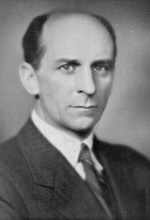
Sir David Rivett was a physical chemist and science administrator. He spent two decades leading Australia's Council of Scientific and Industrial Research (CSIR), first as chief executive officer from 1927 and then as Chairman from 1946 to 1949, shaping the organisation that would become the CSIRO. He was a Foundation Fellow of the Academy and served as vice-president 1954–1955.
Download the memoir
Alan Walsh 1916–1998
Written by Peter Hannaford.
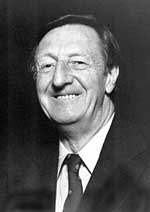
Alan Walsh was the originator and developer of the atomic absorption method of chemical analysis, which revolutionised quantitative analysis in the 1950s and 1960s. Atomic absorption provided a quick, easy, accurate and highly sensitive method of determining the concentrations of more than 65 of the elements, rendering traditional wet-chemical methods obsolete. The method has found important application worldwide in areas as diverse as medicine, agriculture, mineral exploration, metallurgy, food analysis, biochemistry and environmental control, and has been described as 'the most significant advance in chemical analysis' in the 20th century.
Family background and early influences
Alan Walsh was born on 19 December 1916 and brought up in Hoddlesden, a small moorland village in the borough of Darwen, in Lancashire, England, about twenty miles north of Manchester. He was the eldest son of Thomas Haworth Walsh, who managed a small family cotton mill in Hoddlesden, and Betsy Alice Walsh (née Robinson). He had an older sister, Evaline, and two younger brothers, Jack and Tom. In 1947 Alan emigrated to Australia and soon afterwards met an English-born nurse, Audrey Dale Hutchinson, whom he married in 1949. They had two sons, Thomas Haworth and David Alan.
The family cotton mill, Vale Rock Mill, Holden Haworth Ltd, was one of two mills that employed most of the people in Hoddlesden and many from the next town. Alan's father, Thomas, was an astute and remarkable man who managed the mill for 52 years, including the period during the late 1920s and 1930s when the cotton industry was badly hit by the depression. Thomas had the interests of his family at heart but laid down the rules and would not allow disobedience of any kind. Alan's mother, Betsy, was a charming, warm-hearted woman. Alan was very like her in some ways but his astuteness and determination came from his father. The village was quiet: just one pub, a school, a church and a village shop, which Alan's grandfather, Benjamin Walsh, ran and which sold everything from meat, vegetables and groceries to clothing. Benjamin was a friend and helper of the vicar, and had a big say in village affairs. Alan's grandmother, Mary (née Haworth), was a strong-minded woman of the old school who insisted on good manners at all times.
Alan's uncle and godfather, Marsden Walsh, described Alan as a delightful and serious boy. He was something of a loner and happy with his own company, qualities his uncle said would stand him in good stead. Even though he had quite a serious side to him, he had a great sense of fun. He had what was known as a lazy eye and for a period had to wear a patch. He made light of this and fooled about so that his friends thought nothing of it because he made them laugh. He had a great sense of humour, but was never unkind at someone else's expense. Whenever he talked about his early life, he would say he was brainwashed – too much religious teaching – and how narrow their life was. Once when asked what he wanted to do with his life he said 'I want to find things out and how they work'. So, when later he became a scientist his uncle was not surprised.
Education
From the age of ten Alan attended the local grammar school in the nearby town of Darwen, where he passed the Northern Universities Matriculation examination in 1933 and the Higher School Certificate examination in 1935. Of his school days, Alan recalls:
I had no idea where I was headed during secondary school. In fact when I was 16 years old I was advised to do French, English and History and drop Science. At the time I was having trouble with eye strain and because I thought French, English and History would involve a lot of reading, I chose rather to study Mathematics, Chemistry and Physics in which I performed quite well…. [1]
At that stage I was very uncertain about my next step. I remember being attracted by a teacher training course, but my headmaster had other ideas. He finally spoke to my father and they persuaded me to apply for the honours course in physics at the University of Manchester. [2]
In October 1935 Alan entered the honours school of physics at the University of Manchester. In his second and third years he was a resident at St Anselm Hall, where the warden, the Reverend T.H. South, described him as 'a quiet, industrious student, with a sense of humour, and a sense of responsibility, who has been popular and respected in Hall. He has been a successful captain of our Association Football XI this season.' In his final year Alan took the joint course in physics and electrotechnics, an option available for honours students in physics.
Of his time at Manchester, Alan recalls: [3]
It was only after I went to university that I experienced the real joys of learning and research. I had been at university only two weeks when I attended a lecture by Professor (later Sir) Lawrence Bragg, who was head of the University Physics Department. In a lecture to the University Physical Society he told, in extremely simple language, the story of the pioneering work he and his father had done in their development of X-ray methods for determining the structure of crystals. The basic simplicity and beauty of their contribution greatly impressed us freshers: the drama was enhanced by the knowledge that their work had been of such outstanding merit that they were awarded the Nobel Prize.
Even after graduating from Manchester University, I still had no definite plans regarding my future employment. The problem was shelved when, much to my surprise, I was awarded a research scholarship to work on the determination of crystal structures by X-ray methods.
In August 1938 Alan undertook postgraduate research in the Physics Department at the Manchester College of Technology, which later became the University of Manchester Institute of Science and Technology. His supervisor was Dr William H. Taylor, Head of the Physics Department at that time and known for his X-ray work on mineral crystals. During this period Alan's research was influenced by Dr Henry Lipson, who proposed that he study the structure of ß-carotene, an important biological molecule that presented a considerable challenge to X-ray structure analysis at that time. He spent one year at the Manchester College of Technology and then continued the theoretical work on the analysis of ß-carotene for a further period after he had moved to the British Non-Ferrous Metals Research Association. He was awarded the degree of MSc (Tech) in 1944 for a thesis entitled An X-ray examination of ß-carotene. In 1960 he was awarded a DSc from the University of Manchester for his contributions to atomic and molecular spectroscopy.
The war years 1939–45
In September 1939 Alan began duties as Investigator in the Physics Section of the British Non-Ferrous Metals Research Association (the 'BNF') in Euston Street, London, under the direction of the leading British spectrographer, D.M. Smith. Alan recalled:3
In the first place I was to work on the development and application of spectroscopic [emission] methods of metallurgical analysis, about which I virtually knew nothing, but with the intention of also, in due course, working on X-ray studies of metals. With the outbreak of war [on the day he was due to start], these plans were abandoned and for the duration I worked only on spectroscopy.
During World War II Alan was unable to join the Services because of his metallurgical occupation, but he undertook part-time service in the Home Guard, where 'he was put in the mobile cavalry (bicycle section), being of the athletic type. He had represented Manchester at tennis'. [4]
At the BNF Alan was given the task of determining which metals were being used in enemy bombers which had been shot down. The information was passed on to the war economists, who could then make deductions about how the German war effort was progressing. During this time Alan devised a number of methods for the rapid and accurate spectrographic analysis of aluminium, copper and zinc based alloys (1-4). These methods also had an important role in the production control of war materials and were widely used in industry. The usual procedure was to make the sample for analysis one electrode of an electric arc or spark and to examine the light emitted by means of a spectrograph. The presence of any element could be detected by noting the wavelengths of the spectral lines while their intensities were a measure of the concentrations.
During the course of this work Alan became aware that when following a method that worked well in one laboratory, difficulties arose when applying it in others. He then devised and built a prototype of the General Purpose Source Unit (8) from existing components and bits and pieces of government surplus. This unit was a highly versatile but simple electrical source unit, capable of generating a variety of electrical discharges, including arc-like and spark-like discharges, for use in spectrographic emission analysis. The 'Walsh Circuit' permitted a high degree of stability and reproducibility of the electrical characteristics of individual discharges. Alan assisted in developing the commercial form of the Source Unit, which was subsequently manufactured by Hilger and Watts Ltd, London as the BNF Spectrographic Source Unit FS 130. It appeared on the market in 1950 and was still being produced in the 1980s.
In January 1944 Alan was seconded to the post of Deputy Chief Chemist at the Metal and Produce Recovery Depot, Ministry of Aircraft Production, in Eaglescliffe, Durham. There he was in charge of the laboratory and technical operations concerning the preparation and inspection of aluminium ingots obtained by melting aircraft scrap.
In January 1945 Smith left the BNF to join Johnson Matthey, and Alan returned to the BNF as Chief Spectroscopist to take charge of the spectrographic research and to give assistance in other applications of physics to metallurgy. Later in 1945 Alan visited Germany as a member of the British Intelligence Objective Sub-Committee Team on Spectrochemical Analysis. Bill Ramsden, who worked at the BNF from 1950 to 1954 and later became a life-long friend of Alan's, writes: [5]
My own impressions are that Alan Walsh was a rather unique person, characterised by an original mind and an unusual ability to penetrate to the heart of a problem. He was also a 'character', possessed of a dazzling wit and a mischievous sense of humour, and one was very fortunate to be in his company…. As far as the BNF was concerned, I have no doubt that he created 'waves' in that establishment.
During the spring of 1945 the BNF was asked to explore the possibilities of developing a spectrographic technique for determining impurities in uranium metal, and Alan duly devised a method for doing this that was released for publication some years later (14). Around this period the BNF was involved in the 'Tube Alloys Project', which was a cover for the development of the British atom bomb. Former staff from the BNF were recently astonished to read in The Times [6] that a secretary at the BNF, Melita Sirnis (later Melita Norwood), had been recruited by the KGB and had been passing on 'highly sensitive' material to the Soviet Union for forty years under the code name of 'Hola'. Melita Sirnis had been personal secretary to the Director of the BNF, Dr G.L. Bailey, during the period 1939-1948 and would have had free access to the Association's work during that period. However, Bill Ramsden recalls that during his time at the BNF, from 1950-54, there was certainly no level of security or screening and doubts that 'highly sensitive' material would have been sent after 1950. [7] He writes 'Certainly, the thought of my early reports on photoelectric emission spectroscopy as well as the details of the Walsh BNF Source Unit being available to the Kremlin before being circulated to BNF members is slightly hilarious.'
Of his research at the BNF Alan wrote (83):
By the end of the war I think there was a general feeling of satisfaction, and perhaps even a state of euphoria, regarding the development of spectrochemistry. I believe few workers shared my strong conviction, which I frequently expressed, that further progress would require a completely new line of attack. I tried desperately hard to conceive totally different approaches but came to a total impasse…
I was particularly conscious of the fact that accurate analysis [by atomic emission] required standards of very similar composition to the sample for analysis. If one wanted to be cynical about this then one could claim that accurate spectrochemical analysis consisted in confirming that the composition of a sample was what it was supposed to be…
It was with a sigh of relief that I left these problems of spectrochemical analysis in 1946…
The early CSIR/CSIRO years 1946–51
*Appointment to the CSIR Division of Industrial Chemistry, Melbourne, Australia
In 1945 Alan applied for an advertised position of Research Officer for Spectroscopic Investigations in the Chemical Physics Section of the Division of Industrial Chemistry, Council for Scientific and Industrial Research (CSIR), at Fisherman's Bend in Melbourne. The Chief of the Division, Dr I.W. (later Sir Ian) Wark, had proposed the establishment of a new Chemical Physics Section to apply modern physical techniques to the solution of chemical problems. The functions of the Section would include 'spectrographic work of a fundamental nature and general spectro-analysis for the Division'. [8] Dr A.L.G. (Lloyd) Rees, who took up the position of Section Leader of the new Chemical Physics Section in November 1944, convinced Wark to purchase several state-of-the-art spectroscopic instruments, including a large Hilger-Littrow quartz spectrograph, a Hilger-Müller double monochromator, a Beckman DU ultraviolet-visible spectrophotometer, and a Perkin-Elmer Model 12B infrared spectrometer. The Research Officer for Spectroscopic Investigations would be responsible for setting up a laboratory for emission spectrographic analysis and for undertaking research in the newly developing field of infrared spectroscopy.
In July 1945 a report of an interview at the Australian Scientific Liaison Office in London by a junior officer states 'Walsh does not give me the impression of one who could direct research, but I should imagine he would be a careful and painstaking worker'. The position was subsequently offered to a another applicant, who after a considerable period of time could not make up his mind. After Alan had contacted the Liaison Office to enquire about his application, Mr Lewis Lewis, who at that time was the Australian Scientific Liaison Officer in London, wrote to Wark about Walsh 'with whom I was quite well impressed'. In March 1946, in a letter to CSIR Head Office based on a recommendation from Rees, Wark wrote:
Walsh seems to have been in charge of a small team at the BNF and is held in sufficient regard to be sent to Germany… These facts, combined with Lewis' favourable impression, lead us to the conclusion that we have been unduly cautious regarding him. In any case, there is room for a man of his attainments for pure research work, even if we must ultimately seek another leader.
In May 1946 Alan was duly appointed to CSIR, but before leaving England, Wark and Rees arranged for him to spend a period of three to four months in the laboratory of G.B.B.M. (later Sir Gordon) Sutherland in Cambridge, obtaining experience in the new field of infrared molecular spectroscopy. During this period in Cambridge, Alan established life-long associations with two molecular spectroscopists, Donald Ramsay and Norman Sheppard, the latter of whom introduced Alan to the experimental and theoretical aspects of infrared spectroscopy. This work in Sutherland's group led to a paper in Nature on the infrared spectrum and molecular structure of phthiocerane (10). In a letter to Wark, Sutherland wrote 'in my opinion you have got hold of a very good man'.
Alan set sail for Australia via the USA, where he visited a number of companies and laboratories to see the various items of spectroscopic equipment that Rees had ordered for the new spectroscopy laboratory at CSIR. He arrived in Melbourne in April 1947 aboard the 'Dominion Monarch'. Upon arrival in the CSIR Division of Industrial Chemistry at Fisherman's Bend in Melbourne, Alan recounted: [9]
The main building of the laboratories was most impressive, almost posh. Behind was a motley collection of old army huts. But the scientific equipment was first class… The conditions for the 'men at the bench' were utopian. Individual freedom and initiative were not only permitted, they were actively encouraged; a bold failure was more highly regarded than a cautious advance. Red tape and bureaucratic nonsense were totally absent.
The working conditions bore no relationship whatsoever to the popular concept of a government-controlled organisation. The frequent arrival of new staff, many from overseas, and of magnificent new equipment contributed to the general feeling of excitement. It was as lively a place to work in as one could imagine. The high calibre of the leadership at that time is reflected by the subsequent careers of Sir Ian [Wark], his right-hand man Mr Lewis Lewis, and those who were section leaders…
We were a hard working bunch. Most of us worked on Tuesday and Thursday evenings, and there were usually several people in the laboratories on other evenings and at weekends. Even the Minister [in charge of CSIRO] R.G. Casey used to visit the laboratories at weekends. He took an earnest interest in all the research projects…
An amusing facet of life at that time was that many of us were operating instruments and techniques which were unique in Australia. We could therefore claim undisputed leadership within Australia of various areas of chemical research. We rather enjoyed being referred to as a 'pride of prima donnas'.
Whilst life was fun it was also earnest, and there was no escape from Wark's insistence on excellence. As an example, the inimitable R.G. (Dick) Thomas said, 'If you tell Wark in the morning you have discovered how to annihilate gravititational forces, he'll want to know what you're going to do in the afternoon'.
Infrared molecular absorption spectroscopy
Upon commencing at CSIR Alan set about installing the new Perkin-Elmer Model 12B spectrometer, thereby establishing his first interaction with the Perkin-Elmer Corporation. This was the first operating infrared spectrometer in Australia, and there was a steady stream of requests for service and collaborative work from organic chemists both within the Division and outside it. Alan was particularly interested in understanding the mechanics of the technique and studying the structure of small molecules. Together with Arthur Pulford, an MSc student from the University of Sydney, he studied the vibrational spectrum of nitrosyl chloride (NOCl) and calculated its geometry and thermodynamic properties (15).
The Perkin-Elmer Model 12B, like all commercial infrared spectrometers at that time, used a direct current (DC) amplification system. To obtain good spectra with such systems was difficult because small changes in ambient temperature caused pronounced wandering of the baseline. Alan recalled (75):
The best spectra were obtained late at night or in the early hours of the morning. It was therefore a memorable occasion, which substantially improved my quality of life, when our Model 12B was converted to a Model 12C. This incorporated a fast thermocouple, which permitted the use of a modulated light source and a synchronous AC [alternating current] detection system and completely removed the problem of drifting base lines. Recording infrared spectra was transformed from a chore to a pleasure.
Alan soon realised that the resolution of the Perkin-Elmer (prism-based) spectrometer was quite inadequate for resolving the rotational lines of any but the lightest molecules, and even in these cases the full details of the spectrum were not revealed. To improve the resolution he devised a simple and elegant modification of the infrared prism monochromator in which radiation was passed two or more times through the same optical system (17). To do this he placed a pair of right-angle mirrors at the exit slit of the spectrometer to reflect the radiation back through the prism and, to isolate the desired multiple-pass beam from the other beams, he placed a rotating 'chopper' in front of the additional mirrors to modulate only the multiple-pass light and fed the output of the thermocouple detector to an amplifier tuned to the frequency of the chopper. An additional advantage of this modification was that the level of stray light, hitherto a major problem in infrared spectroscopy, was reduced dramatically.
Alan's 'double-pass monochromator' was patented in 1950, with coverage in Australia and eight overseas countries. Perkin-Elmer, the world's major manufacturer of infrared spectrometers, secured an exclusive licence and in 1953 began manufacturing a kit of 'Walsh Mirrors' to allow the conversion of their standard infrared spectrometer to a double-pass monochromator system. This experience with patenting and licensing and the interaction with Perkin-Elmer had significance for future events in that it involved Alan personally with the commercial aspects of scientific investigation.
Atomic emission spectroscopy
Shortly after his arrival at CSIR Alan also initiated a project to investigate the fundamental processes occurring in spectroscopic atomic-emission sources, and in particular to attempt to correlate the emission of radiation from the discharge with the electrical phenomena occurring in circuits containing an arc or a spark gap. He had the instrument workshop construct a source unit to the Walsh BNF design (8), which was capable of producing sparks that were electrically identical. Although such source units were by then well established in laboratories in the UK, the CSIR unit proved rather unreliable and was not sufficiently stable for the research Alan was proposing. John Shelton, who worked with Alan on this project, writes: [10]
It is interesting to speculate whether Walsh would have invented atomic absorption analysis if the source unit had been successful and allowed the planned research on inter-element effects to proceed. The frustration of the planned emission work stimulated him to think more and more about the tremendous number of sample atoms in the ground state, compared with the few, sensitive to minor changes in electrical and other conditions, in excited states.
Atomic absorption spectroscopy 1952–77
Establishment of the principle of the method
In an address to the Silver Anniversary Symposium on Great Moments in Analytical Chemistry at the Pittsburgh Conference in 1974, Alan recounted (68):
My initial interest in atomic absorption spectroscopy was a result of two interacting experiences; one of the spectrochemical analysis of metals over the period 1939-46; the other of molecular spectroscopy over the period from 1946-52. The interaction occurred in early 1952 when I began to wonder why, as in my experience, molecular spectra were usually obtained in absorption and atomic spectra in emission. The result of this musing was quite astonishing: there appeared to be no good reasons for neglecting [atomic] absorption spectra; on the contrary, they appeared to offer many vital advantages over atomic emission spectra as far as spectrochemical analysis was concerned. There was the attraction that absorption is, at least for atomic vapours produced thermally, virtually independent of the temperature of the atomic vapour and of excitation potential. In addition, atomic absorption methods offered the possibility of avoiding excitation interference, which at that time was thought by many to be responsible for some of the inter-element interference experienced in emission spectroscopy when using an electrical discharge as light source.
A number of journalists have written (and it is commonly believed) that Alan conceived the atomic absorption method of chemical analysis in 'a flash of inspiration' in early 1952. [11,13,14] However, a colleague of Alan's at the BNF during the war, Sidney Payne, writes: [15]
I think that he [Alan] envisaged atomic absorption far earlier than indicated by Karen Robinson.14 I clearly remember chatting to him whilst I was using a simple flame [emission] photometer and he commented upon the fact that only a small proportion of the atoms were excited by this technique and that it would be better if some way could be found to measure the much larger quantity of unexcited atoms. My reply was 'Well, why don't you go away and think about it'. History confirms that he did just that.
The following is a reconstruction of the events leading up to Alan's establishment of the principle of the atomic absorption method, based on articles by Alan (68, 82), a colleague John Shelton,10 and Andrew McKay,11 and a recorded interview with Alan: [12]
On a Sunday morning in March 1952 Walsh was working in the vegetable garden of his home in the Melbourne bayside suburb of Brighton when he suddenly had a revealing flash of thought, something that stemmed from his earlier work in related fields. He hurried inside, dirt still on his shoes, and phoned his colleague, John Shelton. 'Look John!' he exulted. 'We've been measuring the wrong bloody thing! We should be measuring absorption, not emission!' John reminded him: 'We've been through that before – you can't work out the concentration of a sample from the absorption because of the emitted light at the same wavelength'. Walsh replied: 'I've thought of that. We'll use a chopper on the source and a tuned amplifier, so the light emitted from the sample won't matter.'
Early next morning Walsh set up a simple experiment, using the element sodium. By morning tea he had a successful result. 'I was very excited and called in my colleague, Dr J.B. Willis, who at that time was working on infrared spectroscopy and later was to make important contributions to the atomic absorption method of chemical analysis. "Look", I shouted, "that's atomic absorption". His reply, which I have never let him forget, was "So what?" This was typical of the general reaction to my early work on atomic absorption'.
It would appear that the 'revealing flash of thought' on the Sunday morning in March 1952 alluded not to Alan's initial conception of the atomic absorption method of chemical analysis but rather to his sudden realisation, after a considerable period of mulling over the subject, that 'atomic absorption spectra appeared to offer many vital advantages over atomic emission spectra' (68) and that 'what we needed to do first was actually to measure absorption'. [16]
In his initial, simple demonstration of the atomic absorption method, Alan used a standard sodium vapour lamp operated from a 50 Hz mains supply and thus had an alternating output, so that it was not necessary to use a 'chopper'. The sodium D lines from this source were isolated, but not resolved from each other, by means of a simple direct-vision spectrometer and their combined intensity was measured by means of a photomultiplier tube, the output from which was recorded on a cathode ray oscillograph. Amplification of the signal was by the AC amplifier in the oscillograph. A simple air-coal gas flame was interposed between the sodium lamp and the entrance slit of the spectrometer. When a water solution containing a few milligrams of sodium chloride was sprayed into the air supply of the flame, the cathode spot on the oscillograph deflected to zero, thus establishing the principle of the atomic absorption method of chemical analysis.
In his chairman's address (71) to the Fifth International Conference on Atomic Spectroscopy in 1975, Alan conjectured why atomic absorption spectra had remained largely unexplored for almost one hundred years since Kirchhoff had first interpreted the Fraunhofer lines in the spectrum of the Sun as atomic absorption lines and used them to identify the elemental constituents of the solar atmosphere, and since Kirchhoff and Bunsen had founded qualititative spectrochemical analysis based on atomic spectra emitted by substances vaporized in a flame. Alan believed that one of the reasons atomic absorption spectra had been neglected for so long was a misunderstanding regarding the implications of Kirchhoff's law, which states that 'for radiation of the same wavelength at the same temperature the ratio of the emissive power to the absorptive power is the same for all bodies'. Alan pointed out that this law was often interpreted as 'good radiators are good absorbers and poor radiators are poor absorbers' (which holds only for radiation of a given wavelength and a given temperature) and that it had generally been assumed that methods based on emission spectra would be equally applicable to the same range of elements as those based on absorption spectra, which were generally much more difficult to measure, especially in a luminous flame. In early 1952 Alan began to realise this may not be the case and as a result of his two interacting experiences he began to wonder why it was that spectroscopists usually measured atomic spectra in emission and molecular spectra in absorption. As a result of considering this problem he concluded that atomic absorption spectra could prove much superior to conventional atomic emission spectra for many spectrochemical analyses.
Development of the atomic absorption method
Although his initial, simple demonstration of the atomic absorption method was performed using a sodium vapour lamp as the light source, Alan envisaged that the source would generally be a 'white-light' continuum source, such as a hydrogen or tungsten lamp, that would be capable of being used for the whole range of metals (68). However, when he attempted to determine copper and zinc using a continuum source and a high-resolution Hilger-Littrow spectrograph, he found the sensitivity to be disappointingly low (68). He realised that the resolution of the spectrograph was insufficient to accurately measure the profile of the extremely narrow absorption lines (about 0.003 nm) and that, even if a spectrograph or monochromator with much higher resolution became available, the energy transmitted over the small spectral bandpass would be much too low to provide adequate signal-to-noise ratios. Alan recounted (75):
I decided to abandon all attempts to produce a high-resolution dispersion system and [instead] to obtain high effective resolution by replacing the continuum light source by atomic spectral lamps which emitted lines which were considerably narrower than the absorption lines they measured. If the emission line is sufficiently narrow, the peak absorbance can be measured, and this can be correlated with atomic concentration. This concept of using a sharp-line source was the vital step in the development of atomic absorption spectrophotometers. It not only obviated the need for a high-resolution monochromator, it also gave atomic absorption methods one of their most attractive features. This is the ease and certainty with which one can isolate the required line, a characteristic that results from the fact that the line to be selected is usually one of the strongest emitted by the lamp, and it is only necessary to isolate this from other lines emitted by the lamp. This contrasts with emission methods, in which it is necessary to isolate the required line from all other lines emitted by the sample, many of which [from other elements] may be much more intense and at neighbouring wavelengths.
A CSIRO colleague, Alec Moodie, recalls that during the (North American) summer of 1952, when he was at Pennsylvania State University, he received an airletter from Alan with a sketch of his proposed atomic absorption scheme and a comment at the end, 'The sharp-line source doesn't yet exist!'
Apparently while reading Tolansky's book High Resolution Spectroscopy, [17] Alan learned that a hollow-cathode discharge can provide a source of very sharp spectral lines and quickly realised 'that could be a very robust and rugged source'. He also considered electrodeless discharge lamps of the type he and a colleague, Norman Ham, subsequently developed for Raman spectroscopy (32), but soon realised that hollow-cathode lamps offered a much wider coverage of elements. In January 1953 Alan, together with John Shelton and the glass instrument makers, George Jones and Frank Williams, set out to construct hollow-cathode lamps which used a closed gas-circulating system, of the type described by Tolansky, in which the rare gas was pumped continuously through traps to remove molecular impurities liberated by the discharge from the cathode and from the walls of the tube. This system involved a rack of elaborate gas handling and pumping gear and was not very convenient. During a visit to the USA in mid-1953, Alan reported back to John Shelton on the work of Dieke and Crosswhite, [18] who were using compact sealed-off hollow-cathode lamps in which the gaseous impurities were removed by a 'getter' of activated uranium. Alan and John Shelton then abandoned the gas circulating system and during August-September 1953 began the development of sealed-off hollow-cathode lamps for all the elements that could be determined by atomic absorption, using zirconium getters as suggested by Alan's section leader, Lloyd Rees. This was a daunting, exhaustive task, which took several years to accomplish. The first satisfactory sealed-off hollow-cathode lamps were constructed and tested during the period December 1953 to January 1954.
At this stage Alan had arrived at a satisfactory method for making the atomic absorption measurements, which was to become the generally accepted method, and at an experimental arrangement that had all the essential components of a modern commercial atomic absorption spectrophotometer: a sealed-off hollow-cathode lamp as source, a flame atomizer as absorber, and a 'chopper' and synchronously tuned amplifier. A critical factor in Alan's successful development of the atomic absorption method was his appreciation of the necessity for a modulated light source and a synchronously tuned amplifier system to discriminate between the emission of the source and that of the luminous flame absorber.
A provisional patent application was lodged on 17 November 1953. As soon as the final patent specification was filed, on 21 October 1954, [19] Alan submitted his landmark paper 'The application of atomic absorption spectra to chemical analysis' to Spectrochimica Acta (29). This was published in early 1955, virtually at the same time ** as a paper by C.T.J. Alkemade and J.M.W. Milatz, [20] who had arrived independently at the concept of analytical atomic absorption spectroscopy. The latter authors did not pursue their work further, possibly because they regarded the method merely as one for determining 'all metals that are usually to be determined in flame photometry'.
Alan's original paper on atomic absorption (29) is quite remarkable. In addition to proposing the atomic absorption method and discussing the various factors governing the relationship between atomic absorption and atomic concentration, he also proposed the details of the atomic absorption instrumentation that are essentially those in use today and he proposed or suggested several applications and developments of the atomic absorption method that were to keep teams of scientists, both at CSIRO and in other laboratories, occupied for the next twenty to thirty years. These included applications of atomic absorption to absolute chemical analysis, that is, analysis without the requirement of calibrating standards of known composition; applications to the determination of relative oscillator strengths of atomic resonance lines; applications to isotopic analysis; and the use of a furnace for vaporizing samples in atomic absorption spectroscopy.
Early exploitation of the atomic absorption method
During May to July 1953 Alan visited laboratories in England and the USA and discussed the possible commercial exploitation of atomic absorption with a number of instrument manufacturers. The only person to show any enthusiasm was Dr Alexander Menzies, a physicist and Director of Research for the leading British instrument manufacturer, Hilger and Watts Ltd, with whom Alan had previously had dealings through the manufacture of the BNF Spectrographic Source Unit. CSIRO arrived at a tentative exclusive licence agreement with Hilger and Watts, based on the provisional patent application.
The first public demonstration of a working atomic absorption instrument was in March 1954 at an exhibition of scientific instruments held by the Victorian Division of the (then British) Institute of Physics at the University of Melbourne. The exhibited instrument had all the essential components of a modern commercial atomic absorption instrument, including a sealed-off (copper) hollow-cathode lamp as source, a flame atomizer as absorber, and a 'chopper' and synchronously tuned amplifier to discriminate between the emission of the source and that of the luminous flame. There was also provision for a sodium vapour lamp and viewers were invited to 'dip their (salty) finger' into a beaker of water and this would register a deflection on the strip chart recorder. A photograph of the 'first atomic absorption spectrophotometer' is shown in Figure 2. Alan wrote (68):
The apparent complexity of the instrument was due largely to its being of the double-beam type, which in our early experiments, we regarded as essential because of the poor stability of many of our hollow-cathode lamps. The viewer was possibly further confused by the optical path being in opposite directions on the instrument and on the explanatory diagram. Whatever the reason, the instrument aroused no interest whatsoever during the three days it was on exhibition.
However, when Dr Menzies visited Melbourne shortly afterward to assess its performance, he was sufficiently impressed for his firm to decide to produce, under licence to CSIRO, the first commercial atomic absorption spectrophotometer.
In July 1954 CSIRO entered into an exclusive licence agreement with Hilger and Watts on terms which provided for a 5% royalty on each instrument sold. The exception to this exclusivity was for the case of a potential Australian manufacturer or if Hilger and Watts failed to produce satisfactory instrumentation, in which case the licence would be withdrawn.
In July 1954 Alan's colleague, John Shelton, left on a three-year secondment to the Australian Scientific Liaison Office in London, where it was agreed he would spend one-third of his time spreading the word about atomic absorption, visiting laboratories in England, and keeping in touch with the production of the atomic absorption equipment by Hilger and Watts. Barbara Russell was employed on a fixed-term appointment to replace John, who had expected to see a steady stream of papers from Alan and Barbara, showing the effectiveness of the atomic absorption method in hitherto difficult analyses. However, this did not happen. John writes:10 'Dr Wark had commented to Walsh that as the principle of the method had been established and was to be published, he should leave the "hack work" to others and get back to research'. Although Alan certainly did not regard the practical analytical work as 'hack work', he returned to his fundamental research on the assessment of the possibilities of absolute chemical analysis by atomic absorption and on the testing of the peak atomic absorption method, by comparing measurements on aqueous solutions with the known oscillator strengths of elements over a wide range of oscillator strength values and excitation wavelengths.
In early 1956 Alan sent John Shelton a draft of a paper that included the latest results to test the peak atomic absorption method. Dr Menzies, from Hilger and Watts, arranged for John to lecture on this work at a meeting of the Spectroscopy Group of the Institute of Physics in London in March 1956. The results aroused some interest and led to requests for the lecture to be repeated at the Chemical Inspectorate and Atomic Energy Laboratories at Woolwich and at the research laboratories of the British Aluminium Company. In a letter to Alan in March 1956, John reported: [21]
Apparently some people got the idea from your paper in Spectrochimica Acta that the method was a scientific curiosity rather than a practical analytical method. Several people have mentioned to me that they had not thought seriously about using atomic absorption until they had heard the lecture, so I feel pleased that some tangible result has come from the lecture.
John later wrote10 that he liked to think that this letter might have had some influence on the change in direction of the atomic absorption project that was soon to take place at CSIRO.
The Hilger and Watts experience
During the period Hilger and Watts held an exclusive license (1953-57), their interaction with Alan and CSIRO was sparse and progress was slowed by technical difficulties, including the development of satisfactory hollow-cathode lamps. A Hilger and Watts progress report for July 1956 stated that enquiries from potential users had 'not so far revealed any demand for a comprehensive instrument capable of dealing with many elements'. [22] It had therefore been decided to manufacture the atomic absorption equipment as an attachment to the existing Hilger and Watts Uvispek spectrophotometer. [23] However, there was no provision in the attachment for modulating the light from the source, probably because this would have necessitated major alterations to the Uvispek itself, which had a DC amplifier/detection system, whereas Alan's work had shown that a modulated light source and synchronously tuned amplifier were essential for discriminating between the emission of the source and that of the luminous flame absorber.
In early 1956 John Shelton learned that Dr Menzies was planning to present a paper on the Hilger and Watts unmodulated DC atomic absorption system to the Fifteenth Congress of the International Union of Pure and Applied Chemistry in Lisbon later that year. This triggered an immediate reaction from Lloyd Rees and Alan. John was sent to the Lisbon conference with the intention of making it clear that the Hilger and Watts system was not a genuine atomic absorption instrument and that the full benefits of atomic absorption necessitated a modulated source and synchronously tuned amplifier/detector. The CSIRO paper included some results of the first tests of the peak atomic absorption method by comparing measurements on aqueous solutions with the known oscillator strengths of elements over a wide range of oscillator strength values and excitation wavelengths and also some results on limits of detection. However, the paper did not contain any real analytical results, and John Shelton recalls that it 'deservedly went down like a lead balloon'. In a letter to Alan in September 1956, reporting on the Congress, John wrote: [24]
Menzies followed immediately afterwards and is now really plugging atomic absorption. His results on brass have given him a really improved outlook…. He took a Uvispek with atomic absorption attachment to Lisbon (some of it by air which no doubt hurt his Scots soul) and gave demonstrations. As a toy it goes quite well, and it's to be hoped that more people will get into doing the actual analytical tests – i.e. on real problems – that, it seems to me, are needed most now. Hack work it may be, but until somebody does some appreciable amount of first class analytical work with the method then the analyst will be shy of it. And they won't be convinced with synthetic samples. They'll want actual samples and a statistical analysis of results.
The Lisbon paper appeared in the congress proceedings (30) and a full version was published in 1957 (31). Neither paper attracted any interest. Alan told how 'the most interest shown at that stage in the technique had been by school children at a working display of the instrument at a Chemex exhibition in Melbourne in May 1956'. [25]
In mid-1957 Alan was planning an extended visit to Europe and he arranged to visit Hilger and Watts in London with the specific intention of pointing out the deficiencies in their atomic absorption equipment and having them rectified. Alec Moodie recalls that Alan decided to concentrate on just two objectives: to convince Hilger and Watts that they should incorporate a modulated light source with synchronous detection and that they should use a stainless steel, rather than a brass, burner for the flame to avoid obtaining spurious zinc atomic absorption signals. When Alan visited Hilger and Watts, he discovered that the company was experiencing economic difficulties and that two of its leading optical designers, F. Twyman and A. Green, had both left the company. The meeting, comprising a board of executives, went on well into the evening, and Alan still had made no progress, later confessing he had 'failed on both objectives'. After the meeting, when leaving the building, it was dark and raining quite heavily, and the executives drove off, leaving Alan standing in the rain, despondent and looking for the nearest public transport. After a while a limousine pulled up, with Alan dripping with water and expecting to be offered a lift to a station. One of the executives in the back of the limousine wound down the window, called 'Hey Walsh, do you realise there is a tube station down the road?', wound up the window, and drove off. At a gathering soon after, Alan was apparently asked whether it was true that the Hilger and Watts atomic absorption instrument was useless. 'No', he said, 'It is not useless, it would make a great pie warmer'.
In June 1957, Lewis Lewis, who was now at CSIRO Head Office in Melbourne, visited Hilger and Watts at the request of the (then) Deputy Chairman of CSIRO, Sir Frederick White, to put it to them that their efforts so far had not done justice to the potential of the technology. Hilger and Watts agreed to their exclusive licence being revoked and replaced with a non-exclusive licence, provided no other licences were granted on more favourable terms.
Although Hilger and Watts recognised the limitations of the Uvispek attachment, they were obliged to accept that it would take several years to bring out an improved version. Under the circumstances it was decided to continue with the manufacture of the simple attachment until such time as they could offer a sophisticated integrated instrument. In February 1958, Hilger and Watts sold their first atomic absorption instrument, the Model H 909, and from 1961 sales continued at about 30 to 60 instruments a year for several years. [22]
The Techtron experience
In 1958, Eric Allan of the Ruakura Soil Research Station at Hamilton, New Zealand, who had assembled his own atomic absorption equipment following discussions with Alan, published the first analytical atomic absorption results, on the determination of trace amounts of magnesium in various agricultural materials. [26] Shortly afterwards, John David, of the CSIRO Division of Plant Industry in Canberra, using improvized equipment made with Alan's assistance, reported the determination of zinc and other elements in plant-digest solutions. [27] This was followed by analytical applications in clinical chemistry, by John Willis of the CSIRO Division of Chemical Physics, [28] and in the mineral processing industry, by Max Amos and co-workers from Conzinc Rio Tinto Australia. [29] These initial analytical results on the applications of atomic absorption stimulated a steady flow of requests to Alan, mostly from industry, for help in getting atomic absorption into wider use in Australia.
By 1958 there was still no sign of any instrument manufacturer prepared to produce the type of instrument Alan considered necessary. He then decided to embark on 'Operation Backyard' – the construction of equipment in Australia to apply the atomic absorption method – and gave instructions on how to put together a 'do-it-yourself' kit. [30] Fred Box of CSIRO designed and built the electronics, which included a broadband AC amplifier (commonly called the 'Working Man's Amplifier' or 'WMA') and a power supply to run the hollow-cathode lamps (34). George Jones and later John Sullivan developed and provided the expertise and 'hands-on' skills for producing the hollow-cathode lamps (36), while John Willis worked on the analytical methods for specific analyses. A simple commercially available monochromator, such as a small Zeiss quartz-prism monochromator, was recommended for isolating the atomic resonance lines.
Alan then had to find businesses that were prepared to co-operate in manufacturing components that were not available commercially. He recalled: [31]
The electronic part of our equipment was perfectly conventional electronics, nothing fancy, so we put out a tender for manufacturing six of our amplifiers and power packs, and a little firm called Techtron put in the lowest bid, so they got the business. They had a staff of five. Then I toured the backyards of Melbourne to find a little machine shop [Stuart R. Skinner] with a staff of eight. Then we tried various glass-blowing people for the lamps, and we found a little firm [Ransley Glass Instruments, later to become Atomic Spectral Lamps] that was willing to try. This was a pure glass-blowing firm, who knew nothing about vacuum technique or electrical discharge in gases, and they had no technical people on their staff at all.
By mid-1962, it was estimated that in excess of thirty of these 'do-it-yourself' kits had been supplied to Australian laboratories and about ten to other parts of the world, including New Zealand and South Africa. Alan recalled:25 'It was certainly enough for Karl Zeiss in Germany to wonder why so many of their monochromators were being sold in Australia'.
In July 1962 Alan and Lloyd Rees arranged a symposium on atomic absorption spectroscopy through the Victorian State Committee of CSIRO, of which John Shelton was secretary. Alan and colleagues John Willis, John Sullivan and John McNeill, and several users of atomic absorption equipment, made presentations. The meeting was attended by about eighty users, potential users and CSIRO staff, including the Chairman of CSIRO, Sir Frederick White, and Lewis Lewis. At the end of the symposium, Geoffrey Frew, Chairman of Techtron Appliances Pty Ltd, declared his intention to manufacture a 'complete' atomic absorption spectrophotometer. Alan recalled how all the main players were present at the same place at the same time and the whole deal was virtually signed and sealed that evening. This announcement by Frew was 'tantamount to announcing the impending birth of an Australian spectroscopic instrument industry' (82).
In early 1964, Techtron produced the first all-Australian atomic absorption instrument, the Model AA-3, which incorporated a 'Sirospec' grating monochromator designed by John McNeill [32] at CSIRO, diffraction gratings ruled on a ruling engine designed and constructed by Dai Davies and Geoffrey Stiff at CSIRO, and a 'WMA' AC amplifier unit. The AA-3 was exhibited publicly for the first time at the Pittsburgh Conference on Analytical Chemistry in March 1964. A detailed account of the Techtron atomic absorption story has recently been written by Max Amos. [33]
At this stage Alan and his colleagues at CSIRO had established atomic absorption as a widely used analytical method in Australia, with a small flow-over into New Zealand and South Africa. Alan wrote (68):
While knowledge of the technique spread rapidly throughout Australian industry, there was one memorable exception. I recall the technical director of one of our biggest mining companies phoning CSIRO Head Office in the early 1960s and stating that he had just returned from South Africa where they were using a brand new instrument called the atomic absorption spectrophotometer. He wanted to know whether there was anyone in CSIRO who knew anything about it. Our man in Head Office said he didn't know but he would make enquiries.
In 1965 Max Amos from Sulphide Corporation and John Willis from CSIRO published a joint paper on the use of the high-temperature nitrous oxide-acetylene flame, [34] which extended the applicability of the atomic absorption method to more than sixty-five elements, including previously recalcitrant refractory elements such as aluminium, vanadium, zirconium and beryllium. From that stage onwards there was a dramatic increase in interest in the atomic absorption method and it rapidly gained wide acceptance. Alan recalled:30
The real winner in Australia, of course, was the mining boom and its timing was a real fluke. At the very time when we suddenly wanted tens of millions of analyses there was a technique waiting to do it. It's incredible that it happened like that. I don't think you could name a single mining company that didn't come here [to our laboratory].
In August 1965, Techtron Appliances Pty Ltd merged with Atomic Spectral Lamps Pty Ltd to form Techtron Pty Ltd, which manufactured the Model AA-4 with a synchronously tuned amplifier and a nitrous oxide-acelylene burner. This was followed by a period of rapid growth, with staff increasing to around 200 in 1966. Geoffrey Frew was obliged to move premises and decided to build a new factory. He tells25 how Alan accompanied him to the Oakleigh branch of the Commonwealth Trading Bank 'to give weight to our plans to build a modern factory for the manufacture of scientific instruments for export'. Frew was granted the loan and in March 1967 the company moved into the new factory, in Mulgrave on the outskirts of Melbourne. In October 1967, Techtron Pty Ltd was approached by Varian Associates, a successful instrument manufacturing company in Palo Alto, California, with an offer of acquisition, first a 50.5% holding and progressing to 100% over five years.33 The merger, to form Varian Techtron Pty Ltd, brought 'great strengths to the company in the way of manufacturing techniques, financial support, and perhaps most importantly, a world-wide distribution network for its products'. [35] This was followed by further rapid growth, with sales increasing at an average of 30% a year for the next six years and staff growing to 630 by 1972. The company continues today as Varian Australia Pty Ltd, and is the second largest manufacturer of atomic absorption equipment, exporting more than two-thirds of its output.
In 1970, Geoffrey Frew donated a substantial sum to the Australian Academy of Science 'in recognition of the successful commercial development of atomic absorption spectrochemical analysis, which had been originated by Dr A. Walsh of the CSIRO Division of Chemical Physics in 1954'. The Geoffrey Frew Fellowships enable distinguished scientists from abroad to travel to Australia to participate in the Australian Spectroscopy Conferences and to visit scientific centres around the country. Recipients have included Nobel Laureates A.L. Schawlow, G. Porter, G. Herzberg, C. Cohen-Tannoudji and J. Polanyi.
The Perkin-Elmer experience
From 1958 Alan made regular visits to the USA, conducting lecture tours and reporting recent atomic absorption results from Australia and New Zealand. The analytical spectroscopists and major American instrument manufacturers remained sceptical of the value of the method. After papers he had presented at the Louisiana State University Symposium on Analytical Chemistry in January 1958, Alan reported that one spectroscopist, Jim Robinson from Esso Research, Baton Rouge, was enthusiastic about the potential of the atomic absorption method. In mid-1958 Robinson obtained approval to start some atomic absorption work, using equipment based on a Perkin-Elmer Model 13 infrared-ultraviolet spectrometer. [36] During his 1958 visit, Alan also visited the Perkin-Elmer Corporation, with whom he had previously had dealings in regard to the double-pass monochromator. A Perkin-Elmer representative indicated to him that the company would be 'seriously interested in becoming a licensed manufacturer of atomic absorption equipment if it could be shown capable of determining calcium in blood serum' (82). Alan's colleague, Alec Moodie, recalls how Alan's laboratory 'soon became littered with hospital samples that were laden with pathogens and which had to be treated rather cautiously'.
Alan realised he needed the support of an experienced chemist and asked a colleague, John Willis, who had been working on infrared spectroscopy, if he could look into the calcium problem. The determination of calcium in blood serum turned out to be one of the most difficult first problems John could have tackled. After a while he decided to tackle magnesium in blood instead, which turned out to be relatively straight-forward at a time when the available (wet) methods were so difficult and laborious that such a determination was scarcely attempted. Shortly afterwards, John was able to extend the atomic absorption method to the rapid determination of sodium, potassium and calcium in body fluids. [37]
In March 1959 John Willis submitted an interim report of his work on calcium and magnesium in blood serum to Perkin-Elmer. Meanwhile, Perkin-Elmer had assembled a flame photometer-like atomic absorption instrument and had started some atomic absorption work of their own. [38] In November 1959 the company was granted a licence from CSIRO to manufacture atomic absorption equipment. In 1960, after extensive internal discussions, Perkin-Elmer established a group, headed by Walter Slavin, to develop an atomic absorption instrument. In 1961 the company began shipments of an improvized atomic absorption instrument, the Model 214, using components that had been developed earlier for the Model 13 infrared-ultraviolet spectrometer.
In May 1961 Walter Slavin and a colleague, Herbert Kahn, submitted a detailed report [39] to Perkin-Elmer management that included the design of a completely new atomic absorption instrument, the Model 303. The report met with 'massive management resistance', especially in the marketing department.38 In early 1962 it was clear that management would block, or at least continue to delay, the start of the Model 303. So Walter Slavin phoned Alan, who agreed to go to Perkin-Elmer in Norwalk, Connecticut to meet with senior management. Alan recounted:3
After I had described the widespread use of atomic absorption methods in Australia the chairman of the meeting, Chester Nimitz Jr *** (a former submarine commander and son of Chester Nimitz, who commanded the US Pacific Fleet in World War 2) asked rather tersely: 'If this goddamn technique is as good as you say it is, why isn't it being used right here in United States of America?' My reply, which my friends at Perkin-Elmer love to recall, was 'You'll have to face up to it, Chester, the United States is just an underdeveloped country'.
Alan tells how each Christmas thereafter he and his wife Audrey received a card from Chester Nimitz, which invariably included the message: 'Glad to report we are developing nicely!'
In March 1962 Perkin-Elmer began building the Model 303. It was released on the market in April 1963, about the same time as the Techtron AA-2, which used an imported monochromator. By 1965 the Model 303 had already overtaken infrared spectroscopy as Perkin-Elmer's largest product line and had captured the bulk of the atomic absorption market. This prompted Alan to remark (71):
Indeed, whereas previously it [atomic absorption] had been regarded by some reactionaries as the greatest confidence trick since a Sydney taxi-driver sold the Harbour Bridge to an American millionaire, it was now being hailed as the greatest invention since the bed! I presume the truth lies somewhere between these two extremes.
In 1966 Alan's Chief, Lloyd Rees, felt that as result of Perkin-Elmer's highly successful atomic absorption operations the company ought to consider making a serious investment in the Australian scientific instrument business. Walter Slavin and Alan arranged for Lloyd Rees to meet the head of the Perkin-Elmer instrument business in Norwalk. Walter Slavin tells how Alan and he waited outside the office for the whole afternoon for the deal to be negotiated and were then advised that it was felt that it would be monopolistic for Perkin-Elmer to buy Techtron. The decision was that Perkin-Elmer would provide commercial support to Australian science by setting up a factory to manufacture a helium quadrupole mass-spectrometer leak detector developed by Don Swingler at the CSIRO Division of Chemical Physics. Alan and Walter had been seeking support for the commercialization of some of the atomic absorption research originating in Alan's laboratory, such as the resonance detector (46), but this had been rejected because it would have meant Perkin-Elmer going into competition with Techtron 'on their own turf'.
In 1967 Perkin-Elmer purchased land immediately adjacent to the site of the new Techtron factory in Mulgrave, Melbourne, to build a factory to manufacture the helium leak detector. Geoffrey Frew, the Chairman of Techtron, recalled:25 'Although we knew they had no licence to manufacture atomic absorption instruments in Australia, I was very annoyed by the speculations that followed the announcement of their land purchase and setting up business next door'. At the opening of the Perkin-Elmer factory in October 1967, Perkin-Elmer's founder and President, Richard Perkin, was 'very optimistic and predicted that his company would expand steadily in Australia and, as well as making the helium leak detector, would tender for government contracts'.25
Coincidentally, in October 1967 Techtron was approached with the offer of acquisition by Varian Associates. After just six weeks of operation Perkin-Elmer surprisingly closed its plant in Melbourne and in May 1968 the building was purchased by Varian Techtron Pty Ltd as part of a massive expansion of its operations.
Further atomic absorption and related work
During the 1960s and 1970s Alan's research was directed toward the development of novel instruments and techniques to simplify and improve atomic absorption equipment. He was especially keen to develop instruments of the simplest possible design for use in industrial environments where the samples were actually being taken.
In particular, Alan felt it should be possible to replace the monochromator, which was rather fragile, bulky and expensive, with a simpler and more rugged 'non-dispersive' device. In 1965 he and John Sullivan developed the resonance detector (46, 49, 52, 56), which consisted of a vapour cell of the appropriate element to selectively absorb the resonance lines from the source and a photomultiplier to detect the atomic fluorescence emitted by the vapour cell. Alan was known to remark 'Even a chemist can't put it out of alignment'. Such resonance detectors were subsequently tested in an industrial environment for the determination of calcium and magnesium in brown coal by the State Electricity Commission of Victoria and for the determination of nickel and zinc in ore samples. [40] Later, Alan and a colleague, Peter Larkins, developed the separated (nitrogen-sheathed) flame as a versatile resonance detector for the isolation of atomic resonance lines (70, 72).
The resonance detector was followed by the development of the ingenious technique of 'selective modulation' for isolating atomic resonance lines (48, 56, 59). Radiation from a sharp-line source is passed through a pulsating vapour of absorbing atoms and the resonance lines are detected using a synchronous amplifier tuned to the frequency of modulation of the atomic vapour. Alan predicted that the selective modulation technique should also lead to appreciable sharpening of the profile of the atomic resonance line, giving rise to 'sub-Doppler' linewidths. This was subsequently demonstrated experimentally, [41] culminating in Alan proudly claiming a bottle of red wine as a result of a long-standing wager with me.
Alan realised that light intensities higher than those available from standard hollow-cathode lamps would be required in applications involving resonance detectors or atomic fluorescence detection. In 1965 he and John Sullivan developed the 'high-intensity' hollow-cathode lamp (45), which employs two discharges, a hollow-cathode discharge to generate an atomic vapour by cathodic sputtering and a high electron-current discharge, isolated from the first, to excite the atoms. The 'Sullivan-Walsh' high-intensity lamp allows the intensity of the resonance lines to be increased up to a hundred-fold without any increase in atom density and hence linewidth. It also has the advantage that most of the light output is usually concentrated in the strongest resonance line. Such lamps are manufactured by Varian Australia Pty Ltd and by the Perkin-Elmer Corporation. A modified version, based on that developed in Alan's laboratory by Martin Lowe, [42] is manufactured by Photron Pty Ltd in Melbourne.
Alan's original paper (29) also envisaged the possibility of using atomic absorption as a simple method of isotopic analysis. By employing a sharp-line source containing only one isotope of an element, analyses can be performed for that isotope if the 'isotope shift' of the resonance line is larger than or comparable with the width of the line. Successful isotopic analyses have since been realised for elements having relatively large isotope shifts, such as lithium, boron (which was investigated in Alan's laboratory by Hannaford and Lowe [43]), lead, mercury and uranium.
In his landmark paper (29) Alan proposed that the atomic absorption method should offer the possibility of absolute chemical analysis, that is, analysis without the need for standard samples of known composition. His next two papers (30, 31) went some of the way towards demonstrating absolute analysis, but Alan realised the inadequacy of the flame absorber, in which the atomization was usually far from complete. Professor Boris L'vov in Leningrad accepted the challenge and later established graphite-furnace atomic absorption spectroscopy, involving the complete vaporization of samples. L'vov, in collaboration with Walter Slavin and colleagues at Perkin-Elmer, has now successfully realised absolute atomic absorption analysis for a wide range of elements. [44] In addition, use of the graphite furnace as an atomizer has increased the sensitivity of atomic absorption analysis by one to two orders of magnitude.
From the time of his original atomic absorption paper (29), Alan was conscious of the limitations of flame methods of atomization, sometimes referring to the flame as 'a hotbed of chemical reactions'. The limitations include incomplete atomization of most elements from their compounds, causing low sensitivity and possible chemical interferences; the necessity of an oxidant, rendering the vacuum ultraviolet (and hence elements like carbon, sulphur and phosphorus) inaccessible; and the need for prior dissolution of the sample. In addition, the presence of various molecular species can introduce background absorption signals, and the need for an explosive gas such as acetylene is undesirable in certain locations such as hospitals.
In a paper published in 1959, Alan and Barbara Russell reported (33) that a hollow-cathode discharge can provide a simple and convenient means of generating an atomic vapour of essentially any solid element. Energetic rare-gas ions formed in the hollow-cathode discharge bombard the surface of the cathode and eject atoms to produce an atomic vapour. Thus this process of cathodic sputtering provides a method in which metals and alloys can be atomized directly without prior dissolution. Furthermore, the method should, in principle, not be subject to any of the above limitations of the flame. In June 1967 Alan employed me to look further into the cathodic sputtering method of atomization. In 1973, together with David Gough, we reported the first results, on the determination of a range of elements in solid samples of iron-base alloys (63, 64). Alan wrote (68):
I would not expect the scientific instrument manufacturers to be greatly interested in the simple sputtering cell… I would, however, like to think that some of them are musing on possible ways of embellishment to ensure that any commercial version will have an impressive price tag.
Indeed, it took more than another decade before an atomic absorption sputtering system was manufactured, by Analyte Corporation, USA, in 1988.
In his final Keynote Address, [45] to the Pittsburgh Conference in 1990, Alan stated that his own work on atomic absorption 'originated in a laboratory devoted primarily to basic, curiosity-oriented research and finished in applied research of tremendous economic value'. He went on to say that one of his colleagues had 'taken the return journey'. I had worked with Alan on attempts to develop methods of atomization based on cathodic sputtering that were largely unsuccessful for routine analysis. However, my colleagues and I then showed that the atomic vapours produced by cathodic sputtering can provide a surprisingly good environment for conducting a variety of fundamental laser spectroscopic experiments. These included time-resolved fluorescence measurements of atomic lifetimes and their application to the determination of solar elemental abundances from the Fraunhofer absorption lines; coherence spectroscopy including quantum beats in excited or ground atomic states; and high-resolution Doppler-free laser saturation spectroscopy. Thus cathodic sputtering has permitted high-resolution and time-resolved laser spectroscopic techniques to be readily extended to a very wide range of atomic systems (81). Alan seemed particularly excited by this work, not only because of its potential as a universal method for determining atomic lifetimes, and hence absolute oscillator strengths, for atomic absorption spectroscopy, but also because the Fraunhofer absorption lines are 'just atomic absorption'. Alan concluded his Pittsburgh address with 'my experiences over forty years with CSIRO have convinced me that the doors between fundamental and applied research should remain open'.
Significance and benefits of atomic absorption
Atomic absorption has provided a quick, easy, accurate and highly sensitive means of determining the concentrations of over sixty-five of the elements. The method has found important application world-wide in areas as diverse as medicine, agriculture, mineral exploration, metallurgy, food analysis, biochemistry and environmental monitoring. It has been described as 'the most significant advance in chemical analysis' in the twentieth century. [46]
By the time the original patents of atomic absorption had expired around 1969, twenty licences had been issued, and there were also several manufacturers in countries such as Japan in which patents had not been sought. During 1963-67 sales of atomic absorption instruments experienced exponential-like growth. By 1969 there were more than 10,000 atomic absorption spectrophotometers in use in hospitals, factories and laboratories around the world, and by 1977 this number had grown to around 40,000. Alan tells how a slight decrease in the rate of world sales around 1968 came as a relief to his colleague, John Willis, who 'feared that if sales continued to increase at the same rate as 1963-68, then by the turn of the century the whole surface of the Earth would be covered by atomic absorption spectrophotometers'. [47] This did not come about!
The current world market for atomic absorption instruments is around $A300 million a year. Varian Australia Pty Ltd in Melbourne, with a staff of around 400 and a similar number outside the company engaged in contract work, has the second largest share of the market, after the Perkin-Elmer Corporation, while GBC Scientific Equipment Pty Ltd in Melbourne, with a staff of around 180, is the third largest. In addition, Photron Pty Ltd in Melbourne manufactures hollow-cathode lamps and high-intensity hollow-cathode lamps for atomic absorption. The commercialization of the atomic absorption spectrophotometer essentially led to the birth of the scientific instrument industry in Australia.
In 1968, A.W. Brown, a scientist with postgraduate qualifications in business administration, was recruited by John Shelton at CSIRO Head Office to conduct a detailed cost-benefit analysis of the atomic absorption project. This study [48] conservatively assessed the value of the net benefits to the Australian economy at around $22 million (in 1968 Australian dollars), compared with $1.3 million originally spent on the research. (Later estimates gave the accumulated benefit to Australia by the year 1977 as in excess of $200 million, including overseas royalties, the setting up of new industry, and the productivity increases in a wide range of enterprises.) Much to the surprise of many, Brown found that the major benefits to the economy were not through the manufacture of atomic absorption equipment in Australia but rather through benefits to the user, that is, benefits associated with productivity gains, especially the ability to perform large numbers of assays very rapidly and with a high order of accuracy. This component far outweighed the benefits of manufacture. Royalty income was miniscule by comparison.
Mr Barry Jones, a former Minister for Science in the Australian Government, recently remarked: [50] 'I don't know there is a single significant laboratory anywhere in the world that doesn't have an atomic absorption spectrophotometer. The tragedy is, of course, as with so many other of our ideas with something that really began here, licensing rights were sold off to other countries and the result is that only a small proportion of the actual machines were manufactured in Australia after a while.' This is a popularly held view among journalists, politicians and academics. During the period 1954 to 1962, Australia did not have the scientific instrument manufacturing capability to handle the massive expansion that resulted first from the Australian mineral boom of the 1960s and later from the 'environmental boom' and the enormous demand from around the world. There was no company in Australia geared up to cope with such a demand. Moreover, the cost-benefit analysis of Brown showed that the major benefits to Australia's economy lay not in royalties or in manufacture of the instrument but through benefits to the user.
Alan regarded the benefits of atomic absorption to humanity – for example, through its use in hospitals throughout the world – as having 'given him more satisfaction than all the dollars it has earned'. One of his favourite stories [11], [49] concerned a five-year-old boy, who in 1968 had suffered extensive burns while playing with a can of petrol and was undergoing treatment at the Children's Medical Research Foundation in Sydney. For weeks doctors fought to save his life, and finally violent convulsions started for no apparent reason and death appeared imminent. Tests with an atomic absorption spectrophotometer established that the boy had suffered a severe loss of magnesium as a result of the burns. Doctors replaced the lost magnesium, the convulsions ceased, and the boy eventually recovered. A photograph of the boy had a prominent place in Alan's office for the remainder of his time at CSIRO.
When asked about the appropriateness of the development of atomic absorption in Australia, Alan replied: [16]
Well, of course it was fortunate. We say it was good planning! I think it's a good example of how uncommitted research can finally be more significant than directly applied work. If somebody had said in 1950 that there was going to be a mineral boom in ten years' time which would need new methods of analysis, I'm sure we would have tried to elaborate existing methods, rather than follow a completely new line.
In his final scientific paper (83), written in 1991, Alan concluded:
There are two important lessons to be learned from this account of the development of atomic absorption methods and the difficulties encountered in convincing analysts and scientific instrument manufacturers of their potential.
First, it should be noted that this work originated in a laboratory where scientists were encouraged to study a subject at a basic level and were not expected to have a specific goal for every set of investigations. I think this is a tremendously important point. Increasingly we find young scientists being channelled into increasingly narrow areas of activities aimed only at targets with good prospects of success. They are being given less and less room to manoeuvre. Their work is being largely confined to answering questions, ignoring the many lessons that have shown that much successful research has its origin in asking the right question.
The second lesson is that it is a mistake for the scientist or the inventor to try to sell an invention by scientific and technical arguments rather than by a demonstration of how well it can fulfill the functions it claims to fulfill. The licensee is not interested in how clever the invention is; he or she merely wants to know what benefits the invention affords the designer, manufacturer, and user of the equipment in which it is incorporated.
Retirement 1977–98
Retirement from CSIRO
In November 1976 Alan gave notice of his intention to retire from CSIRO on 5 January 1977, just after his sixtieth birthday and after thirty years of service and fifteen years as Assistant Chief of the Division of Chemical Physics. He had for many years said 'I will have run out of new ideas by the age of sixty and I should make way for a younger person'.
Two weeks after giving notice, Alan received a telex:
I have pleasure in informing you that Her Majesty The Queen has been graciously pleased to approve the recommendation that you be awarded a Royal Medal in recognition of your distinguished contributions to emission and infrared spectroscopy and your origination of the atomic absorption method of quantitative analysis.
Alan had the distinction of being only the fourth Australian scientist to have been awarded a Royal Medal, after Ferdinand von Mueller in 1888 and Nobel Laureates Sir Macfarlane Burnet and Sir John Eccles. In the Silver Jubilee Queen's Birthday Honours List in June 1977, Alan was created a Knight Bachelor for 'his distinguished service to science'. Alan's many other honours included election to Fellowship of the Royal Society of London in 1969 and Foreign Member of the Royal Swedish Academy of Sciences in 1969, being only the second Australian scientist (after Burnet) on whom the latter honour had been bestowed.
On the occasion of Alan's retirement, his Chief of Division, Dr Lloyd Rees, paid the following tribute:51
Alan Walsh did not only invent an analytical instrument called the atomic absorption spectrophotometer – he created a field of scientific work in atomic absorption spectroscopy and initiated and cultivated its application to elemental chemical analysis in areas as disparate as agriculture and chemical industry, and medicine and the mining and metallurgical industries. His contribution to science, industry and human welfare has been enormous. In spite of his great distinction Alan Walsh is a human being – he enjoys life and has never found it necessary to develop eccentricities or affectations.
Alan seemed overwhelmed by all the fuss being made of his retirement, and at a CSIRO dinner in his honour remarked 'I've been to so many farewell dinners recently that I'm beginning to acquire a taste for wine'.
Alan was intending to become a private consultant to industry and sadly had to vacate his office and laboratory at the CSIRO Division of Chemical Physics. He had also accepted an honorary fellowship at Monash University, adjacent to CSIRO, which had awarded him an honorary doctorate in 1970. But first he was going to take a long holiday 'to recharge my batteries and to have some time to renovate the house, do some gardening, swim a little, and improve my golf swing'. After a weekend's golf Alan was known to comment 'golf defies all theory' and 'it is a relief to get back to research where the problems were more amenable to rational analysis'.
Six years later, in June 1982, Alan was elated to learn that he had been invited back to CSIRO as a Senior Research Fellow. In December 1994 the Spectroscopy Wing at the CSIRO Division of Chemical Physics was named the 'Alan Walsh Spectroscopy Laboratory'.
The Perkin-Elmer consultancy
After his visit in 1962, Alan began to visit Perkin-Elmer in Norwalk on a regular basis and participated in some major commercial decisions. These included the decisions for Perkin-Elmer to construct their own hollow-cathode lamps, to manufacture a Zeeman attachment to their atomic absorption equipment to correct for background absorption, and to manufacture the inductively coupled plasma source. [38]
About a year after his retirement from CSIRO, Alan became a formal consultant to Perkin-Elmer. During 1978-1982 he and his wife, Audrey, spent several Australian winters beside the Bodensee near Überlingen, Germany, where Alan made frequent visits to the Perkin-Elmer plant, the 'Bodensee-werk'. At that time the chief research interest there was the hydride generation technique for atomic absorption, and Alan suggested that it might be very interesting to combine the hydride work with a 'solar-blind' photomultiplier to provide a simple non-dispersive atomic fluorescence spectrometer for the determination of arsenic and selenium. Alan and Walter Slavin convinced the Bodenseewerk engineers to build a prototype and it worked nicely (79). However, Perkin-Elmer marketing decided the market was too small. Some years later the Chinese built a highly successful hydride instrument for a large market. [38]
In the early 1980s Alan initiated a project to investigate coherent forward scattering as a possible method of spectrochemical analysis (80). Coherent forward scattering had been pioneered in Oxford as a spectroscopic technique in the mid-1960s by George Series, [52] of whom Alan had long been an admirer. The technique relies on the fact that the light emitted from atoms in the forward direction is phase-coherent and so the intensity is proportional to the square of the number of atoms, thus offering the possibility of higher sensitivity than atomic absorption. The method has the additional advantage that any background radiation scattered from 'particles' in the atomic vapour is not detected. With Alan's help, Perkin-Elmer conducted an extensive development programme on coherent forward scattering and built a system derived from their Zeeman background correction instrument. The project was abandoned when it could not be proved to be commercially attractive.
The scientist and the man
It is instructive to consider some of the characteristics that may have contributed to Alan's success as a scientist and to his successful development and commercialization of the atomic absorption method of chemical analysis.
First and foremost, his work was characterized by a remarkable simplicity and elegance, a hallmark of many great scientists. Alan himself wrote (83):
My general attitude to research was greatly influenced by the fact that I studied physics at Manchester University. The Physics Department had an illustrious record of major achievements, including Rutherford's development of the nuclear theory of the atom, Bohr's first theory of the origin of atomic spectra, Moseley's law of X-ray spectra, and [Lawrence] Bragg's work on the determination of crystal structures by X-ray crystallography. A feature of all these advances was [that] whilst they were profound they were all very simple. I think by the time I had finished my course at Manchester I took it for granted that the very essence of a significant contribution to physics was a fundamental simplicity.
Sometimes Alan's ideas and schemes were so deceptively simple that they were not always appreciated at first, but as the years went by, they frequently had a habit of becoming important.
Alan was blessed with an extraordinarily creative and fertile mind, forever generating new ideas. One of his colleagues, Peter Larkins, tells [53] how on one occasion a colleague was attempting to improve the performance of a sputtering system as an atomizer for atomic absorption. Alan made a suggestion which it was estimated would improve the absorption sensitivity by a factor of about two. He came back a while later with another suggestion to give another factor of two. By lunchtime it was estimated he had been back fifteen times! He also displayed great zest and enthusiasm in whatever he tackled, and this seemed to infect those around him. He was a great inspiration to work with. John Willis tells [54] how in the early days he had been working on the Littrow spectrograph with a modification which Alan and he had hoped would vastly improve its performance. Alan came into the laboratory and asked John how he was getting on. John replied with an air of disappointment that he couldn't do much better than a factor of two. 'Don't despise a factor two, John', he said. 'Three factors of two make a factor of ten!'
Alan had a rare combination of vivid imagination and experimental practicality. He was a wonderfully intuitive scientist, with an enormous grasp of the numerical, carrying numbers and orders of magnitude in his head. He was known to say [55] 'Kelvin could take no pleasure in an equation unless he could feel its weight'. He could make things work so well that some people felt he could 'work magic'. He never pretended to have any unreal powers; he always had his feet firmly on the ground. On one occasion his Chief, Lloyd Rees, wanted to construct a reflecting infrared microscope, which was to be used by John Willis to study the infrared spectra of small protein samples. It was clear to Alan that the numerical aperture of the infrared spectrometer was ill-matched to the microscope. The instrument workshop launched into building the microscope, and the carpenters made a magnificent timber box lined with felt. No detectable signal came through. Alan was heard to say [54] 'Lloyd seems to hold me personally responsible for the laws of optics being what they are'.
Alan grew up in a small family business where he acquired an acute business sense. He once remarked: [51] 'My family was steeped in the traditions of the Lancashire textile industry. I was brought up in the real world – where one went out to make a quid'. Unlike many scientists of his generation, he enjoyed mixing with the captains of industry and spoke their language. It was fascinating to observe him in action at a meeting or in some business negotiation. He would rarely take the lead, preferring to listen politely and assimilate what others had to say. At the end of the meeting he would invariably be asked his opinion, and then would eloquently deliver a definitive statement, which would often end the discussion. He had little time for 'virtuoso performances'. He also had the tenacity and perseverance to see a long and difficult project or business negotiation through to completion. A colleague once said of him:13 'If he had a problem he would gnaw away at the damn thing until it surrendered'.
Many people expected a distinguished scientist like Alan to be a stereotype academic, totally devoted and consumed in his research and with little time for the ‘ordinary' things in life. His Chief, Lloyd Rees, once wrote: [56]
Throughout his life he [Alan] has been interested in sport, football, cricket, squash and latterly golf. His other sport was drinking red wine. At one stage of his career he indulged in all-year-round early morning swimming in Port Phillip Bay, which, during the winter months, can be sustained by the hardiest individuals only. He has, however, recovered from this aberration and now spends much of his spare time cultivating camellias.
Alan was an avid follower of cricket, especially English cricket, and a great admirer of the inimitable English cricket commentator John Arlott. Alec Moodie recalls how on one occasion Alan proudly showed him a newspaper clipping about his younger brother, Tom, who had opened the batting for the village cricket team in Hoddlesden and on this occasion 'carried his bat' through the innings but failed to 'open his account'. Alan described his brother as 'always cautious, typical of a Lancashire batsman'.
Alan had a remarkable ability to mix with people from all walks of life. His colleague, John Willis, states: 'I have never met anyone who was so immediately at home with people, whether it was politicians, businessmen, distinguished scientists, the younger members of the Division, the tradesmen, or the canteen ladies'. I myself can hardly recall an instance when Alan tried to put another person down or any scientific paper or lecture where he criticized the work of others. It was as though life were too short not to spend it being constructive at all times. He was a wonderful mentor and role model for any young scientist to emulate, forever striving for excellence and providing encouragement and words of wisdom.
Finally, Alan had a wonderful English North Country humour, which was legendary world-wide. During discussions or during gloomier moments in the laboratory he could defuse a situation by coming out with a characteristic 'one-liner' followed by loud, raucous laughter that echoed the length of the passage. Some of his sayings and traditions still live on in the Alan Walsh Spectroscopy Laboratory.
Alan Trumble, a close friend and neighbour of Audrey and Alan, commented, in a eulogy to Alan:57
Alan loved life and people, always showing a very genuine interest in others' activities and concerns for their problems. He was a devoted family man and extremely proud of his boys, Tom and David, absolutely delighted with his daughters-in-law, a doting grandfather to Chevaun, Miriam, Emily and Jack. You could not be close to the Walsh family without appreciating the wonderful affection of a husband for a wife.
Epilogue
In Alan's final years his memory sadly began to fade but he still retained his mischievous sense of humour and good nature to the end. In this memoir we have attempted to capture some of that humour for posterity.
Alan died in Melbourne on 3 August 1998, aged 81, survived by his widow, Audrey, and sons, Tom and David, and their families.
Honours and distinctions
Medals and awards
- 1966: Britannica Australia Award
- 1969: Talanta Gold Medal
- 1969: Royal Society of Victoria Research Medal
- 1972: Maurice Hasler Award in Spectroscopy, US Society of Applied Spectroscopy
- 1975: Kronland Medal, Czechoslavak Spectroscopic Society
- 1975: James Cook Medal, Royal Society of New South Wales
- 1976: Torbern Bergman Medal, Swedish Chemical Society
- 1976: Royal Medal, Royal Society of London
- 1977: Knight Bachelor
- 1978: John Scott Award, City of Philadelphia, USA
- 1980: Matthew Flinders Lecture and Medal, Australian Academy of Science
- 1982: Robert Boyle Medal, Royal Society of Chemistry (Inaugural Award);
- 1982: K.L. Sutherland Memorial Medal, Australian Academy of Technological Sciences (Inaugural Award)
- 1991: Colloquium Spectroscopicum Internationale Award for Major Scientific Contributions to Analytical Spectroscopy (Inaugural Award)
Academic affiliations
- 1958: Fellow, Australian Academy of Science
- 1969: Foreign Member, Royal Swedish Academy of Sciences
- 1969: Fellow, Royal Society of London
- 1969: Honorary Member, Society of Analytical Chemistry, Great Britain
- 1972: Honorary Fellow, Chemical Society, Great Britain
- 1975: Honorary Fellow, Royal Society of New Zealand
- 1979: Honorary Fellow, Australian Institute of Physics
- 1980: Honorary Fellow, Royal Society of Chemistry, Great Britain
- 1981: Honorary Member, Japan Society for Analytical Chemistry
- 1982: Fellow, Australian Academy of Technological Sciences
Honorary degrees
- 1970: Doctor of Science, Monash University, Australia
- 1986: Doctor of Science, University of Manchester, UK
Special journal issues, Spectrochimica Acta
- 1980: Commemoration of 25th anniversary of Alan Walsh's landmark paper on atomic absorption [58]
- 1999: Alan Walsh Memorial Issue [59]
About this memoir
This memoir was originally published in Historical Records of Australian Science, vol. 13(2), 2000. It was also published in Biographical Memoirs of Fellows of the Royal Society of London, 2000. It was written by Peter Hannaford, Alan Walsh Spectroscopy Laboratory, CSIRO Manufacturing Science and Technology, Clayton, Victoria 3169.
Acknowledgements
I express my deep gratitude to Sir Alan Walsh for his inspiration, encouragement and friendship over a period extending more than thirty years. I am especially indebted to Lady Walsh for providing background material and numerous anecdotes about Alan; to Alan's cousin, Mrs Kathleen Hoyle, for generously providing the material on Alan's early life in Hoddlesden; to Professor Alec Moodie for providing many of the stories and anecdotes concerning Alan's life at CSIRO; to Mr John Shelton for providing background material on Alan's development of the atomic absorption method; to Mr Walter Slavin for providing material about Alan's association with Perkin-Elmer; and to Dr John Willis for providing numerous sources of information, including the background on Alan's work in molecular spectroscopy, and for preparing the bibliography.
I am especially grateful to Professor Sandy Mathieson, John Shelton, Walter Slavin and John Willis for constructive comments on the manuscript. I also gratefully acknowledge contributions from Mr Max Amos, Mr Peter Beale, Mr David Gough, Dr Norman Ham, Mr Bill Ramsden, Professor Norman Sheppard, Mr John Sullivan, Mr Rodney Teakle and Dr Harold Whitfield. Finally, I wish to thank my colleagues from the Alan Walsh Spectroscopy Laboratory at CSIRO and my wife Kay for permitting me three months of pleasure to indulge in writing this biographical memoir.
The photograph of Alan Walsh was taken in June 1979 by the CSIRO Division of Chemical Physics.
References
- 'Alan Walsh. The making of a scientific breakthrough', Double Helix News (CSIRO), 11 (1988), 10.
- A. Walsh, 'Why did you become a scientist?', written in 1993 for The Quantum Book of How and Why, later published as Why? Scientists Answer Children's Questions (Australian Broadcasting Corporation, 1998) eds P. Long and J. Phemister. Walsh's article never appeared in the final version of the book (A. Walsh, personal papers). Walsh's personal papers, of which I was able to make extensive use, will be deposited in the Basser Library, Australian Academy of Science, Canberra.
- L. Parker, 'Scientist viewpoint', Science Teachers Journal, 34(3) (1988), 81-86.
- P.T. Beale, letter to J.B. Willis, 28 November 1998 (A. Walsh, personal papers).
- W. Ramsden, letter to J.B. Willis, 24 November 1998 (A. Walsh, personal papers).
- 'Don't judge spook by her cover', The Times; reprinted in The Australian, 13 September 1999.
- W. Ramsden, personal communication, January 2000.
- J.B. Willis, 'Spectroscopic research in the CSIRO Division of Chemical Physics 1944-1986', Hist. Rec. Aust. Sci., 8 (1991), 151-182.
- I.W. Wark, 'The CSIRO Division of Industrial Chemistry 1940-1952', Rec. Aust. Acad. Sci., 4 (1979), 7-41.
- J.P. Shelton, 'Atomic absorption spectroscopy – a personal recollection, 1947-1958', Spectrochim. Acta B, 54 (1999), 1961-1966.
- A. McKay, 'The absorbing atom', in Surprise and Enterprise: Fifty Years of Science for Australia (CSIRO, 1976), pp. 6-7. Based on an earlier article by J.R. Price, Australia Now, 1 (1971), 12-13.
- 'Alan Walsh and the atomic absorption spectrophotometer', CSIRO Scifile, 34 (1988), 4.
- B. Beale, 'Eureka! they cry', Sydney Morning Herald, 5 April 1986.
- K. Robinson, 'Sir Alan Walsh 1916-98', Chemistry in Britain, 35(1) (1999), 59; Coresearch, No. 376 (1998), p. 4.
- S.J. Payne, 'Remembering Alan Walsh', Chemistry in Britain, 35(3) (1999), 23.
- H.A. Willis, 'Sir Alan Walsh, the inventor of atomic absorption spectrometry', ESN Interviews, European Spectroscopy News, 24 (1979), 18-23.
- S. Tolansky, High Resolution Spectroscopy, Methuen, London, 1947.
- G. Dieke and H.M. Crosswhite, 'Purification of rare gases using activated uranium', J. Opt. Soc. Am., 42 (1952), 433.
- Apparatus for spectrochemical analysis, Australian Patent Application 23,041/53 (Nov. 17, 1953); Australian Patent Specification 163,586 (Oct. 21, 1954).
- C.T.J. Alkemade and J.M.W. Milatz, 'A double-beam method of spectral selection with flames', Appl. Phys. Res., B4 (1955), 289-299; 'Double-beam method of spectral selection with flames', J. Opt. Soc. Am., 45 (1955), 583-584.
- J.P. Shelton, letter to A. Walsh, 5 March 1956 (A. Walsh, personal papers).
- A.C. Nicholas, 'A case study of an innovation: the development of atomic absorption spectroscopy', January 1965 (A. Walsh, personal papers).
- A.C. Menzies, 'A study of atomic absorption spectroscopy', Anal. Chem., 32 (1960), 898-904.
- J.P. Shelton, letter to A. Walsh, 21 September 1956 (A. Walsh, personal papers).
- M.L. Carseldine, The development of atomic absorption spectroscopy and subsequent instrument manufacturing industry that has arisen in Australia. MSc thesis, Griffith University, Brisbane (1984).
- J.E. Allan, 'Atomic absorption spectrophoto-metry with particular reference to the determination of magnesium', Analyst, 83 (1958), 466-471.
- D.J. David, 'The determination of zinc and other elements in plants by atomic absorption spectroscopy', Analyst, 83 (1958), 655-661.
- J.B. Willis, 'Determination of magnesium in blood serum by atomic absorption spectroscopy', Nature, 184 (1959), 186-187.
- B.S. Rawling, M.D. Amos and M.C. Greaves, 'The determination of silver in lead concentrates by atomic absorption spectroscopy', Nature, 188 (1960), 137-138.
- P. Kelly, 'A good idea is so hard to sell', The Australian, 31 May 1976.
- S. Encel, 'Science, discoveries and innovation: an Australian case history', Int. Soc. Sci. J., 22 (1970), 42-53.
- J.J. McNeill, 'Diffraction grating ruling in Australia', Rec. Aust. Acad. Sci., 2 (1972), 18-39.
- M.D. Amos, 'The development of the atomic absorption spectrometer manufacture in Australia’, Spectrochim. Acta B, 54 (1999), 2023-2030.
- M.D. Amos and J.B. Willis, 'The use of high-temperature pre-mixed flames in atomic absorption spectroscopy', Spectrochim. Acta, 22 (1966), 1325-1343; errata ibid, p. 2228.
- M. Spiller, 'Varian-Techtron Pty Ltd: company and product history', Doc: 1241P, Edition No. 1, May 1985.
- J.W. Robinson, 'A tribute to Sir Alan Walsh – development of atomic absorption in the United States – "a personal view''', Spectrochim. Acta B, 54 (1999), 1993-1998.
- J.B. Willis, 'The early days of atomic absorption spectrometry in clinical chemistry', Spectrochim. Acta B, 54 (1999), 1971-1975.
- W. Slavin, personal communication, January 2000.
- W. Slavin and H. Kahn, Perkin-Elmer Engineering Report 594, May (1961).
- R.M. Lowe and J.V. Sullivan, 'Developments in light sources and detectors for atomic absorption spectroscopy', Spectrochim. Acta B, 54 (1999), 2031-2039.
- D.S. Gough and P. Hannaford, 'Sharpening of atomic resonance lines by selective modulation', Spectrochim. Acta B, 35 (1980), 677-85.
- R.M. Lowe, 'A high-intensity hollow-cathode lamp for atomic fluorescence', Spectrochim. Acta B, 26 (1970), 201-205.
- P. Hannaford and R.M. Lowe, 'Determination of boron isotope ratios by atomic absorption spectroscopy', Anal. Chem., 49 (1977), 1852-1857.
- B.V. L'vov, 'Recent advances in absolute analysis by graphite furnace atomic absorption spectroscopy', Spectrochim. Acta B, 45 (1990), 633-655.
- A. Walsh, 'The development of atomic absorption methods of elemental analysis', Keynote Lecture, Pittsburgh Conference on Analytical Chemistry, 1990 (A. Walsh, personal papers).
- I.W. Wark, Why Research? A Research Scientist Writes of his Work, Educational Employers Ltd, Reading, UK, 1968.
- J.B. Willis, 'Analysis of biological materials by atomic spectroscopic techniques – a review of progress in the last decade', Revue de GAMS, 1971, No. 3, pp 83-91.
- A.W. Brown, 'The economic benefits to Australia from atomic absorption spectroscopy', Econ. Record, (1969), 158-180.
- 'Answer to the puzzle of a burnt boy', Sydney Morning Herald, 14 September 1968.
- B.O. Jones, P. Hannaford and G. Nossal, Interview with Robyn Williams and Martin Hewetson, The Science Show, Australian Broadcasting Corporation, 5 September 1998.
- 'Dr Alan Walsh to become industry consultant', Coresearch, No. 212 (1977), p. 1; A.L.G. Rees, telex to M. Dack, 31 December 1976 (A. Walsh, personal papers).
- A. Corney, B.P. Kibble and G.W. Series, 'The forward scattering of resonance radiation with special reference to double resonance and level-crossing experiments', Proc. Roy. Soc. London, A 293 (1966), 70-93.
- P.L. Larkins, 'Sir Alan Walsh – the scientist and the man', Analyst, 117 (1992), 231-233.
- J.B. Willis, personal communication, March 2000.
- A.F. Moodie, personal communication, December 1999.
- A.L.G. Rees, communication to CSIRO Head Office, 22 August 1972 (A. Walsh, personal papers).
- A. Trumble, Eulogy, Thanksgiving Service for Alan Walsh, 7 August 1998.
- 'Atomic absorption spectroscopy: past, present and future – to commemorate the 25th anniversary of Alan Walsh's landmark paper in Spectrochimica Acta', Spectrochim. Acta B, 35 (1980), 637-993.
- Alan Walsh Memorial Issue, Spectrochim. Acta B, 54 (1999), 2031-2039.
Bibliography
Contributions to books
- A. Walsh, The spectrographic analysis of aluminium alloys by the direct comparison method, in Collected Papers on Metallurgical Analysis by the Spectrograph, ed. D.M. Smith, Brit. Non-Ferrous Metals Research Assoc., London, 1945, pp. 65-81.
- A. Walsh, D.M. Smith, The spectrographic analysis of zinc base alloys, ibid., pp. 116-129.
- D.M. Smith, A. Walsh, Note on the spectro-graphic determination of aluminium in aluminium brass (76/22/2), ibid., pp. 130-134.
- A. Walsh, Light sources for spectrochemical analysis, in Metal Spectroscopy, ed. F. Twyman, Griffin, London, 1950, pp. 170-228.
- N.S. Ham, A. Walsh, Raman bands in liquids, in Encyclopaedic Dictionary of Physics, Vol. 6, Pergamon, Oxford, 1962, p. 177.
- A. Walsh, J.B. Willis, Atomic absorption spectrometry, in Standard Methods of Chemical Analysis, Vol. 3, Part A. Instrumental Methods, ed. F.J. Welcher, Van Nostrand, Princeton, NJ, 1966, pp. 105-117.
Journal articles
- D.M. Smith, A. Walsh, The electrical screening of sparking apparatus for use in spectrographic analysis, J. Sci. Inst., 20 (1943), 63-64.
- A. Walsh, A general-purpose source unit for the spectrographic analysis of metals and alloys, Bull. Brit. Non-Ferrous Metals Research Assoc., No. 201 (1946), 60-80; Metal Industry, 68 (1946), 243, 263, 293.
- A. Walsh, The suppression of radio interference from spark generators used in spectrographic analysis, Brit. Non-Ferrous Metals Research Assoc., Paper No. S35/125 (1946).
- S. Stallberg-Stenhagen, E. Stenhagen, N. Sheppard, G.B.B.M. Sutherland, A. Walsh, Infra-red spectrum and molecular structure of phthiocerane, Nature, 160 (1947), 580-582.
- A. Walsh, The spectroscopic determination of thermodynamic data, J. Proc. Aust. Chem. Inst., 16 (1949), 371-386.
- A. Walsh, J.B. Willis, Infra-red absorption spectra at low temperatures, J. Chem. Phys., 17 (1949), 838.
- A. Walsh, J.B. Willis, Infra-red absorption spectra at low temperatures, J. Chem. Phys., 18 (1950), 552-556.
- A. Walsh, Spectrographic analysis of uranium, Spectrochim. Acta, 4 (1950), 47-56.
- A.G. Pulford, A. Walsh, The infra-red spectrum and thermodynamic constants of nitrosyl chloride, Trans. Faraday Soc., 47 (1951), 347-353.
- J.C. Earl, R.J.W. Le Fèvre, A.G. Pulford, A. Walsh, The infra-red spectra of three sydnones, J. Chem. Soc., 481 (1951), 2207-2208.
- A. Walsh, Design of multiple monochromators, Nature, 167 (1951), 810-811.
- N.S. Ham, A.L.G. Rees, A. Walsh, Infra-red studies of solvent effects, Nature, 169 (1952), 110-111.
- N.S. Ham, A.L.G. Rees, A. Walsh, The infra-red spectra of solutions of iodine in mesitylene, J. Chem. Phys., 20 (1952), 1336-1337.
- N.S. Ham, A. Walsh, J.B. Willis, A quadruple monochromator, Nature, 169 (1952), 977.
- A. Walsh, Multiple monochromators. I. Design of multiple monochromators, J. Opt. Soc. Am., 42 (1952), 94-95.
- A. Walsh, Multiple Monochromators. II. Applications of a double monochromator to infra-red spectroscopy, J. Opt. Soc. Am., 42 (1952), 96-100.
- N.S. Ham, A. Walsh, J.B. Willis, Multiple monochromators. III. A quadruple monochromator and its application to infra-red spectroscopy, J. Opt. Soc. Am., 42 (1952), 496-500.
- A. Walsh, Multiple monochromators, Nature, 169 (1952), 976.
- A. Walsh, Echelette zone plates for use in far infra-red spectroscopy, J. Opt. Soc. Am., 42 (1952), 213.
- A. Walsh, Reduction of scattered light in a Littrow-type monochromator, J. Opt. Soc. Am., 43 (1953), 58.
- A. Walsh, Design of double-beam multiple monochromators, J. Opt. Soc. Am., 43 (1953), 215.
- A. Walsh, J.B. Willis, Multiple monochromators. IV. A triple monochromator and its application to near infra-red, visible and ultra-violet spectroscopy, J. Opt. Soc. Am., 43 (1953), 989-992.
- A. Walsh, The application of atomic absorption spectra to chemical analysis, Spectrochim. Acta, 7 (1955), 108-117; erratum, ibid., p. 252.
- J.P. Shelton, A. Walsh, The application of atomic absorption spectra to chemical analysis, Proc. XV Congr. Pure Appl. Chem. (Lisbon 1956), IV-50 (1958), 403-409.
- B.J. Russell, J.P. Shelton, A. Walsh, An atomic absorption spectrophotometer and its application to the analysis of solutions, Spectrochim. Acta, 8 (1957), 317-328.
- N.S. Ham, A. Walsh, Microwave-powered Raman sources, Spectrochim. Acta, 12 (1958), 88-93.
- B.J. Russell, A. Walsh, Resonance radiation from a hollow cathode, Spectrochim. Acta, 15 (1959), 883-885.
- G.F. Box, A. Walsh, A simple atomic absorption spectrophotometer, Spectrochim. Acta, 16 (1960), 255-258.
- B.M.Gatehouse, A. Walsh, Analysis of metal samples by atomic absorption spectroscopy, Spectrochim. Acta, 16 (1960), 602-604.
- W.G. Jones, A. Walsh, Hollow-cathode discharges: the construction and characteristics of sealed-off tubes for use as spectroscopic light sources, Spectrochim. Acta, 16 (1960), 249-254.
- A. Walsh, The application of atomic absorption spectra to chemical analysis, Adv. Spectrosc., 2 (1961), 1-22.
- N.S. Ham, A. Walsh, Potassium and rubidium Raman lamps, J. Chem. Phys., 36 (1962), 1096-1097.
- A. Walsh, Atomic absorption spectroscopy, Proc. Int. Conf. Spectrosc., 10 (1962), 127-142.
- A. Walsh, Atomic absorption spectroscopy, Rep. Conf. Hydrocarbon Res. Group Inst. Petrol., London (1962), pp. 13-28 (Inst. Petrol., London, 1962).
- C.K. Coogan, J.D. Morrison, A. Walsh, J.K. Wilmshurst, Fourth Australian Spectroscopy Conference, Aust. J. Sci., 26 (1963), 141-145.
- C.K. Coogan, J.D. Morrison, A. Walsh, J.K. Wilmshurst, Spectroscopy in Australia, Nature, 200 (1963), 319-322.
- A. Walsh, Atomic absorption spectroscopy in Australia, Feigl Anniversary Symposium on Analytical Chemistry, Birmingham, 1962 (Elsevier, Amsterdam, 1963) pp. 281-287.
- A. Walsh, Fourth Australian Spectroscopy Conference, Canberra, 1963, Appl. Optics, 3 (1964), 322.
- J.V. Sullivan, A. Walsh, High intensity hollow-cathode lamps, Spectrochim. Acta, 21 (1965), 721-726.
- J.V. Sullivan, A. Walsh, Resonance radiation from atomic vapours, Spectrochim. Acta, 21 (1965), 727-730.
- A. Walsh, Some recent advances in atomic absorption spectroscopy, Proc. 12th Int. Conf. Spectrosc., (1965), pp. 43-65.
- J.A. Bowman, J.V. Sullivan, A. Walsh, Isolation of atomic resonance lines by selective modulation, Spectrochim. Acta, 22 (1966), 205-210.
- J.V. Sullivan, A. Walsh, The application of resonance lamps as monochromators in atomic absorption spectroscopy, Spectrochim. Acta, 22 (1966), 1843-1852.
- A. Walsh, Some recent advances in atomic absorption spectroscopy, Jl. N. Z. Inst. Chem., 30 (1966), 7-21.
- A. Walsh, Some recent advances in atomic absorption spectroscopy, Zh. Prikl. Spektrosk., 4 (1966), 471-480. (In Russian – translation of preceding reference.)
- J.V. Sullivan, A. Walsh, Resonance monochromators for absorption measure-ments in the visible and ultraviolet, Spectrochim. Acta B, 23 (1967), 131-132.
- A. Walsh, Atomic absorption spectroscopy (Einstein Memorial Lecture, 1967), Aust. Physicist, 4 (1967), 185-189.
- A. Walsh, Atomic absorption spectroscopy: a foreword, Appl. Opt., 7 (1968), 1259-1260.
- A. Walsh, Simultaneous multi-element analysis by atomic absorption spectroscopy, XIII Colloquium Spectroscopicum Internationale, Ottawa, 1967, pp. 257-268 (1968).
- J.V. Sullivan, A. Walsh, The isolation and detection of atomic resonance lines, Appl. Opt., 7 (1968), 1271-1280.
- P.L. Larkins, R.M. Lowe, J.V. Sullivan, A. Walsh, The use of solar-blind photomultipliers in flame spectroscopy, Spectrochim. Acta B, 24 (1969), 187-190.
- A. Walsh, Physical aspects of atomic absorption, ASTM Spec. Tech. Pub., No. 443 (1969) 3-18.
- P.A. Bennett, J.V. Sullivan, A. Walsh, A simple protein meter, Anal. Biochem., 36 (1970), 123-126.
- A. Walsh, The application of new techniques to simultaneous multi-element analysis, Pure Appl. Chem., 23 (1970), 1-10.
- A. Walsh, Preface to B.V. L'vov, Atomic Absorption Spectrochemical Analysis, (Adam Hilger, London, 1970).
- A. Walsh, Eighth Australian Spectroscopy Conference, Monash University, 16-20 August 1971, Appl. Opt., 11 (1972), 708.
- D.S. Gough, P. Hannaford, A. Walsh, The application of cathodic sputtering to the production of atomic vapours in atomic fluorescence spectroscopy, Spectrochim. Acta B, 28 (1973), 197-210.
- A. Walsh, Atomic absorption methods for the direct analysis of metals and alloys, (Hasler Award Address, 1972), Appl. Spectrosc., 27 (1973), 335-341.
- A. Walsh, Invention and innovation, Search, 4 (1973), 69-74.
- A. Walsh, Non-dispersive systems in atomic spectroscopy, Pure Appl. Chem., 34 (1973), 145-161.
- A. Walsh, Obituary to Mr J.E. Allan, Search, 4 (1973), 126.
- A. Walsh, Atomic absorption spectroscopy – stagnant or pregnant?, Anal. Chem., 46 (1974), 689A-708A.
- A. Walsh, Ninth Australian Spectroscopy Conference, Australian National University, 13-17 August 1973, Appl. Optics, 13 (1974), 703.
- A. Walsh, The separated flame as a resonance detector, Analyst, 100 (1975), 764.
- A. Walsh, Spectrochemistry since Kirchhoff and Bunsen. Proc. Roy. Aust. Chem. Inst., 42 (1975), 297-303.
- P.L. Larkins, A. Walsh, Flame-type resonance spectrometers – a new direction in atomic spectroscopy, Proc. Int. Conf. on Heavy Metals in the Environment, Toronto, 27-31 October 1975, 249-259.
- A. Walsh, Atomic absorption spectroscopy and its applications – old and new, Pure Appl. Chem., 49 (1977), 1621-1628.
- A. Walsh, Atomic spectroscopy – what next?, Atom. Abs. Newsletter, 17 (1978), 97-99.
- A. Walsh, The birth of modern atomic absorption spectroscopy, Chimia, 34 (1980), 427-429.
- A. Walsh, The application of atomic absorption spectrometry to chemical analysis, Matthews Flinders Lecture of the Australian Academy of Science, Hist. Rec. Aust. Sci., 5 (1980), 129-162.
- A. Walsh, Atomic absorption spectroscopy – some personal recollections and speculations, Spectrochim. Acta B, 35 (1980), 639-642.
- A. Walsh, Atomic absorption and atomic fluorescence methods of elemental analysis: their merits and limitations, Phil. Trans. Roy. Soc. London, A305 (1982), 485-498.
- K. Braun, W. Slavin, A. Walsh, Non-dispersive atomic fluorimeter for metals that form volatile hydrides, Spectrochim. Acta B, 37 (1982), 721-726.
- A. Walsh, Coherent forward scattering and its application to elemental analysis, Anal. Proc., 21 (1984), 54-55.
- P. Hannaford, A. Walsh, Sputtered atoms in absorption and fluorescence spectroscopy, Spectrochim. Acta B, 43 (1988), 1053-1068.
- A. Walsh, The development of atomic absorption methods of elemental analysis 1952-1962, Anal. Chem., 63 (1991), 933A-941A.
- A. Walsh, The development of the atomic absorption spectrophotometer, Spectrochim. Acta B, 54 (1999), 1943-1952; reproduced from a draft of a manuscript written in June 1976.
Notes
Numbers in brackets refer to the bibliography.
Numbers in square brackets refer to the references.
* In 1949 the (Australian) Council for Scientific and Industrial Research (CSIR) became the Commonwealth Scientific and Industrial Research Organization (CSIRO). In October 1958 the Chemical Physics Section of the CSIRO Division of Industrial Chemistry became the Division of Chemical Physics, with Dr A.L.G. Rees as its foundation chief.
** The receipt date of Walsh's paper (29) is stated as 18 January 1955, which was subsequently amended to 19 November 1954 in an erratum (29). The receipt date of the paper by Alkemande and Milatz was 29 December 1954, and 27 December 1954 for a short Letter to the Editor.
*** Chester Nimitz Jr was Vice-President of the Instrument Division of the Perkin-Elmer Corporation and soon became President and later Chairman of the Board of Perkin-Elmer.
Alan McLeod Sargeson 1930–2008
Alan Sargeson was an extraordinarily gifted inorganic chemist who consistently made important and lasting contributions to his discipline. His lifelong interests were in the area of coordination chemistry, especially in the stereochemistry and reactivity of complexes involving the transition element cobalt. Notable discoveries included the elucidation of the mechanisms of substitution reactions of cobalt complexes, and the demonstration that amino acid amides and their esters and phosphate esters incorporated in properly designed metal complexes could achieve the high rates of hydrolysis displayed by enzyme reactions. Perhaps most notable was the discovery of the ready formation of cage complexes where the metal is fully encapsulated. His impact on his field was far-reaching, his achievements were at the highest level and for over thirty years he was among the few who dominated the field.
Download the memoir
About this memoir
This memoir was originally published in Historical Records of Australian Science, vol. 22(2), 2011. It was written by B. Bosnich.
Alan Forrest Reid 1931–2013
Dr Alan Reid is remembered as the founding father of automated mineralogy. He achieved international recognition as a research scientist, and was also a visionary leader within CSIRO, Australia's largest scientific organisation.
Reid contributed a distinguished body of basic research to solid state chemistry, publishing on organometallics, thermodynamics, crystal structures, high pressure minerals and mineral processing. He went on to lead development of processes that greatly benefited industry. These included the solar absorber surface AMCRO, and the QEM*SEM analysis that automatically characterised mineral assemblages.
As an Institute Director at CSIRO he made important contributions to the structure and business processes of the organisation, during a period of upheaval unprecedented in its history. It was Reid's leadership and perseverance that led to the establishment of the Queensland Centre for Advanced Technologies, the Australian Resources Research Centre in Western Australia, and major redevelopment of the CSIRO site at North Ryde in NSW.
A master of broad collaboration with researchers, academics, companies and government agencies, when he retired from CSIRO Reid further benefited Australian science as a consultant to government and industry.
The mineral reidite, a high pressure phase of ZrSiO4, is named after this tireless polymath.
Download the memoir
About this memoir
This memoir was originally published in Historical Records of Australian Science, vol. 27(2), 2016. It was written by K. Reid.
Alan Buchanan Wardrop 1921–2003
Written by R.E. Williamson, H.G. Higgins and B.A. Stone.
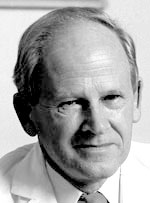
Introduction
Alan Buchanan Wardrop was one of Australia's most distinguished students of plant cell wall ultra-structure who made major contributions to our understanding of the structure of secondary walls and of how that structure affected the industrial uses of wood fibres. His work integrated information from observations with polarised light, X-rays and electron microscopy. Joining the Forest Products Division of Australia's Council for Scientific and Industrial Research in 1945, he became Foundation Professor of Biological Sciences at La Trobe University, Melbourne, in 1965.
Alan Buchanan Wardrop died in Melbourne on 20 May 2003. He was a distinguished student of plant cell wall ultrastructure, spending twenty years with the Forest Products Division of the Council for Scientific and Industrial Research (CSIR, later CSIRO) between 1945 and 1964 before becoming Foundation Professor of Botany at La Trobe University where he remained until retiring in 1986. Coming to the subject at the start of the electron microscopy era, his work illuminated many fundamental aspects of the heavily thickened secondary walls of wood fibres and the properties that affect their use in pulping. He also conducted many important experiments on the primary walls laid down in growing cells before secondary wall thickening occurs and on how growth modified their structure.
Early years
Alan Wardrop was born in Tasmania, in King Street, Sandy Bay, Hobart on 28 July 1921. He was the second son of James McAllan and Ethel May Wardrop (née Buchanan) and the younger brother of John Lindsay Wardrop (born 1916). His father was born in Clydebank, Scotland in about 1886 and the family migrated to Tasmania when Alan's father was about three. His mother was born in Hobart in 1889. James Wardrop worked for the Tasmanian public service (serving in several departments) while Ethel Wardrop was the homemaker. There was no tradition of science in the family but Alan noted, when interviewed many years later (Blythe 1998), that his father was always very supportive of his pursuing science whereas he viewed his mother as more protective although never opposed to his scientific ambitions. He commented that 'I don't think she wanted me to have to work too hard in life'!
He attended Albuera Street Primary School from 1928 and Hobart High School from 1934. The high school had several notable teachers and, with Hobart being so small, some teachers taught at both school and university. Alan many years later remembered Gordon Brett and Victor Crohn (Blythe 1998). Biology was not taught to male students at that time but Hobart's attractive setting and in particular walks to the summit of Mount Wellington helped foster his interest in the diversity of vegetation as well as providing a favourite recreation.
A £50 University Scholarship helped Alan's move to the University of Tasmania in 1939. Degree courses in botany had started only in 1938 and, with a background in the physical sciences, his initial goal was to study biochemistry. This he pursued through first-year studies of physics, chemistry, mathematics and botany. In 1940, he won the Florence Sprent Prize for Zoology and the University Prize for Physics. After third-year botany and chemistry, he took honours biology in a class of some fifteen students. Alan remembered some sixty years later the teaching of the professor of physics, Leicester McAulay, not only for his studies of electric fields around growing roots but also for his eccentricities in dress and manner. The influence of Dr Hugh Gordon, the university's first appointment in botany, and of Professor E. E. Kurth in chemistry were also noted.
Graduating in 1942 during the war, science students were put into reserved occupations and Alan pursued an MSc in the Chemistry Department. This involved course work and a research project and was funded by a University of Tasmania Research Scholarship and Commonwealth Research Grant. Many wartime programmes were in progress in Hobart, notably those of Professor Kurth. 'Kurth kilns' for charcoal production were widespread (one survives at Gembrook near Melbourne) and were used to generate 'producer gas' as a petrol substitute. Alan's project involved hydrolysing wood cellulose to monomer sugars that were then fermented to alcohol, which was also of interest as a fuel substitute. He harboured no illusions of changing the course of the war and confessed that it never seemed to him that they were going to make enough alcohol to affect the war effort. The project did, however, involve an interesting study of cellulose hydrolysis kinetics, a subject to which he returned later in his career. His MSc, supervised by Professor Kurth and B. J. F. Ralph, was awarded in 1944 with a thesis entitled 'An investigation of the acid hydrolysis of the wood of Eucalyptus obliqua L'Her'. Results from the study were published with Ralph in 1946.
In 1944, Alan began training as a Royal Australian Air Force navigator at Balnarring, on Western Port Bay in Victoria, after which he went to Mount Gambier, in South Australia, for air navigation training. Alan derived great satisfaction from his navigational training and found it immensely satisfying to be able to calculate where his plane should be and then look down and have the prediction verified. Shortly after the war's conclusion, he worked for a year as resident tutor in chemistry at Trinity College, University of Melbourne.
In 1946, Alan married Beulah May Brims, the daughter of plywood manufacturer Marcus Brims. Beulah worked in CSIRO as a research chemist for a short period and later as a Senior Tutor in Mathematics at the University of Melbourne. Their four children were Martin, Alison, Ann and Simon. Martin was a Rhodes Scholar (1974) and subsequently held a senior position in the Australian government service. Alison gained a PhD from the Biochemistry Department at La Trobe University and currently works in the Botany Department there. Ann graduated from the University of Melbourne with a BA and LLB and is a Senior Lecturer in the School of Law at La Trobe University. Simon won an 1851 Exhibition science research scholarship to Oxford from where he graduated in 1990 with a DPhil in mathematics.
Plant cell walls
Almost all Alan Wardrop's research concerned plant cell walls, the polysaccharide-rich structure assembled just outside the plasma membrane so forming a cage surrounding almost every plant cell. Young, expanding cells are surrounded by a thin primary wall that both controls growth and is also remodelled by it. When growth is complete, many cells – notably those forming wood – deposit a thick secondary wall. New polymers reach the wall through the plasma membrane so that continuing synthesis displaces the components of the original wall away from the plasma membrane. A mature wall is therefore layered from youngest to oldest on passing from its inner to its outer surface. Different layers can have quite different structure and composition, reflecting changes over time in the cell's activity.
Walls contain many polymers but cellulose is particularly noteworthy. Long, unbranched chains of glucose residues crystallise to form cellulose microfibrils that are only a few nm wide but many µm long. Crucially, cells control the orientation of the microfibrils they deposit. Orientation can change with time, producing the distinct layers of polylamellate walls, and cell growth can reorientate microfibrils in the primary wall after they are deposited. The structure of the primary wall is central to plant growth and the structure of the secondary wall is of great industrial interest because it determines many of the properties of timber and wood pulp. Both types of wall are dominated by cellulose microfibrils although lignin – a phenolic polymer that encrusts cellulose in the secondary walls of wood fibres – accounts for much of wood's rigidity.
Wardrop took up the challenge of describing wall structure and in particular of documenting microfibril orientation in the multilayered walls of wood fibres and the process of lignification. His work, particularly that published between 1947 and 1960, settled many fundamental issues of wood fibre structure. In this, he employed both the 'classical' tools of X-ray diffraction and optical microscopy and the techniques of electron microscopy that, beginning in the 1940s, gave more direct views of wall structure.
CSIR(O) Forest Products 1945–1964
Alan joined the CSIR Division of Forest Products situated on the Yarra Bank in South Melbourne in 1945 as an Assistant Research Officer in the Wood Structure Section. He progressed rapidly through the various professional grades – Research Scientist, Senior Research Scientist, Principal Research Scientist and Senior Principal Research Scientist – and was appointed head of the Section of Wood and Fibre Structure, as it had been renamed, in 1961. He resigned in 1964 to return to the University of Tasmania as Professor of Botany. During his two decades at Forest Products, Wardrop made a massive contribution to plant science. His work on cell walls was largely concentrated on a few major themes: the arrangement of cellulose microfibrils, the structure of microfibrils, lignification, reaction wood, plant growth, and fibre structure in relation to utilisation.
Wardrop came to these studies at a time when important conceptual and technical advances were occurring. Ideas, of which the multi-net hypothesis was the most enduring (Roelofsen and Houwink 1953), provided an explanation for how growth modified wall structure. On the technology side, electron microscopy was starting to provide refreshingly direct images of wall structure. With the methods that preceded it, 'a complex mental process intervened between the observations made and the structure delineated' (Preston 1958). It is easy to forget, however, just how much sophisticated structural information had already been deduced by that 'complex mental process' after observing how walls behaved when irradiated with polarised light or with X-rays. This information included estimates of the sizes of the crystalline regions of cellulose, their spacings, their orientation and the differences in orientation between different layers of the wall. Wardrop was skilled in the classical methods, which he applied throughout his career, but played a significant role in developing electron microscopy as a method to study walls.
Organisation of microfibrils in cell walls
Alan's studies of the arrangement of microfibrils in cell walls were by far his most extensive, and represent a major contribution to our knowledge of this subject. He employed a variety of techniques in his work but was primarily a microscopist. In his work on the organisation of the cell wall, Wardrop clearly expounded the nature of the primary and secondary walls, relating them to earlier studies by Kerr and Bailey. The 'barber's pole' illustration showing the microfibrillar arrangement of the various layers, first published by Wardrop and Bland in the Proceedings of the Fourth International Congress of Biochemistry (1958), became quite famous.
Much of Wardrop's early work was in collaboration with H. E. Dadswell, head of the Wood Structure Section, who in 1960 became Chief of the Division of Forest Products on the retirement of S. A. Clarke. Their first collaboration led to a note in Nature in 1946 describing observations of cell wall deformations in wood fibres and another early study dealt with the nature of intercellular adhesion in delignified tissue.
In 1947, just six months after his marriage, Alan and his wife travelled on the converted troop ship Almeida to England where, supported by a CSIR Research Studentship, he took up PhD studies in the Botany Department at the University of Leeds. The PhD degree had not yet been established in Australia. The post-war period in the UK was a time of rationing: meat, in particular, was in short supply and the only affordable beverage was Tetley's Ale. Meetings with other Australian PhD students in Manchester, Cambridge and Oxford led to clandestine purification of industrial-grade alcohol using Raney nickel to remove impurities.
His supervisor in Leeds was R. D. Preston, who had graduated in 1929 as a physicist before moving into plant science. He became Reader in Plant Biophysics in 1948 and was later Professor and Head of the Astbury Department of Biophysics and, in 1954, Fellow of the Royal Society (Cushing 2005). In Leeds, Wardrop investigated the fine structure of the cell wall of the conifer tracheid, elucidating the dimensional relationships in the outer layer of the secondary wall, the organisation of the secondary wall in relation to the growth rate of the cambium, the influence of pressure on cell wall organisation and the orientation of microfibrils in the wall's different layers. His PhD was awarded in 1948 for a thesis entitled 'The submicroscopic organisation of the plant cell wall and its bearing upon the growth of the plant cell', and the results were published in a series of papers with Preston between 1947 and 1951. Wardrop came to regard Preston as his mentor and they remained in contact for many years with Wardrop contributing the introduction to a Festschrift marking Preston's 75th birthday in 1983. He looked back fondly on the Leeds interlude as most productive, and one that had set him on his life's course. His work there did much to settle important issues regarding the alignment of microfibrils in the conifer tracheid.
Wardrop described in his interview (Blythe 1998) how his work, conceived in Melbourne and brought to fruition in Leeds, settled a controversy between Preston and I. W. Bailey at Harvard University in favour of the latter. The dispute concerned the orientation of cellulose in each of the three layers of the secondary wall (S1, S2 and S3 where the S1 layer, the first deposited, is on the outside adjacent to the primary wall). Preston believed from his X-ray and optical data that microfibrils in each layer had the same mean orientation and that only the spread of microfibril angles differed from layer to layer. Bailey had proposed in 1934 that the inner and outer layers were transverse or formed shallow helices whereas the middle layer formed a steep helix. Wardrop devised an elegant method in which wood was sectioned in a series of planes starting with transverse and ending with longitudinal. The sections were examined in polarised light to find in which section each wall layer showed maximum birefringence. At this point, its microfibrils were aligned in the plane of the section. Birefringence was plotted as a function of section angle for each layer and showed unequivocally that the orientations of microfibrils differed between the layers, essentially confirming the view of Bailey. Wardrop notes that, although Preston 'pulled out every stop in arguing his case … he acknowledged that we had a clear result'. As some concession to Preston's views, the 1947 paper did provide evidence favouring his idea that there were also differences in the spread of microfibril angles between layers.
In 1949, Wardrop also published, from work in Leeds, a description of the micellar1 organisation in the primary cell walls of cambium cells and oat coleoptile parenchyma. This had the interesting result that micelles in primary walls were smaller than those in secondary walls.
On returning to Forest Products in 1949, Wardrop continued his research into the cell wall organisation of the conifer tracheid and cambium, initially in collaboration with A. J. Hodge, who was one of those operating what was then Australia's only electron microscope in the CSIRO Division of Industrial Chemistry at Fishermen's Bend in Melbourne (Rasmussen 1999). There were, of course, no well-established specimen preparation methods in those days. Electron microscopists interested in plant cell walls were fortunate in not being dependent on the emergence of methods to preserve delicate cytoplasmic structures or to cut ultra-thin sections to see fine structure. Cell walls and cellulose in particular were very durable in the face of mechanical and chemical challenges, allowing electron microscopists to use shadowing and replicas to image cellulose microfibrils at high resolution on the inner and outer surfaces of walls. (Similar methods were being used by the Melbourne group to study wool fibres and viruses; Rasmussen 1999.) Goodchild and Dowell (Goodchild and Dowell 1986) attribute Wardrop's introduction to metal shadowing to his time in Leeds where Preston, using similar methods, had published striking images of the large microfibrils in Valonia ventriculosa (Preston et al. 1948). This conclusion presumably comes directly from Wardrop whom they credit for 'reminiscences' in their acknowledgements. Rasmussen emphasises the role of visits to laboratories that A. L. G. Rees made on his way to Melbourne from England but notes that success finally came after three years 'when the group reversed standard replica procedures by first shadowing the wood, and then removing the surface layer of metal by flowing a layer of replica plastic over the shadowed surface and peeling it'. These replica and shadowing methods, with some refinement, continue in use today along with, of course, many methods involving sectioning that reveal the wall's full thickness as well as its surfaces. Some images provided by Hodge and Wardrop in 1950 would not look out of place in contemporary papers.
The papers of Hodge and Wardrop imaged the inner surface of tracheids from Pseudotsuga taxifolia where microfibrils were inclined at 80° to the cell's long axis. It is striking that Wardrop already considered that they had a clear view of tracheid wall structure from his Leeds birefringence data and that these results reinforced and confirmed that view in more direct fashion. The first paragraph of the Nature paper cites two papers of Wardrop and Preston (1947 and in press, presumably 1949) showing 'the walls of these cells to be composed of three coaxial micellar spirals such that the inner and outer spirals are relatively flat … while the central spiral is steep …'. (These are the layers now referred to as the S1, S2 and S3 layers, outside to inside.) In similar vein, the full paper's summary states that their work 'provides confirmation of the type of cell wall organisation of conifer tracheids proposed in other investigations on the basis of X-ray and optical evidence and of microscopic examination'. Striking images of the walls of cambial cells showed much less strongly oriented microfibrils, again in keeping with the X-ray and optical results of the 1949 study by Preston and Wardrop. The 5 to 10 nm diameter of the fibrous structures in the cambial cell walls suggested to them that the 'microfibrils may correspond to the “micelles” or crystalline regions inferred from X-ray examination'. From 1951, the Division of Forest Products had its own electron microscope and so too did the company Australian Paper Manufacturers (Goodchild and Dowell 1986). This concentration of resources in the wood fibre area presumably testifies to the high hopes held that important insights would emerge to provide a better understanding of wood fibres and their utilisation.
Wardrop's resumed collaboration with Dadswell led to insights regarding the inner and outer wall surfaces. They rejected the concept of a tertiary wall at the tracheid's inner surface as resulting from misinterpretation of cytoplasmic debris and, having traced the balloon-like swellings seen in cuprammonium hydroxide to the middle layer of the secondary wall being intermittently constricted by the outer layer, rejected the concept of a 'skin substance'. Wardrop summarised his views on the organisation and properties of the outer layer of the secondary wall in conifer tracheids in 1957. Two systems of prominent striations were visible with bright-field illumination and electron microscopy showed that they consisted of two grid systems of microfibril bundles. A fine grid of bundles each about 60 nm wide lies adjacent to the primary wall, the two sets of bundles intersecting at about 80°. This is overlain by a coarse grid of microfibril bundles 200–300 nm wide, arranged in the same orientation. Taken together, the Leeds and CSIR studies settled many fundamental questions regarding the arrangement of microfibrils in secondary walls.
Cellulose structure
Wardrop also investigated the micellar structure of cellulose and related topics. Work in Leeds led to publications in 1948 (with Preston as first author) that reported crystallinity in never-dried cell walls – so disposing of the possibility that drying caused crystallisation – and in 1949 that showed that micelles in primary walls are smaller than those in secondary walls. In 1951, after returning to CSIRO, Wardrop and D. H. Foster used X-ray diffraction to study the dependence of cellulose crystallinity on the degree of acid hydrolysis of wood and cotton. They suggested that regions of lower lateral order were attacked first during hydrolysis. The results were consistent with the view that the mesomorphic region surrounding the micelles was more extensive in wood than in cotton. Wardrop also studied the intermicellar spaces in cellulosic fibres by treating them with gold chloride prior to electron microscopic examination. With delignified flax, the crystal aggregates that formed between adjacent microfibrils were 7–10 nm wide, in fair agreement with conclusions from X-ray data on the spacing between micelles.
Lignification
The process of lignification was another major theme in Wardrop's research. From the mid-1950s onwards, he published about a dozen papers on this subject, the last in 1981; and indeed he was still exploring new experimental systems in his final period of sabbatical leave in 1985. A note in Nature in 1956, with E. Scaife, reported the occurrence of peroxidase (a putative supplier of oxidant for lignin formation) in the tension wood of angiosperms, and a detailed paper by Wardrop in Tappi Journal in 1957 described the lignification phase in the differentiation of wood fibres in terms of the physical texture and sub-microscopic organisation of the cell wall. He found that lignin occurred mainly between the cellulose microfibrils but that it can penetrate them to some extent, and that lignin is concentrated in the region of the middle lamella and primary wall. Lignification began in the primary wall at the cell corners and then extended to the middle lamella and primary wall. Wardrop and Scaife argued that at least one peroxidase-controlled phase of lignification proceeds within the cell wall and concluded that lignin precursors originate within individual cells at a particular stage of their differentiation. Wardrop and D. E. Bland showed, from ultraviolet absorption spectra of the lignin found at various stages of differentiation, that a higher proportion of conjugated units is incorporated during the initial phases of polymerisation.
In addition to studying the course of lignification in wood, Wardrop and G. W. Davies studied lignification in model systems where eugenol, a lignin precursor, was used to increase lignification. In Avena coleoptile sections and internodes of Elodea densa, eugenol-induced lignification took place in the cell walls and the product was deposited between the microfibrils as with natural lignification. Finding that the treatment killed cell protoplasts, they suggested that the reaction depended on cell wall enzymes. In the woody stems of Pinus radiata, Eucalyptus regnans and Tilia americana, ultraviolet-detected artificial lignification occurred in the xylem, phloem and cambial zone although the products differed in their staining reactions.
Wardrop and J. Cronshaw (a recent graduate from Preston's laboratory) described the formation of phenolic substances in ray parenchyma of Eucalyptus elaeophora. They were enclosed in vesicles within a structure resembling a chloroplast.
Reaction wood
Wood is not, of course, a material with constant structure, and the morphology and chemistry of reaction wood received Wardrop's attention, initially in co-operation with Dadswell and later with G. W. Davies and G. Scurfield. These are the types of wood formed under the mechanical stresses acting on tree branches that are angled away from the vertical. They described the variation in cell wall organisation between compression wood formed on the lower side of softwood branches and tension wood formed on the upper side of hardwood branches. Staining techniques and ultraviolet microscopy revealed that compression wood tracheids were highly lignified, while tension wood tracheids were virtually unlignified. They identified three types of tension wood in which the number of secondary wall layers varied along with the degree of lignification. They suggested that lack of lignification may be the first stage in tension wood formation. Microscopic compression failures are common in tension wood and can be related to the phenomenon of 'brittle heart'. Tension wood is associated with the extreme 'wooliness' observed when hardwoods are sawn in the direction of the grain. Other manifestations include high longitudinal shrinkage and a remarkable tendency to collapse when dried from the green condition.
Growth
From early in his career, Wardrop took a keen interest in the process of plant growth as it contributed to both the elongation of stems and roots (primary growth) and the increase in girth of woody stems (secondary growth), the process generating the cells that go on to form thick, lignified secondary walls. His PhD supervisor, Preston, had investigated the relationship between cell dimensions and cell wall organisation since 1934 and in their 1950 paper, Wardrop and Preston derived a relationship between micellar angle and the rate of growth of cambial initials. In a 1953 paper with Dadswell, Wardrop described the development of the conifer tracheid, including the nature of cell division in the cambium and the dimensional changes involved in tracheid differentiation. Differentiating tracheids increase in length at their tips where only the primary wall is present. Secondary wall formation commences before the dimensional changes of differentiation are complete. This is consistent with the observed increase in the number of turns of the micellar helix with increasing cell length. They suggested that the cytoplasmic surface governed the helical orientation of micelles in the secondary wall. In a subsequent paper they pointed to the correlation between the size of fibrils seen by electron microscopy and the size of micelles as determined by X-ray methods. They also noted the relationship between the degree of cell wall lignification and the grinding quality of eucalypt woods used for groundwood pulp production.
In the mid-1950s, Wardrop investigated the mechanism of surface growth in the parenchyma of Avena coleoptiles incubated in vitro with 14C-glucose. From electron microscope observations, A. F. Frey-Wyssling and K. Muhlethaler in Zürich favoured tip growth occurring in these cells. With autoradiography, Wardrop found a uniform distribution of 14C-labelled cellulose over the cell surface. Moreover, by using pit-fields as markers to estimate extension in different parts of the cell directly, he was able to show that growth was also uniformly distributed. Electron micrographs indicated a multi-net type of growth in the coleoptile parenchyma as proposed by Roelofsen and Houwink (Roelofsen and Houwink 1953) in which microfibrils deposited transverse to the major axis of growth were passively reorientated (strain realignment) towards the axis of growth. As a result, the wall's inside surface showed transverse microfibrils whereas its external surface showed microfibrils that had been reorientated towards the longitudinal. In an experiment where longitudinal growth was inhibited by colchicine, an alkaloid from the autumn crocus Colchicum autumnale, Wardrop showed that the microfibrils on the outer surface did not develop the longitudinal orientation they showed after normal growth, so confirming an important prediction of the multi-net theory.
Wardrop in 1959 also studied root hairs that, with clear evidence that growth was highly localised at the tip, he saw as a useful model for interpreting experiments on cells such as tracheids where growth localisation was less clearly established. Roelofsen had suggested that microfibrils seen on the wall's inner surface (and which in this case were parallel to the cell's long axis) represented a secondary wall. Using various pulse-chase experiments with labelled glucose and providing simple diagrams predicting the distribution of label with and without secondary wall deposition, Wardrop's autoradiographs elegantly showed that secondary wall deposition probably began immediately growth stopped at a site just behind the tip and continued along the cell's whole length. He contrasted the results with what happened in tracheids that showed tip growth but with a more diffuse growth zone.
Fibre utilisation
Although most of Wardrop's research was of a fundamental character, he was also interested in the influence of fibre and tracheid structure on the properties and utilisation of wood and paper. About three-quarters of the publications devoted to these practical ends are in collaboration with Dadswell, to whom considerable credit must be given for leading Wardrop in this direction. Several joint papers were with G. W. Davies and other collaborators were A. J. Watson, C. F. James, W. E. Cohen and F. Addo-Ashong.
As early as 1951, Wardrop and Dadswell discussed the relationship between cell wall structure and fibre properties and stressed the importance in pulp and paper research of changes to the fibre surface before and during their bonding to form the paper sheet. The pulping processes – which convert wood into free fibres suitable for papermaking – received considerable attention, particularly the so-called semi-chemical processes using a combination of chemical treatments and mechanical energy. The structural changes occurring during preparation of cold soda pulps from both eucalypts and pines showed that the mechanical action breaks the cell wall external to and including the outer layer of the secondary wall. This exposed the lightly lignified middle layer of the secondary wall as a potential bonding surface between the fibres. Hardwoods provide superior cold soda pulps to softwoods, and they reached the important conclusion that this was related to hardwoods having less lignification of the intercellular layer. These studies were extended to several pulp types (Asplund, Masonite, neutral sulphite and groundwood). In processes that required high temperatures, fibres separated in the middle lamella, whereas they separated within the cell wall itself during low temperature processes. Others later related these observations to the glass-transition temperature of lignin.
Beating is an essential prerequisite to papermaking and is notoriously inefficient in energy terms, prompting much research to identify the essential changes that occur with a view to improving efficiency. With C. F. James, Wardrop studied the structural changes occurring during beating of wood pulp fibres. Using shadow casting in conjunction with the optical microscope, they distinguished the primary wall and the outer and middle layers of the secondary wall of fibres and tracheids. At various stages in the beating of eucalypt kraft pulp, they observed changes in the amount of primary wall debris and – in sheets formed from the pulp – in the number of primary wall inter-fibre connections, in the damage to the vessel members and in the occurrence of fibre splitting. They found that in pine kraft pulp, the outer layer of the secondary wall, as well as the primary wall, was removed, facilitating the formation of inter-fibre connections during papermaking.
Wardrop and Davies also studied the morphological factors related to the penetration of liquids into wood – an important issue in chemical pulping and areas such as wood preservation. Penetration in Pinus radiata proceeded from one tracheid to the next via the bordered pits, with lateral spread through the rays and resin canals facilitating longitudinal penetration. In Eucalyptus regnans, penetration was through the vessels and then to adjacent fibres and rays. Tyloses blocked some vessels in the heartwood. After entering the cell lumen, reagents diffused centrifugally through the cell wall, so that the middle lamella and especially the cell corners were the last regions to react.
Wardrop and F. Addo-Ashong also discussed the anatomy and fine structure of wood in relation to its mechanical failure, but concluded that knowledge of the mechanical properties of the cell wall and middle lamella did not permit accurate assessment of their contribution to the strength of wood. However they could deduce that the structure of the complex comprising the middle lamella, the primary wall and the S1 (first deposited) layer of the secondary wall exerted considerable influence on such properties. Wardrop also studied the variation of breaking load in tension of the xylem of conifer stems. Tangential longitudinal sections taken from successive growth rings showed an increase in breaking load with distance from the stem centre, accompanied by an increase in tracheid length, basic density (a measure of the concentration of dry matter in the wood) and cellulose content, and a decrease in micellar spiral angle. They concluded that cell wall organisation and basic density governed the breaking load of the wood sections. They attributed the increased breaking load on drying to changes in the intercellular layer.
Given these and other findings, Dadswell and Wardrop also helped guide foresters and others involved in tree breeding to recognising those wood properties required for specific end uses, such as the production of pulpwood for the paper industry. As early as 1959 they recognised the importance for papermaking of a high proportion of thin-walled cells, with a low extractives content and a certain proportion of latewood. As these are subject to genetic control, they pointed out that it should be possible to develop suitable trees by selective breeding. As discussed later, these remain important goals over forty years later, and data Wardrop painstakingly collected and analysed in the 1940s and 1950s is now collected in seconds using SilviScan technology.
University of Tasmania
In 1964, Alan Wardrop left CSIRO to take up the Chair of Botany at the University of Tasmania on 1 September. He succeeded Professor Newton Barber FRS, an expert in plant cytogenetics and ecological genetics of eucalypts. Asked about the move when interviewed some thirty years later, Wardrop found it hard to give a specific reason but mentioned a wish to teach and changes going on in CSIRO. He mentioned that he had little sympathy with the organisation's discussions about what constituted pure and what applied research. Things moved quickly in Hobart, where he secured a large grant to purchase a Siemens electron microscope and enjoyed a full introduction to teaching by lecturing to students in each of the three years of the BSc course.
Unfortunately, his younger daughter's illness meant she could not be moved to Hobart away from Melbourne's medical facilities. In late October 1965, Wardrop wrote to the Registrar at the newly created La Trobe University enquiring about that university's Foundation Chairs in Biological Sciences and was told (in a letter of 8 November) that the selection committee might consider a late application, should he wish to apply. His application was forwarded to the committee and Wardrop was offered the post on 29 November. In announcing his appointment in a press release and in a personal letter to Professor Keith Isles (Vice-Chancellor of the University of Tasmania), Dr David Myers (La Trobe's Vice-Chancellor) was at pains to stress that Wardrop's departure from Tasmania was for personal reasons and did not reflect adversely on the University of Tasmania. The latter agreed to release him and he joined La Trobe on 15 January 1966.
La Trobe University
Wardrop's appointment to the Foundation Chair in Biological Sciences came very early in La Trobe's history. The first meeting of the Interim Council had been held only a year before (on 19 December 1964) and Wardrop, together with three other newly appointed professors, was elected by staff to join the Interim Council in 1966. The following year, the first year that undergraduates were admitted, he was appointed first Dean of the School of Biological Sciences, one of four schools then in existence. Wardrop's vision as Dean was that organisms – be they plant, animal, fungal or microbial – had many unifying principles and that these should emerge in the School's teaching and research. He was very disappointed when separate Departments were formed within the School.
Botany Department
The new university provided remarkable opportunities to shape a substantial department both in personnel and in facilities. He appointed staff in the areas of plant anatomy (Ian Staff), algal physiology (Dilwyn Griffiths), mycology (Alan Griffiths) and ecology (Bob Parsons). Later he appointed a biochemist (John Anderson), a biophysicist (Charles Pallaghy) and a chemo-taxonomist (Trevor Whiffin). In the mid-1970s, the two Griffiths took chairs in Townsville and Hong Kong respectively, allowing appointment of a cell biologist (Richard Williamson) and a plant pathologist (Philip Keane); a little later, he was also able to appoint a phycologist (Bill Woelkerling). While providing wide coverage of plant science in teaching, these appointments also provided a strong core of researchers interested in cellular processes that was further strengthened by the establishment of a Biochemistry Department unusually strong in plant research and, in particular, in the chemistry of cell wall polysaccharides. While supporting this direction for the new department, Wardrop took care to ensure that first-year teaching, including its biochemistry components, remained under the Botany Department's control – along with, of course, the associated resources! This began when candidates being interviewed for the Biochemistry Chair were presented with course summaries and questioned on their attitudes to first-year teaching.
Publications reflecting work done at La Trobe began emerging in 1968 using a newly acquired electron microscope (Siemens Elmiskop 1A), an ultramicrotome, a well-equipped Zeiss Photomicroscope with microphotometer, and good Melbourne connections that provided access to a scanning electron microscope at the Defence Research Laboratories at Maribyrnong. A venerable X-ray machine was acquired from Wardrop's old CSIRO Division and a convenient site for glasshouses and plant growth cabinets developed. A Balzer's freeze-etch apparatus was also acquired with contributions from three Australian paper companies.
In teaching, Wardrop always began the first-year biology course with cell biology lectures emphasising the unity of organisms at that organisational level. He was also determined to present something of the history behind current ideas, rather than just presenting these in isolation. His quiet, rather shy demeanour perhaps counted against him as lecturer to large, first-year audiences, although his audience's attention was reputedly held as they watched him being progressively 'reeled in' as his wanderings around the stage wrapped the microphone cable ever more times around the lectern! On one occasion his meanderings led him to fall backwards off the platform, fortunately without physical harm. Teaching styles were under discussion. While perhaps somewhat sceptical, he supported Ian Staff's efforts to develop audiovisual teaching methods for plant anatomy, using slides and audio tapes in the pre-computer 1970s.
The atmosphere in the Department under Wardrop's leadership was non-confrontational. A bottle of wine often assisted staff meetings and invitations to staff for lunch on or off campus kept busy colleagues in easy contact with each other. He owned an impressive-looking brief case from which, rather than agenda papers, bottles of wine would emerge, having been cosseted by the case's carefully moulded inserts. Meetings did not, however, shirk thorny issues and 'academic standards' were frequently discussed, sometimes with quite heated exchanges. He readily took responsibility for the Department's standards and explained to new staff members that, although La Trobe's first-year student intake might not be very well credentialled because students valued proven institutional reputations, graduates (BSc or PhD) should stand both national and international comparisons. His study leave reports always remarked on teaching in the universities he visited, including entry standards, degree of specialisation permitted, and so on.
Wardrop was unsympathetic to reforms suggesting the uncoupling of professorial rank from departmental chairmanship and so remained head, although absences on sabbatical leave and through ill-health left John Anderson acting ably in the position for extended periods. Wardrop had strong views on the responsibility of academics to undertake research and, in particular, favoured pressing Demonstrators (mainly responsible for organising practical classes) to do research if they were to have continuing appointments. An issue that surfaced intermittently was whether to rename the department 'Plant Science' or some other term more fashionable than Botany. It never was.
Academic life as Chairman of the Department of Botany, and on occasion Dean, brought with it a high administrative load and in this Wardrop was something of a procrastinator. As the administrative load grew, teaching became more of a chore because, as he put it, 'You dared not take your eye off what money was coming in, and that sort of thing'.
Wardrop and the other professors of biological sciences faced unwanted publicity in the pages of Nature and elsewhere. Charles Pallaghy, senior lecturer in the Botany Department, espoused creationist views. The School prohibited Pallaghy from using the curriculum, or departmental facilities or materials, to promote his ideas. Coverage of Pallaghy's views made their way from Melbourne's Age newspaper to Nature's correspondence section (Pallaghy 1985, 1986). In the first letter, Pallaghy asserted that one reason for the scarcity of scientifically well-credentialled creationists was that 'creationists are threatened by their own colleagues and by legal action by their own school boards and institutions if they do not keep a strictly low profile either publicly or in their own class rooms'. A letter in Nature in 1986, signed by all professors in the School of Biological Sciences, was the final public offering in the controversy. It affirmed the 'right of a tenured academic to espouse whatever views he believes worthy of promulgation, through whatever extracurricular forum he is able to capture'. It went on, however, to dissociate the professors and other staff from creationist views and to affirm that they remained 'totally committed to rational, scientific explanation of biological and all other natural phenomena'.
University and other service
Wardrop served several times as Acting Vice-Chancellor, including in 1973 when the jailing of La Trobe students for trespass or damaging the US Consulate in Melbourne led to violent demonstrations on campus. Against the advice of administrators, Wardrop initiated a dialogue with the students. At the meeting, he was interrupted by a staff member who had experienced totalitarianism in Nazi Germany and spoke about the evils of totalitarianism of any kind. Wardrop turned the situation around by directing the staff member to sit down and shut up. He went on to tell the meeting that he had been to see the jailed students and proceeded to explain what the University stood for. He won applause from students, staff and the administration and the violence receded.
Wardrop also served on the Council of the Royal Society of Victoria from 1972 to 1982 and the Council of the Victorian Institute of Marine Science from 1977 to 1982. Membership of the School Biology Committee of the Australian Academy of Science (1976–1986) brought involvement with production of the Web of Life textbook. He was also a member (1979–1981) of the Academy's Plant Sciences Section.
Research at La Trobe
Clearly, there were considerable calls on Wardrop's time and energy in establishing a school and department, plus a requirement to assemble research equipment. Nonetheless, beginning with papers in 1968, Wardrop continued his interests in cell wall ultrastructure, publishing in his own right and with some of the department's first visitors and PhD students. These included S. M. Jutte (Nijmegen), B. W. Thair (Commonwealth Exchange student), S. C. Chafe (Forest Product Laboratory, Ottawa), L. R. Jarvis and E. F. Schneider (Ottawa). They used the recently developed freeze etching technique to study, among other topics, the mechanism governing the formation and orientation of microfibrils, nuclear pore structure and the microfibrils in the test of an animal making cellulose – the ascidian, Pyura stolonifera.
An essential contributor to the success of this research and that at CSIRO was Wardrop's senior technician, Fred Daniels. He followed Wardrop to La Trobe and, as well as scrupulously maintaining the electron microscopy facilities, carried out much research and taught electron microscope techniques to students (undergraduate and graduate), staff and visitors. It could be a chilling experience to walk to Fred's office to break the news that your carelessness had led to a malfunction that Fred would have to fix.
In the final decade of Wardrop's career, his research increasingly depended on sabbatical leave. A stay in 1978 with Professor M. M. A. Sassen in the Department of Botany, Nijmegen University, allowed him to renew his long-standing interest in microfibril orientation in elongating plant cells. Sabbatical leave in 1986, with R. Malcolm Brown Jr in the Department of Botany, University of Texas at Austin, furthered his interest in the plasma membrane structures synthesising cellulose microfibrils.
Microfibril alignment
Microfibril alignment in the cell wall was a recurrent theme in Wardrop's work at CSIRO. At that time, few techniques were available to look for cytoplasmic structures that might align the microfibrils. That had changed by the late 1960s and important conceptual advances regarding the orientation mechanisms had occurred. Wardrop's work at La Trobe concerned two major issues: first, determining the orientation of newly synthesised microfibrils and identifying structures that aligned them, and secondly, determining what changes in alignment the microfibrils undergo as cells grow and new synthesis displaces them towards the wall's outer face. Both topics remain live issues (Baskin 2005).
In 1970, Chafe and Wardrop used the freeze-etch apparatus to fracture the plasma membrane of celery collenchyma and examine its particles (membrane proteins embedded in the lipid bilayer). They were looking for structural features that might orientate microfibrils and so chose a polylamellate wall in which microfibril alignment changed with the deposition of successive layers. The dominant view developed during the 1960s was that microtubules on the cytoplasmic face of the plasma membrane controlled the alignment of microfibrils growing on the membrane's outer face (Newcomb 1969). Preston (Preston 1964), however, argued that particles in the plasma membrane were decisive (see also Wardrop's comments in the Preston Festschrift of 1983). Chafe and Wardrop's statistical analyses did not reveal ordering of the plasma membrane particles that would support a role in aligning microfibrils. In contrast, they found that many microtubules did coalign with microfibrils and, given the regular changes in microfibril orientation seen in collenchyma, they could rationalise non-coalignment as the microtubule orientation changing first to set up the next shift in microfibril orientation.
There is an interesting sidelight to the microtubule-microfibril story. Part of the supporting evidence was that colchicine depolymerised the microtubules and often changed microfibril arrangement on the wall's inner surface. Wardrop had used colchicine in 1956 to inhibit oat coleoptile and onion root elongation and show that microfibrils on the wall's outer surface remained more nearly transverse than in untreated cells. Tantalisingly, he did not mention microfibrils on the wall's inner face where, over thirty years later, Iwata and Hogetsu (1989) found some changes in microfibril orientation after depolymerising microtubules in oat coleoptile cells. Any changes in microfibril orientation on the inner face seen in 1956 would, of course, have been very hard to rationalise since the discovery of the relevant microtubules in plant cells and a demonstration that they were colchicine's target was still several years in the future.
Between May and November 1975, Wardrop made his first extended overseas trip since joining La Trobe. At the 12th International Botanical Congress in Leningrad, he discussed the possibility of sabbatical leave with Professor M. M. A. Sassen of the Botanisch Laboratorium at Nijmegen, whom he had met in 1974 at the 8th International Congress on Electron Microscopy held in Canberra. The leave went ahead in 1977.
Sassen and Wardrop found common interest in the 'multi-net growth' theory of Roelofsen (then at Delft) that had formed the backdrop to much work on primary walls (including Wardrop's) since the 1950s. In Nijmegen, Wardrop did much research on his own but was ably assisted by Mieke Wolthers-Arts whose speed and precision, he confessed to Sassen, at times challenged his ability to keep her occupied! They focused on the detailed arrangement of microfibrils in the primary cell wall and the way cell elongation reorientated them from transverse to longitudinal as envisaged in the multi-net model. Exceptions to the simple transverse-to-longitudinal gradient through the wall were known in the 1950s but subsequent work, particularly by Jean-Claude Roland in Paris, emphasised just how many primary walls were polylamellate with, for example, layers having transverse microfibrils alternated with layers having longitudinal microfibrils. These walls seemed to lie outside the multi-net paradigm of growth-induced realignment of microfibrils. Wardrop, Wolters-Arts and Sassen, using collenchyma cells, provided evidence suggesting that those microfibrils deposited in the layers of polylamellate walls with transverse microfibrils showed signs of strain realignment towards the longitudinal after elongation. This important finding pointed to multi-net realignment subtly affecting the structure of polylamellate walls and so extended the theory's reach to encompass complex walls that had seemed subject to separate rules.
Wardrop and colleagues recognised that their case was not fully watertight and Wardrop recorded a somewhat different view in his 1998 interview (Blythe 1998). There he commented that he was greatly impressed by Roland's advocacy of a helicoidal wall structure in which newly synthesised microfibrils self-organised into a structure in which microfibril alignment gradually shifts over time, a change recorded by continuous variations in alignment at different depths in the wall (Roland et al. 1987). Although his own observations on collenchyma with Sassen and Wolters-Arts still seemed to support the multi-net hypothesis, Wardrop admitted that Roland's sophisticated staining methods left him with serious doubts. By 1998, he thought the accumulating evidence suggested that the helicoid concept was pretty generally applicable to extending cells. It is probably fair to say that many remain unconvinced of the helicoid model's generality and doubt whether a single model or structural principle can describe all primary walls.
Apart from pursuing his research, Wardrop lectured on cell wall investigation for the advanced students and others working in Nijmegen. His study leave report noted that the course finished with a visit to the pulp mill near Deventer and to the Institute of Forestry and Landscape at Wageningen where, he noted, the breeding programme for hybrid poplars did not select for particular end uses in the way this was done in Australia and the USA. Wardrop also noted that his limited attempts to learn Dutch were inhibited by the excellent English in which the local shopkeepers insisted on replying to his faltering efforts in Dutch!
As if in a final flourish of his skill in deciphering complex wall structures, Wardrop described in 1983 the mechanism leading to the opening of Banksia cones after bushfires. Using all his analytical techniques – and a great deal of that 'complex mental process' to which Preston had referred in 1958 – he elegantly documented the variations in the intricate, layered walls of the sclereids found in different parts of the cone. He argued that fire melted the resin holding the different parts together, allowing the different alignments of microfibrils in the sclereids to lead to differential shrinkage and hence opening.
The First International Cell Wall Meeting
Wardrop's Nijmegen sabbatical led to a meeting that became known as the 'The First International Cell Wall Meeting'. Sassen and Wardrop, following discussions with interested botanists at the Leningrad Botanical Congress, resolved to organise a cell wall meeting and plans were finalised during the sabbatical. Wardrop's study leave report records its growth from an intention to invite seven or eight people for informal discussions to a meeting with thirteen invited speakers with Wardrop giving the introductory address. International harmony was not all it might have been, however, with tensions surfacing between two of the field's major figures, Preston of Leeds and Frey-Wyssling of Zürich. When both were invited, Frey-Wyssling immediately accepted, while Preston (according to Sassen) told Wardrop that he would not be coming if Frey-Wyssling was! The meeting in Nijmegen on 25 and 26 May 1978 drew sixty or so participants mainly from Germany and Holland and established an enduring series of meetings of which the eleventh is planned for Copenhagen in 2007.
Cellulose synthesising machinery
In his final period of sabbatical leave, in the first half of 1985, Wardrop turned to the electron microscopy of the plasma membrane enzymes (terminal complexes) that synthesised microfibrils. He did this in Austin, Texas, with their discoverer, R. Malcolm Brown Jr. Like others using freeze-etching around 1970, Chafe and Wardrop failed to see the labile terminal complexes that Brown and colleagues described a few years later in algae (Brown and Montezinos 1976) and higher plants (Mueller et al. 1976). (Chafe and Wardrop had, like many others, probably spoilt their chances by infiltrating with glycerol to minimise freezing damage.) Their discovery by Brown's group delighted Wardrop who applauded the group's technical excellence. His introduction to Preston's Festschrift in 1983 noted an earlier occasion when arrays of membrane particles in yeast and algae had produced transient excitement at a conference before doubts emerged as early as dinner time! Wardrop's study leave report recorded how he chose the topic: 'I had some doubts as to the interpretation of the role of these structures in relation to the microfibril formation in the cell wall and felt that it was a weakness in the published evidence that they had not been demonstrated by other techniques of electron microscopy'. Working with Krystyna Kudlicka and Takao Itoh (Kyoto), he therefore took up the challenge of demonstrating them in fixed and sectioned cells of the green alga Boergesenia forbesii. They observed the linear terminal complexes in glancing sections of the plasma membrane as deeply staining structures of comparable size to the structures seen by freeze-etching. He noted that work was continuing at La Trobe and at Austin; it was published in 1987 as his final publication.
While in Austin, Wardrop enthusiastically seized the opportunity to learn from Candace Haigler how to make leaf parenchyma cells of Zinnia elegans differentiate into lignified tracheary elements. His study leave report noted that 'Over an extended period I have studied lignification in intact plants and … this system seemed ideal for a more experimental study of the problem'. In Austin, he worked on the effects of calcium and boron on lignification; the technique was later established at La Trobe but no work was published.
Noting the high cost of living in Texas, Wardrop returned a month early to La Trobe. In a final comment to the university hierarchy after his experiences in Texas, he lamented that La Trobe's students were being trained on 'obsolescent/obsolete equipment' and the trend 'to expend funds for equipment on facilities to analyse experimental results, rather than to acquire equipment of contemporary sophistication designed to acquire data to be analysed'. It was a remark entirely in keeping with an approach to research that he had always emphasised – the adoption of novel technologies to see cell walls in new ways and so further to test established theories.
Retirement
After retiring in December 1986 as an Emeritus Professor of the University, Wardrop organised lunches for current and retired professors that provided convivial gatherings with speakers. He also established a connection with the Botany School at the University of Melbourne but did not strongly pursue the connection, or indeed research, after leaving La Trobe. He served on the Council of the Australian Academy of Science from 1988 to 1991 and was Chair of the Academy's Plant Sciences Section between 1987 and 1989.
One retirement activity is worth recording for the light it sheds on his own contribution in the 1950s and how this was perceived almost fifty years later. From 1992 to 2000, Wardrop served on the Scientific Advisory Board of the Co-operative Research Centre for Hardwood Fibre and Paper Science, in which CSIRO Forestry and Forest Products was a major partner. Through this connection, he was an adviser to the Centre's research programme that developed CSIRO's SilviScan-1 into SilviScan-2. Robert Evans gave a very readable account of the development of this remarkable instrument in a 2002 lecture (Evans 2002). He notes that CSIRO researchers of the 1950s such as Wardrop, Watson and Dadswell asked and in part answered many of the questions that still concerned the Division in the 1990s, questions such as 'What are the key wood fibre properties influencing the properties of pulp, paper and wood products'. SilviScan-2 uses X-ray diffraction to collect in seconds information about microfibril (micelle) angle, crystallite size, degree of crystallinity and so on. Data is collected at 50 µm intervals along a thin wood core that can be extracted from a tree being assessed as part of a breeding programme. The properties at each site are separately analysed and displayed in striking 3-dimensional plots. These were precisely the issues that Wardrop's painstaking work in the 1940s and 1950s had dealt with. It was a technical advance that Wardrop would undoubtedly have delighted in and, some fifteen years after his final complaint that La Trobe was emphasising data analysis at the expense of data acquisition, he would probably have been only too willing to agree with Evans that here was a development in data acquisition that left the capacity for data analysis and storage struggling to keep pace!
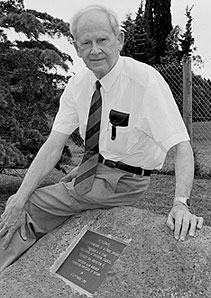
In 1991, sitting atop the stone recording the dedication of the university arboretum to Professor Alan Wardrop, Foundation Professor of Botany, on the 25th anniversary of the opening of La Trobe University.
Perspective
Alan Wardrop was undoubtedly one of the most distinguished and influential forest products scientists of his generation in both the Australian and international contexts. As a colleague he was invariably courteous and co-operative and he gave freely of his knowledge and ideas. As a Section Leader at CSIRO he provided inspiration to those working under his direction and strove to develop a spirit of co-operation. The Section of Wood and Fibre Structure that he came to lead was a most effective research unit. One measure of his influence is the number of prominent international scientists (for example, W. Liese, H. Harada, V. Cheadle, F. Addo-Ashong and J. Cronshaw) who came to CSIRO's Yarra Bank laboratories to work with him in the 1950s and 1960s. A second is Evans' recognition that the work of Wardrop and colleagues in the 1950s identified many of the features of wood fibres that are assessed fifty years later with SilviScan-2, as a central part of the Division's goals to select trees with desirable properties for particular end uses.
At La Trobe, Wardrop was the dominant influence on the Botany Department in its first twenty years and, as first Dean of the School of Biological Sciences, on the establishment of other departments within the School. He never built a large group of collaborators at La Trobe, although his enthusiasm for cellulose research perhaps contributed to one of us (R. E. W.) moving into studying mechanisms of cellulose synthesis and microfibril alignment after leaving La Trobe, a conversion that Wardrop regarded as better late than never!
Wardrop had a mastery of the indirect methods of deducing wall structure from X-rays and polarized light, and was one of the important pioneers of electron microscopy in Australia. Practically all of his contributions were profusely illustrated by elegant light and electron micrographs. These in themselves provide great enlightenment, but they are particularly powerful when supplemented by data derived by other methods and by Wardrop's sophisticated interpretations. His work on cell walls drew on several of the basic sciences in pursuit of his botanical questions. He was not interested in just describing things – he was interested in understanding their function and the detailed processes that brought them about. He used whatever techniques were available to help him arrive at an answer – and those answers are recognised as major contributions to the study of plant cell walls.
Honours and awards
- Edgeworth David Medal of the Royal Society of New South Wales (1952)
- DSc, University of Melbourne (1958)
- National Science Foundation Senior Visiting Scientist Award at University of Wisconsin (1964; not taken up for personal reasons)
- Fellow, International Academy of Wood Science (1966)
- Corresponding Member, Royal Botanical Society of the Netherlands (1971)
- Fellow, Australian Academy of Science (1976)
About this memoir
This memoir was originally published in Historical Records of Australian Science, vol.18, no.1, 2007. It was written by:
- Richard E. Williamsom, Plant Cell Biology Group, Research School of Biological Sciences, Australian National University, Canberra, Australia (corresponding author)
- Huntly G. Higgins, formerly CSIRO Division of Forest Products, Melbourne, Australia
- Bruce A. Stone, Biochemistry Department, La Trobe University, Bundoora, Australia
Acknowledgements
We thank Carolynn Larsen, Librarian, CSIRO, Clayton and Rosanne Walker, Basser Library, Australian Academy of Science for their expert assistance, and Professor Sassen of Nijmegen for his comments on Wardrop's 1977 sabbatical leave and the origins of the International Cell Wall Conferences. The portrait was taken at La Trobe Universityc. 1976.
References
- Baskin, T. I, 2005. Anisotropic expansion of the plant cell wall. Annu Rev Cell Dev Biol 21: 203-222.
- Blythe, M., 1998. Interview with Professor Alan Wardrop (1921-2003). Australian Academy of Science, Canberra.
- Brown, R. M. Jr, Montezinos, D., 1976. Cellulose microfibrils: Visualization of biosynthetic and orienting complexes in association with the plasma membrane. Proceedings of the National Academy of Science USA 84: 6985-6989.
- Cushing, D., 2005. Reginald Dawson Preston. 21 July 1908-3 May 2000. Biographical Memoirs of Fellows of the Royal Society 51: 347-353.
- Evans, R., 2002. Art, science and informatics – visualisation of large, complex data sets in high-speed measurement of the microstructure of wood. In 'The Burgess-Lane Memorial Lectureship in Forestry', University of British Columbia, Vancouver, BC, Canada.
- Goodchild, D. J., Dowell, W. C. T., 1986. The beginnings of electron microscopy in Australia. Micron and Microscopica Acta 17: 101-105.
- Iwata, K., Hogetsu, T., 1989. Orientation of wall microfibrils in Avena coleoptiles and mesocotyls and in Pisum epicotyls. Plant Cell Physiology 30: 749-757.
- Mueller, S. C., Brown, R. M. Jr, Scott, T. K., 1976. Cellulosic microfibrils: nascent stages of synthesis in a higher plant cell. Science 194: 949-951.
- Newcomb, E. H., 1969. Plant microtubules. Annual Review of Plant Physiology 20: 253-288.
- Pallaghy, C. K., 1985. Letter. Nature 316: 184.
- Pallaghy, C. K., 1986. Letter. Nature 320: 9.
- Preston, R. D., 1958. Electron microscopy in biology. Nature 182: 1402-1405.
- Preston, R. D., 1964. Structural and mechanical aspects of plant cell walls with particular reference to synthesis and growth. In M. H. Zimmermann (ed.), 'The Formation of Wood in Forest Trees', Academic Press, New York, pp. 169-188.
- Preston, R. D., Nicolai, E., Reed, R., Millard, A., 1948. An electron microscope study of cellulose in the wall of Valonia ventricosa. Nature 162: 665-667.
- Rasmussen, N., 1999. What moves when technologies migrate? 'Software' and hardware in the transfer of biological electron microscopy to postwar Australia. Technology and Culture 40: 47-73.
- Roelofsen, P. A., Houwink, A. L., 1953. Architecture and growth of the primary cell wall in some plant hairs and in the Phycomyces sporangiophores. Acta Botanica Neerlandica 2: 218-225.
- Roland, J. C., Reis, D., Vian, B., Satiatjeunemaitre, B., Mosiniak, M., 1987. Morphogenesis of plant-cell walls at the supramolecular level – internal geometry and versatility of helicoidal expression. Protoplasma 140: 75-91.
Bibliography
- Ralph, B. J., Wardrop, A. B., 1946. The acid hydrolysis of Australian woods. I. The autoclaving of the wood of Eucalyptus obliqua L'Her with dilute acid. Australian Chemical Institute Journal and Proceedings 13: 144-155.
- Dadswell, H. E., Wardrop, A. B., 1946. Cell wall deformations in wood fibres. Nature 158: 174-175.
- Wardrop, A. B., Preston, R. D., 1947. Organisation of the cell walls of tracheids and wood fibres. Nature 160: 911-913.
- Wardrop, A. B., Dadswell, H. E., 1947. Contributions to the study of the cell wall. IV. The nature of intercellular adhesion in delignified tissue. Australia, Council Scientific and Industrial Research, Bulletin 221: 7-13.
- Wardrop, A. B., Dadswell, H. E., 1947. Contributions to the study of the cell wall. V. The occurrence, structure, and properties of certain cell-wall deformations. Australia, Council Scientific and Industrial Research, Bulletin 221: 14-32.
- Wardrop, A. B., Dadswell, H. E., 1948. The nature of reaction wood I. The structure and properties of tension wood fibres. Australian Journal of Scientific Research Series B-Biological Sciences 1: 3-16.
- Wardrop, A. B., 1948. Erratum. Nature 161: 90.
- Wardrop, A. B., 1948, The submicroscopic organisation of the plant cell wall and its bearing upon the growth of the plant cell, PhD thesis, Department of Botany, University of Leeds.
- Preston, R. D., Wardrop, A. B., Nicolai, E., 1948. Fine structure of cell walls in fresh plant tissues. Nature 162: 957-959.
- Dadswell, H. E., Wardrop, A. B., 1949. What is reaction wood? Australian Forestry 13: 22-33.
- Wardrop, A. B., 1949. Micellar organisation in primary cell walls. Nature 164: 366.
- Wardrop, A. B., 1949. The influence of pressure on the cell wall organisation of conifer tracheids. Proceedings of the Leeds Philosophical and Literary Society 5: 128-135.
- Preston, R. D., Wardrop, A. B., 1949. The submicroscopic organization of the walls of conifer cambium. Biochimica et Biophysica Acta 3: 549-559.
- Preston, R. D., Wardrop, A. B., 1949. The fine structure of the wall of the conifer tracheid. IV. Dimensional relationships in the outer layer of the secondary wall. Biochimica et Biophysica Acta 3: 585-592.
- Wardrop, A. B., Dadswell, H. E., 1950. The nature of reaction wood. II. The cell wall organization of compression wood tracheids. Australian Journal of Scientific Research Series B-Biological Sciences 3: 1-13.
- Hodge, A. J., Wardrop, A. B., 1950. An electron microscopic investigation of the cell wall organization of conifer tracheids and conifer cambium. Australian Journal of Scientific Research B-Biological Sciences 3: 265-269.
- Hodge, A. J., Wardrop, A. B., 1950. An electron-microscopic investigation of the cell-wall organisation of conifer tracheids. Nature 165: 272-273.
- Wardrop, A. B., Preston, R. D., 1950. The fine structure of the wall of the conifer tracheid. V. The organization of the secondary wall in relation to the growth rate of the cambium. Biochimica et Biophysica Acta 6: 36-47.
- Wardrop, A. B., Dadswell, H. E., 1950. Swelling behavior of conifer tracheids and the concept of a skin substance. Australian Pulp and Paper Industry Technical Association Proceedings 4: 198-221.
- Bisset, I. J. W., Dadswell, H. E., Wardrop, A. B., 1951. Factors influencing tracheid length in conifer stems. Australian Forestry 15: 17-30.
- Foster, D. H., Wardrop, A. B., 1951. The crystalline structure of cellulose as revealed by acid hydrolysis. Australian Journal of Scientific Research Series A-Physical Sciences 4: 412-422.
- Wardrop, A. B., 1951. Cell wall organization and the properties of the xylem. I. Cell wall organization and the variation of breaking load in tension of the xylem in conifer stems. Australian Journal of Scientific Research Series B- Biological Sciences 4: 391-414.
- Wardrop, A. B., Dadswell, H. E., 1951. Helical thickenings and micellar orientation in the secondary wall of conifer tracheids. Nature 168: 610-612.
- Wardrop, A. B., Preston, R. D., 1951. The submicroscopic organization of the cell wall in conifer tracheides and wood fibres. Journal of Experimental Botany 2: 20-30.
- Wardrop, A. B., Dadswell, H. E., 1951. Cell-wall studies in relation to pulp and paper research. Australian Pulp and Paper Industry Technical Association, Proceedings 5: 204-222.
- Wardrop, A. B., 1952. Formation of new cell walls in cell division. Nature 170: 329.
- Wardrop, A. B., Dadswell, H. E., 1952. The cell wall structure of xylem parenchyma. Australian Journal of Scientific Research Series B-Biological Sciences 5: 223-236.
- Wardrop, A. B., Dadswell, H. E., 1952. The nature of reaction wood. III. Cell division and cell wall formation in conifer stems. Australian Journal of Scientific Research Series B-Biological Sciences 5: 385-398.
- Wardrop, A. B., 1952. The low-angle scattering of X-rays by conifer tracheids. Textile Research Journal 22: 288-291.
- Watson, A. J., Wardrop, A. B., Dadswell, H. E., Cohen, W. E., 1952. Influence of fiber structure on pulp and paper properties. Australian Pulp and Paper Industry Technical Association, Proceedings 6: 243-266 (with discussion pp. 266-269).
- Wardrop, A. B., Dadswell, H. E., 1953. Development of the conifer tracheid. Holzforschung 7: 33-39.
- Wardrop, A.B., 1954. Observations on crossed lamellar structures in the cell walls of higher plants. Australian Journal of Botany 2: 154-164
- Wardrop, A. B., 1954. The mechanism of surface growth involved in the differentiation of fibres and tracheids. Australian Journal of Botany 2: 165-175.
- Wardrop, A. B., 1954. The intermicellar system in cellulose fibres. Biochimica et Biophysica Acta 13: 306-307.
- Wardrop, A. B., Dadswell, H. E., 1954. The development and structure of wood fibres. Australian Pulp and Paper Industry Technical Association, Proceedings 8: 6-23 (with discussion pp. 24-26).
- Wardrop, A. B., 1954. The fine structure of the conifer tracheid. Holzforschung 8: 12-29.
- Dadswell, H. E., Wardrop, A. B., 1955. The structure and properties of tension wood. Holzforschung 9: 97-103.
- James, C. F., Wardrop, A. B., 1955. A microscopic study of structural changes during the beating of wood fibers. Australian Pulp and Paper Industry Technical Association, Proceedings 9: 107-126.
- Wardrop, A. B., 1955. Mechanism of surface growth in the parenchyma of Avena coleoptiles. Australian Journal of Botany 3: 137-148.
- Wardrop, A. B., Dadswell, H. E., 1955. The nature of reaction wood. IV. Variations in cell wall organization of tension wood fibres. Australian Journal of Botany 3: 177-189.
- Dadswell, H. E., Wardrop, A. B., 1956. Importance of tension wood in timber utilization. Australian Pulp and Paper Industry Technical Association, Proceedings 10: 30-42.
- Wardrop, A. B., 1956. The nature of reaction wood. V. The distribution and formation of tension wood in some species of Eucalyptus. Australian Journal of Botany 4: 152-166.
- Wardrop, A. B., 1956. The nature of surface growth in plant cells. Australian Journal of Botany 4: 193-199.
- Wardrop, A. B., 1956. The mechanism of surface growth in the parenchyma of Avena coleoptiles. Biochimica et Biophysica Acta 21: 200-201.
- Wardrop, A. B., Scaife, E., 1956. Occurrence of peroxidase in tension wood of angiosperms. Nature 178: 867.
- Wardrop, A. B., Dadswell, H. E., 1957. Variations in the cell wall organization of tracheids and fibers. Holzforschung 11: 33-41.
- Wardrop, A. B., 1957. The organization and properties of the outer layer of the secondary wall in conifer tracheids. Holzforschung 11: 102-110.
- Wardrop, A. B., 1957. The phase of lignification in the differentiation of wood fibres. Tappi 40: 225-243.
- Dadswell, H. E., Wardrop, A. B., Watson, A. J., 1958. The morphology, chemistry, and pulping characteristics of reaction wood. In F. Bolam (ed.), 'Fundamentals of Papermaking Fibres', British Paper and Board Makers' Association, London, pp. 187-219 (with discussion pp. 221-228).
- Wardrop, A. B., Cronshaw, J., 1958. Changes in cell wall organization resulting from surface growth in parenchyma of oat coleoptiles. Australian Journal of Botany 6: 89-95.
- Wardrop, A. B., Davies, G. W., 1958. Some anatomical factors relating to the penetration of water into xylem of gymnosperms. Australian Journal of Botany 6: 96-102.
- Wardrop, A. B., 1958. The organization of the primary wall in differentiating conifer tracheids. Australian Journal of Botany 6: 299-305.
- Wardrop, A. B., Dadswell, H. E., 1958. Changes in wood and fibre structure observed in the preparation of cold soda pulps. Journal of the Institute of Wood Science 2: 8-21.
- Dadswell, H. E., Wardrop, A. B., 1959. Growing trees with wood properties desirable for paper manufacture. Appita 12: 129-136.
- Wardrop, A. B., 1959. Cell-wall formation in root hairs. Nature 184: 996-997.
- Wardrop, A. B., Bland, D. E., 1959. Process of lignification in woody plants. In 'Proceedings of the Fourth International Congress of Biochemistry, Vienna, 1958', Pergamon, London, pp. 92-116.
- Wardrop, A. B., Davies, G. W., 1959. Lignification in model systems. Holzforschung 13: 65-70.
- Wardrop, A. B., Liese, W., Davies, G. W., 1959. The nature of the wart structure in conifer tracheids. Holzforschung 13: 115-120.
- Dadswell, H. E., Wardrop, A. B., 1960. Some aspects of wood anatomy in relation to pulping quality and tree breeding. Appita 13: 161-172 (with discussion pp. 172-173).
- Harada, H., Wardrop, A. B., 1960. Cell wall structure of ray parenchyma. Journal of the Japanese Wood Research Society 6: 34-41.
- Wardrop, A. B., Dadswell, H. E., Davies, G. W., 1960. Aspects of wood structure influencing the preparation of semi-chemical pulps. Appita 14: 185-202.
- Cronshaw, J., Davies, G. W., Wardrop, A. B., 1961. Wart structure of conifer tracheids. Holzforschung 15: 75-78.
- Scurfield, G., Wardrop, A. B., 1961. The nature of reaction wood. VI. The reaction anatomy of seedlings of woody perennials. Australian Journal of Botany 10: 93-105.
- Wardrop, A. B., Davies, G. W., 1961. Morphological factors relating to the penetration of liquids into wood. Holzforschung 15: 129-141.
- Wardrop, A. B., Dadswell, H. E., Davies, G. W., 1961. Aspects of wood structure influencing the preparation of semichemical pulps. Appita 14: 185-202.
- Wardrop, A. B., 1961. The structure and formation of reaction wood in angiosperms. In 'Recent Advances in Botany: Proceedings of the IXth International Botanical Congress, Montreal', University of Toronto Press, Toronto, p. 1325.
- Wardrop, A. B., 1961. The structure and organization of thickened cell walls. In 'Recent Advances in Botany: Proceedings of the IXth International Botanical Congress, Montreal', University of Toronto Press, Toronto, pp. 740-746.
- Wardrop, A. B., 1961. The path of penetration of pulping media into wood. In 'Proceedings of a Symposium on the Formation and Structure of Paper, 1961, September 25-29', British Paper and Board Makers Association, Oxford, pp. 621-637.
- Dadswell, H. E., Wardrop, A. B., 1962. Recent progress in research on cell wall structure. In 'Proceedings of the 5th World Forestry Congress, Seattle, 1960', USDA Forest Service, Washington, DC, pp. 1279-1287.
- Wardrop, A. B., 1962. Cell wall organisation. I. The primary wall. Botanical Review 28: 241-285.
- Wardrop, A. B., Cronshaw, J., 1962. Formation of phenolic substances in the ray parenchyma of angiosperms. Nature 193: 90-92.
- Wardrop, A. B., Davies, G. W., 1962. Wart structure of gymnosperm tracheids. Nature 194: 497-498.
- Wardrop, A. B., 1962. Fundamental studies in wood and fibre structure relating to pulping processes. Appita 16: 15-30.
- Scurfield, G., Wardrop, A. B., 1963. The nature of reaction wood. VII. Lignification in reaction wood. Australian Journal of Botany 11: 107-116.
- Wardrop, A. B., Ingle, H. D., Davies, G. W., 1963. Nature of vestured pits in angiosperms. Nature 197: 202-203.
- Wardrop, A. B., 1963. Morphological factors involved in the pulping and beating of wood fibers. Svensk Papperstidning 66: 231-247.
- Wardrop, A. B., Addo-Ashong, F. W., 1963. The anatomy and fine structure of wood in relation to its mechanical failure. In C. J. Osborn (ed.), 'Fracture: Proceedings of the First Tewkesbury Symposium', Butterworths, Melbourne, pp. 169-200.
- Cronshaw, J., Wardrop, A. B., 1964. The organization of cytoplasm in differentiating xylem. Australian Journal of Botany 12: 15-23.
- Wardrop, A. B., Davies, G. W., 1964. The nature of reaction wood. VIII. The structure and differentiation of compression wood. Australian Journal of Botany 12: 24-38.
- Wardrop, A. B., 1964. The structure and formation of the cell wall in xylem. In M. H. Zimmerman (ed.), 'The Formation of Wood in Forest Trees', Academic Press, New York, pp. 87-134.
- Wardrop, A. B., 1964. The reaction anatomy of arborescent angiosperms. In M. H. Zimmerman (ed.), 'The Formation of Wood in Forest Trees', Academic Press, New York, pp. 405-456.
- Allen, R., Wardrop, A. B., 1964. The opening and shedding mechanism of the female cones of Pinus radiata. Australian Journal of Botany 12: 125-134.
- Wardrop, A. B., Foster, R. C., 1964. A cytological study of the oat coleoptile. Australian Journal of Botany 12: 135-141.
- Wardrop, A. B., 1965. Cellular differentiation in the xylem. In W. A. Côté (ed.), 'Cellular Ultrastructure of Woody Plants', Syracuse University Press, Syracuse, pp. 61-97.
- Wardrop, A. B., 1965. The formation and function of reaction wood. In W. A. Côté (ed.), 'Cellular Ultrastructure of Woody Plants', Syracuse University Press, Syracuse, pp. 371-390.
- Wardrop, A. B., Harada, H., 1965. Formation and structure of cell wall in fibres and tracheids. Journal of Experimental Botany 16: 356-371.
- Wardrop, A. B., 1968. Occurrence of structures with lysosome-like function in plant cells. Nature 218: 978-980.
- Zimmermann, M. H., Wardrop, A. B., Tomlinson, P. B., 1968. Tension wood in aerial roots of Ficus benjamina L. Wood Science and Technology 2: 95-104.
- Wardrop, A. B., Jutte, S. M., 1968. The enzymatic degradation of cellulose from Valonia ventricosa. Wood Science and Technology 2: 105-114.
- Wardrop, A. B., 1969. The structure of the cell wall in lignified collenchyma of Eryngium sp. (Umbelliferae). Australian Journal of Botany 17: 229-240.
- Wardrop, A. B., 1969. Fiber morphology and papermaking. Tappi 52: 396-408.
- Chafe, S. C., Wardrop, A. B., 1970. Microfibril orientation in plant cell walls. Planta 92: 13-24.
- Jutte, S. M., Wardrop, A. B., 1970. Morphological factors relating to the degradation of wood fibers by cellulase preparations. Acta Botanica Neerlandica 19: 906-917.
- Wardrop, A. B., 1970. The structure and formation of the test of Pyura stolonifera (Tunicata). Protoplasma 70: 73-86.
- Thair, B. W., Wardrop, A. B., 1971. Structure and arrangement of nuclear pores in plant cells. Planta 100: 1-17.
- Wardrop, A. B., 1971. Occurrence and formation in plants. In K. V. Sarkanen and C. H. Ludwig (eds), 'Lignins', Interscience, New York, pp. 19-41.
- Chafe, S. C., Wardrop, A. B., 1972. Fine structural observations on the epidermis. I. The epidermal cell wall. Planta 107: 269-278.
- Chafe, S. C., Wardrop, A. B., 1973. Fine-structural observations on the epidermis. II. The cuticle. Planta 109: 39-48.
- Jarvis, L. R., Wardrop, A. B., 1974. The development of the cuticle in Phormium tenax. Planta 119: 101-112.
- Wardrop, A. B., 1976. Lignification of the plant cell wall. Applied Polymer Symposia 28: 1041-1063.
- Higgins, H. G., Irvine, G. M., Puri, V., Wardrop, A. B., 1978. Conditions for obtaining optimum properties of radiata and slash pine thermomechanical and chemithermomechanical pulps. Appita 32: 23-33.
- Schneider, E. F., Wardrop, A. B., 1979. Ultrastructural studies on the cell walls in Fusarium sulphureum. Canadian Journal of Microbiology 25: 75-85.
- Wardrop, A. B., Wolters-Arts, M., Sassen, M. M. A., 1979. Changes in microfibril orientation in the walls of elongating plant cells. Acta Botanica Neerlandica 28: 313-333.
- Wardrop, A. B., 1981. Lignification and xylogenesis. In J. R. Barnett (ed.), 'Xylem Cell Development', Castle House Publications, Tunbridge Wells, pp. 115-152.
- Wardrop, A. B., 1981. Anatomical aspects of lignin formation in plants. In 'Ekman-Days 1981: International Symposium of Wood Pulping Chemistry', SPCI, Stockholm, pp. 44-51.
- Schibeci, A., Fincher, G. B., Stone, B. A., Wardrop, A. B., 1982. Isolation of plasma membrane from protoplasts of Lolium multiflorum (ryegrass) endosperm cells. Biochemical Journal 205: 511-519.
- Wardrop, A. B., 1983. The opening mechanism of follicles of some species of Banksia. Australian Journal of Botany 31: 485-500.
- Wardrop, A. B., 1983. An appreciation of R. D. Preston FRS on the occasion of his 75th birthday. Journal of Experimental Botany 34: 659-667.
- Wardrop, A. B., 1983. Evidence for the possible presence of a microtrabecular lattice in plant cells. Protoplasma 115: 81-87.
- Joyner, S., Wardrop, A.B., Stone, B. A., 1985. The wheat aleurone cell-wall – development during aleurone differentiation and degradation during germination. Cereal Foods World 30: 540.
- Thornton, I. W. B., Parsons, P. A., Stone, B. A., Waid, J. S., Wardrop, A. B., 1986. Freedom of thought. Nature 321: 191.
- Kudlicka, K., Wardrop, A. B., Ito, T., Brown, R. M. Jr, 1987. Further evidence from sectioned material in support of the existence of a linear terminal complex in cellulose synthesis. Protoplasma 136: 96-103.
Unpublished manuscript
Thair, B. W., Wardrop, A. B., 1976. Chloroplast development in Selaginella kraussiana (Kunze) A. Braun. (Unpublished manuscript in Basser Library, Australian Academy of Science, Canberra.)

Adrien Albert 1907–1989
Written by D.J. Brown.
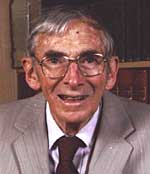
- Introduction
- Formative years (1907–1924)
- Student years (1925–1937)
- Sydney years (1938–1947)
- London years (1948–1956)
- Canberra years (1956–1972)
- Retirement years (1973–1989)
- Albert the man
- About this memoir
Introduction
When Adrien Albert died in Canberra on 29th December 1989, Australia lost an outstanding son. Not only had he introduced and firmly established the discipline of medicinal chemistry within this country but, in so doing, he had contributed greatly to research in heterocyclic chemistry. Little wonder that his early research and scholarship in both areas had been recognized even in 1948 by Sir Howard (later Lord) Florey, who induced the Australian National University to offer Albert the foundation Chair of Medical Chemistry within its newly-established John Curtin School of Medical Research, a position he occupied with distinction until his retirement in 1972 (1). Although a complex person, Albert operated on two simple principles: time was the most precious commodity in life, and, for any who undertook scientific research, the work was infinitely more important than the worker. Those who could share or appreciate these beliefs found in him a stimulating and kindly colleague; those who were irritated by them soon went elsewhere.
Formative years (1907–1924)
Albert was born in Sydney on 19th November 1907. His father, Jacques Albert, was a businessman in the music industry who had come to Australia from the Ukraine, although (probably) of Swiss nationality, while his much younger mother, Mary Eliza Blanche, was Australian born; he had two considerably older half-brothers from an earlier marriage of his father. Jacques did not survive many years, so young Adrien was brought up by his mother and a more distant relative in Sydney. After attending primary schools in Randwick and Coogee, he eventually settled into the Scots College, Sydney, for his secondary education: there he excelled in both music and science, although his youthful enthusiasm for an experimental approach to the latter sometimes proved embarrassing to the school. He matriculated in 1924.
Student years (1925–1937)
At this stage, Albert was expected to enter the family music-publishing business but he had his sights firmly set on a career in pure science. Eventually a compromise was reached and he undertook the then current course in pharmacy, which involved part-time attendance at Sydney University combined with a type of apprenticeship in a pharmacy. However, having become a State-registered pharmacist in 1928, Albert soon realized that life in a pharmacy consisted of too little science and too much commerce for his liking. Accordingly, after the inevitable wrangle, he returned to Sydney University and completed a BSc with first class honours and University Medal in 1932. He worked briefly in the University's Pharmacy Department where he produced his first papers, and then for a period in a fabric dyeing firm to save some money.
He departed for London in 1934. There he commenced research for the PhD degree under he guidance of W.H. Linnell (2) at the College of the Pharmaceutical Society, part of London University. His research project, on the synthesis of new aminoacridines as potential antiseptics, introduced him to the world of heterocyclic chemistry and led to his life-long fascination with the role of heterocyclic compounds in chemotherapy and medicine.
Because he was forced to live on his meagre savings, supplemented only by a minute income from some part-time dispensing work in London, his meals became irregular and inadequate: this, combined with long hours at the bench, led inevitably to stomach ulceration, haemorrhage, and perforation. Emergency surgical intervention was carried out by a junior registrar at a London hospital in the middle of the night: although his life was saved thereby, he was left with an appalling legacy from which he suffered grievously for the rest of his life, despite later skilled reparative work. However, he graduated PhD (Med) in 1937 and immediately set out on a brief but extensive journey (the harbinger of many in later life) to visit German, French and other European centres of chemotherapeutic research, then located mainly in industrial laboratories.
Sydney years (1938–1947)
Albert returned to Australia in 1938 and took temporary teaching positions (offering some research facilities), first in the Pharmacy Department, and subsequently with J.C. Earl in the Organic Chemistry Department of Sydney University. His continuing presence in the latter department was engineered by Earl, using a variety of funding devices, until Albert was appointed as advisor on medical chemistry to the Medical Directorate of the Australian Army in 1942. During this period, he not only continued his earlier acridine antiseptic research with any available co-workers, but also undertook the development of a practical synthesis of the acridine antimalarial, mepacrine ('Atebrin'), and the industrial scale preparation of the antiseptic, proflavine, both of which were needed desperately in the Pacific war zones (3). The Organic Chemistry Department's technical laboratory was given over to the manufacture of proflavine under the direct supervision of Dr Konrad Gibian, an employee of a small but active chemical firm, Timbrol Ltd. Many kilograms were produced under very difficult conditions: all those associated with the makeshift plant (including Gibian and Albert) remained a bright yellow hue for several years afterwards and all paths in the vicinity fluoresced a brilliant green whenever it rained. Proflavine was subsequently replaced by one of Albert's new compounds, aminacrine (9-aminoacridine), but it was produced in an industrial plant under the trade name 'Monacrin'.
Albert was always extremely tall and slim (hence the affectionate nickname, 'the snake' used by his less respectful students) and, at this time, he dressed very nattily in a double-breasted navy-blue suit surmounted by a then-fashionable narrow-brimmed felt hat with a small red or green feather in the band. During a wartime trip to Washington in connection with the mepacrine project, Albert inadvertently sat upon his prized hat all the way across the Pacific in the belly of a bomber: it was never seen again, nor did he ever buy another hat.
Towards the end of the war, Albert's research was at last appreciated by a recently formed funding organization, the (Australian) National Health and Medical Research Council, which began to support his work more adequately. Thus he built up a 'chemotherapy team' which lasted until his departure in late 1947 to join the Wellcome Research Institution in London.
These years had seen the transformation of Albert from a penniless postdoctoral person, with little but potential to offer, into a respected team leader with an established pattern of fundamental research in the burgeoning area of chemotherapy, so recently stimulated enormously by the advent of penicillin and the antibiotic era. His classical experimental studies on the antimicrobial activity of aminoacridines and hydroxyquinolines (with S.D. Rubbo as his chief biological collaborator) had now firmly established the overwhelming importance of physical properties in governing the activity and selectivity of drugs. The chief properties studied were (i) electron distribution governing ionization, the degree of which facilitated or forbade combination of the drug with its receptor, and (ii) steric properties, which controlled access to the correct receptor as well as the fit on arrival. Thus only two of the five possible monoaminoacridines were highly active as antibacterials: the active isomers, 3- and 9-aminoacridine, were those with ionization constants which ensured that they existed mainly as cations at the biological pH of about 7.3, whereas the inactive isomers were less than two percent cations under such conditions. This correlation was subsequently tested rigorously using more than a hundred substituted aminoacridines on more than twenty bacterial species: only those acridines which were greater than fifty percent cations at pH 7.3 emerged as powerful antibacterials. Turning to steric properties, it was shown that any active molecule required a flat area extending over at least three six-membered rings. Thus 4-aminopyridine and 4-aminoquinoline had acceptable ionization constants but lacked sufficient flat area for high activity; likewise, 9-aminoacridine with one of its outer rings hydrogenated (and hence no longer flat) lost its activity although its pKa was still satisfactory; and activity was restored to 4-aminoquinoline by the addition of a coplanar styryl grouping. These findings were of course further tested with other compounds. Albert's expertise in the chemistry of acridines resulted in the publication of an excellent monograph, The Acridines, in 1951 and an updated version some fifteen years later. In reading about acridines, it should be borne in mind that the numbering system was changed by the International Union of Pure and Applied Chemistry about 1950: thus for example,5-aminoacridine became thereafter 9-aminoacridine. Most of Albert's acridine papers and the first edition of his book used the old system but his later papers and the second edition of his book necessarily employed the revised system.
This period of Albert's life concluded appropriately with the award of the DSc (London) in 1947.
London years (1948–1956)
The Wellcome Research Institution in London did not retain Albert's services as a senior research worker for long. On 1st January 1949, he took up his appointment as Professor and Head of the Medical Chemistry Department within the Australian National University. Because no building was available in Canberra, he promptly established his department in hired laboratories on the top floor of the Wellcome Building in Euston Road, London. An appropriate nucleus of staff was engaged and research began about 1st April 1949. As befitted the new era, Albert chose to abandon most former research topics in favour of a new start in purine and pteridine chemistry, an area then pregnant with possibilities following the introduction of 6MP (6-mercaptopurine) and methotrexate as effective anti-leukaemia drugs and the recognition of essential roles for the folic acids in biochemistry. As well as his own bench work, supervision of his new staff, and a deep involvement in planning the new (but yet unnamed) school of medical research for Canberra, Albert now became quite obsessed with the concept of selective toxicity: he had introduced this novel term into pharmacology during a remarkable series of lectures delivered with the encouragement of F.G. Young at University College London during 1948-49. Thus he envisaged an ideal drug as highly toxic to an invading pathogenic organism but minimally toxic to the host: moreover, this concept was applicable not only to human and veterinary medicine, but to pesticides, selective herbicides and such like. This unifying thought was released to a wider audience in the tiny first edition of Selective Toxicity in 1951 and it was progressively developed in successive editions during the next thirty-five years. These books became essential reading for generations of pharmacologists, medicinal chemists, and agricultural chemists, especially in the United States, Japan, and the less conservative parts of Europe.
Despite the enormous enthusiasm of both professor and staff, the new department was not without its vicissitudes. For example, Albert did keep an unusually tight rein on his research staff and this irritated some beyond endurance: one such person even complained formally to Florey (then the de facto director of the unassembled school of medical research) of Albert's perceived shortcomings in human relations, a complaint rejected outright at the time but later followed up tactfully by Florey. Several years later Albert's application for tenure on behalf of an excellent member of his research staff was rejected by the appropriate board in Canberra because of vehement opposition by two influential members, apparently on political grounds. To his lasting credit, Albert campaigned at the highest level, boots and all, against this misguided decision and it was eventually reversed, alas too late to retain the services of the person involved.
At the outset, it was expected that the department would stay in London for perhaps three years but in the event it was there for seven. During that time the new pteridine project produced detailed data on the synthesis, properties and behaviour of hundreds of simple pteridine derivatives, only one of which had been known at the outset. This provided an invaluable sound basis for later and more biologically applied work elsewhere (4). A similar approach to purines was less spectacular, simply because more was known of the basic chemistry to start with. Aspects of related heterocyclic nuclei were studied similarly as required for comparison. Parallel with the above efforts, work continued on the degree of metal-binding by heterocycles, amino acids, and other naturally-occurring substances, mainly in connection with antimicrobial activity. Although the last project proved fascinating at the time, the mathematics involved in calculating stability constants for metal-ligand complexes in solution were so time-consuming and wearisome, that only in later years (during the computer age) did this work bear significant fruit in the hands of Albert's associate, D.D. Perrin.
Canberra years (1956–1972)
In 1956 Albert at last received word that the new building in Canberra was ready for occupation. Accordingly, every piece of equipment (down to the last beaker) in the Euston Road laboratories was carefully packed by all available hands and the professor, most of his staff (including families, domestic pets etc.), and a great many packing cases set out in October for Canberra by devious routes. By March 1957, research had recommenced in Wing-D of the new building, which included a sizeable technical-scale laboratory now fully equipped and serviced for pilot-scale production of intermediates or final products for biological or even clinical trial. Unfortunately, Albert's foresight in providing this facility was never fully rewarded: it proved so expensive to operate effectively that it was eventually converted into an animal breeding and holding area.
Research now flourished with a greatly expanded staff but Albert soon noticed that he enjoyed less personal research time at the bench on account of a greatly increased administrative load and necessary attendance at various boards, committees and other such paraphernalia accumulated by universities. However, he pushed ahead, especially with an investigation of covalent hydration in the pteridine series: this was a chemically and biologically important phenomenon he had discovered shortly before leaving London. He now realized that such addition reactions also occurred to other highly-nitrogenous heterocycles and could involve alcohols, the so-called Michael reagents, amines, and even other heterocycles in place of water. All aspects of this area were explored with his customary thoroughness. He also made several in-depth excursions into the very difficult area of hydropteridines and related series, where he developed much needed methods of synthesis and proof of configuration for such products, prone to facile prototropy. Because of its fundamental importance to any understanding of the physical and biological properties of heterocyclic compounds, Albert now returned to his studies of ionization. For example, he and his colleague, G.B. Barlin, studied tautomeric equilibria of hydroxy-, mercapto-, and amino-heterocycles in solution by using the twin tools of ionization constant measurement and ultraviolet spectra. In addition he produced the first and second editions of Ionization Constants, an invaluable manual covering the background, practical measurement, and interpretation of ionization data. Usually in connection with one or other of the above themes, Albert sometimes reverted to regular synthetic and/or degradative studies of specific pteridines or related heterocyclic compounds. In addition, he produced a slim and subsequently a more detailed edition of Heterocyclic chemistry, the first general text to classify heterocyclic systems logically as paraffinic (fully reduced), ethylenic (partly reduced), p-deficient heteroaromatics (e.g. pyridine), and p-excessive heteroaromatics (e.g. pyrrole) (5). This period also saw the publication of no less than four editions of Selective Toxicity (vide supra) as well as sundry papers and reviews on drug action.
Several years before retirement, Albert became involved (in connection with his covalent hydration studies) with a little known but potentially interesting system, the v-triazolo[4,5-d]pyrimidines: these he insisted 'for simplicity' in naming as 8-azapurines (with purine numbering) against all the rules of systematic nomenclature, the advice of his colleagues, and the wrath of editors. After toiling to make some required derivatives by the usual route from pyrimidines, he began to study alternative synthetic routes from 1,2,3-triazoles, even though such intermediates were by no means easy to produce at that time. His efforts prospered and by the end of 1972 he felt that he had mastered the chemistry sufficiently to begin the preparation of more specific derivatives as potential anti-neoplastic agents and the like.
About 1970 occurred one of the greatest disappointments of Albert's life. An ad hoc review committee recommended the closure of his beloved department, not on account of any apparent shortcomings in quality or quantity of scientific work emerging but on the grounds of a perceived lack of relevance to then current trends in medical research. However, on the advice of Faculty Board, the university eventually decided to compromise by continuing the discipline of medicinal chemistry within the John Curtin School as a slowly diminishing Medical Chemistry Group with more applied guidelines. This flew in the face of Albert's basic philosophy that the relationship between physico-chemical properties and biological activities in molecules was more important to the ultimate development of medicinal chemistry than was any direct search for new or improved drugs. His general distress was clearly expressed during his valedictory lecture on 25th October 1972 but only a hint of his feelings remained evident in the published excerpts (4). In fact, the proposed group was established in 1973 and continued vigorously under a new head until it was phased out thirteen years later (6).
Retirement years (1973–1989)
Although he had the foresight and good fortune to arrange a Visiting Fellowship (with laboratory and office facilities, as well as some technical assistance) within the Research School of Chemistry for 1973 onwards, retirement proved a grievous blow to Albert. For some time he went about lamenting his fate as 'a discard on the scrapheap' and blaming the university for this state of affairs. However, he eventually began to rationalize the situation, to count his blessings, and to settle down to a productive retirement. This process, the recovery of self-esteem, was greatly assisted by several invitations from the United States to deliver the Patton, Blicke, and Smissman Lectures on various campuses and (in particular) to become a well-paid Visiting Professor in A.P. Grollman's Department of Pharmacological Sciences of the State University of New York at Stony Brook, on no less than six occasions.
Thus he continued his studies on the 8-azapurines and their precursors with whatever help he could muster, first in the Research School of Chemistry in Canberra, then at Stony Brook, and finally in the Department of Chemistry in Canberra from 1981. In addition, he maintained a steady output of helpful review-type papers on various facets of drug activity as well as a few others specifically on pteridines. He also produced the sixth and then the truly definitive last edition of Selective Toxicity (1985); a third edition (with E.P. Serjeant) of Ionization Constants (1984), complete with computer programs for hassle-free calculation of overlapping ionization constants and the like; a small volume, The Selectivity of Drugs; and a completely new book, Xenobiosis (on foods, drugs and poisons in the human body), a work already acclaimed as a masterpiece by life scientists and intellectual lay people alike and one which earned him the Olle literary prize from the Royal Australian Chemical Institute. At the time of his death, Albert was working actively on a totally new but yet untitled short version of his earlier heterocyclic chemistry text, this time aimed specifically at undergraduate teaching: it may yet be finished by an appropriate co-author.
Albert the man
As might be gleaned from the foregoing pages, Albert was a prodigious worker at the bench and an organizer of his own and his staff's time into the right channels. He disliked administrative work of all sorts and its cessation was the only good aspect of retirement evident to him. Because of his medical condition, he was unable to start work before 10 o'clock each morning but he seldom ceased work much before midnight, even on the weekends. Much of his writing and planning was done in the evening hours and his assistants and research students usually found long and detailed suggestions for the coming day's work (in characteristically minute handwriting) on their benches when they arrived each morning. Although he was careful to monitor the research area and general approach of his more senior staff, he seldom interfered in their day-to-day work other than to make general suggestions which were usually spot-on and readily accepted. Moreover, unlike some heads of departments, he was meticulous in discouraging the use of his name on papers to which he had made no substantial experimental or planning contribution. Thus, for example, many Parts of the Pteridine Studies series are missing from Albert's bibliography simply because he was not included thereon as an author: nevertheless, in all cases he had made at least minor contributions to the work by way of useful suggestions. However, he did insist, quite correctly, on his right to criticize constructively every paper, review or book to be submitted by any member of his staff for publication.
To anyone who was doing his or her job effectively, Albert was invariably polite and courteous but to any who appeared slack or inefficient (be it in the laboratory, a bank, a restaurant, or indeed anywhere) he could be terse in the extreme. Partly for this reason but mainly because he took great pains in preparing and delivering lectures, he was an excellent teacher of undergraduates. However, for much of his life he avoided teaching in favour of using the time for research, so that it was only in the late thirties and during the eighties that he was seen in this role. As a young man Albert was mildly misogynistic and clearly believed that a woman's place was in the home or in a secretarial or service role. More than once he seriously considered marriage but decided quite objectively that a wife and family would use up valuable time which could be better spent on research. Eventually he did realize and admit that the gender of a scientist was irrelevant but, with a few notable exceptions, he still avoided female co-workers.
Albert was an inveterate traveller providing there was a worthwhile conference or scientific contact at the end of each journey: moreover, he always delivered a well prepared and topical talk at any host institution or meeting and he invariably had telling points to make in any discussion. Thus he was an excellent roving ambassador for Australian science. He was particularly welcome in the United States where his brand of chemical pharmacology at the molecular level was accepted much earlier than in the more conservative European countries. He lectured and made friends in almost every country where heterocyclic chemical and/or drug research was at all developed. He was reasonably proficient in German, French and Italian along with some knowledge of Russian and most other major European languages. His last journey, to an International Pteridine Symposium in Zürich and subsequently to Britain and the Netherlands, was completed less than three months before his death.
Although research always came first, Albert did relax in moderation. He had an extensive knowledge and love of music coupled with considerable skill as a pianist: as might be expected, his playing was completely accurate but sometimes wanting in emotional content. He derived great enjoyment from his piano in early life and middle age but unaccountably disposed of it subsequently, possibly because of some imagined minor inadequacy in his own performance. Instrumental music, in particular that of Bach, Schumann and Schubert appealed to him greatly but he was not overly fond of lieder or choral music. His abilities as a visual artist were confined to photography (essentially a record of his travels) and to cartoons: his depictions of the canine adventures of Woofred and his wife, Ima Bitch, frequently appeared in the most unexpected places during the London years to the surprise and delight of close associates. Unusual plants and flowers fascinated Albert: although he grew only mundane indoor plants, his knowledge of Australian flora was extensive and proved invaluable for entertaining foreign visitors during a short bushwalk or visit to the botanic gardens. Perhaps because of his phenomenal memory and wide reading, he had a knowledge of clinical medicine far beyond matters connected with drug therapy: not being medically qualified, he was unable to make much practical use of this knowledge but medical practitioners often found him several steps ahead of them in diagnosis and up-to-date treatment of some disease or pathological condition.
Besides the Patton, Blicke, and Smissman lectureships and the Olle prize, already mentioned, Albert was the recipient of many honours. He was elected to Fellowship of the Australian Academy of Science in 1958; he was chosen for the inaugural Royal Society of Chemistry (Australian) Lectureship in 1960 and for the Royal Society of NSW Liversidge Research Lectureship in 1964; a biennial Adrien Albert Lectureship was endowed in his honour by the Royal Australian Chemical Institute in 1985; he received the Order of Australia (AO) in 1989; and in the very month of his death he received with genuine delight an invitation from his alma mater to accept a DSc (honoris causa) conferred posthumously on 31st March 1990 in the presence of his next-of-kin and two lifelong friends.
In early December 1989, Albert's health suddenly deteriorated markedly and he died three weeks later of complications resulting from a long-standing resistant Staphylococcus aureas infection, possibly exacerbated by a (genetic) Marfan syndrome condition.
About this memoir
This memoir was originally published in Historical Records of Australian Science, vol. 8(2), 1990. It was written by D.J. Brown, formerly Reader in Medical Chemistry, Visiting Fellow in the Research School of Chemistry, Australian National University.
Notes
(1) R. Porter, 'The John Curtin School of Medical Research', Medical Journal of Australia, 142 (1985) 205.
(2) I.D. Rae and T.H. Spurling, 'Obituary: Adrien Albert A.O.', Chemistry in Australia, 57 (1990) 116.
(3) D.P. Mellor, Australia in the War of 1939-1945, Series 4, Volume 5: The Role of Science and Industry (Canberra: Australian War Memorial, 1958), pp.619 and 635.
(4) Anon., 'The Department of Medical Chemistry, ANU (Excerpts from a lecture given by A.Albert)', Proceedings of the Royal Australian Chemical Institute, 41 (1974) 79.
(5) E. Campaigne, 'Adrien Albert and the rationalization of heterocyclic chemistry', Journal of Chemical Education, 63 (1986) 860.
(6) Anon., 'Medical Chemistry Group', in John Curtin School of Medical Research, Annual Report 1985, ed. P.D. Jeffrey (Canberra: ANU, 1986), p.189.
Physics for Australia pamphlet series
This series of three pamphlets has been created by the National Committee for Physics to highlight the benefit of physics in Australian education and industry and the importance of international physics collaborations.